USAID DEC
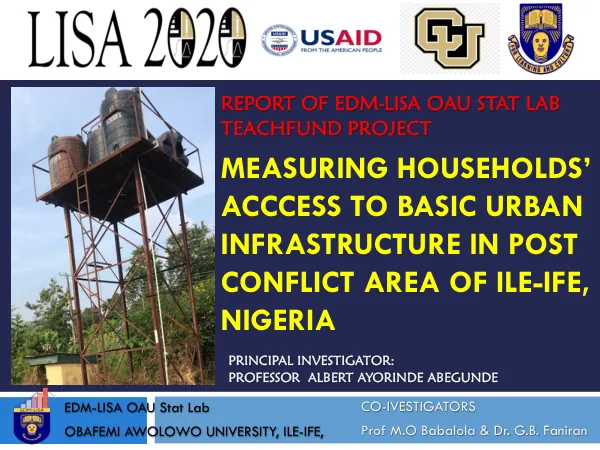
Measuring Households' Access to Basic Urban Infrastructure in Post Conflict Area of Ile-Ife, Nigeria
Sign inUSAID DEC
Measuring Households' Access to Basic Urban Infrastructure in Post Conflict Area of Ile-Ife, Nigeria
The post-conflict area of Ile-Ife, Nigeria, has been plagued by inequality in infrastructural distribution and residents' inaccessibility to available basic infrastructure.
2021 · 42 pages
Sign in to readA free account is required to download.
Abstract
Many conflicts in the area were fueled by disagreements over limited resources, and infrastructure was a key target of conflict actors during the war. As a result, the area is characterized by infrastructure breakdown and inadequacy. This project aimed to determine households' access to three basic urban infrastructure (BUI) - healthcare, education, water, and sanitation - in the post-conflict area of Ile-Ife, Nigeria. The study area was divided into high, moderate, and low conflict impact residential zones, with the boundary area and its periphery forming the project's geographical scope. The project was executed in 12 months, starting from July 2020 and ending in June 2021. The specific objectives of the project were to recruit, train, and build capacity of staff and students to collect and manage data on accessibility to basic urban infrastructure; identify and examine available basic infrastructure; examine socio-economic characteristics of households; determine households' level of accessibility; and facilitate communication of project findings among relevant stakeholders. Activities to achieve the project objectives were structured into four stages: preliminary investigation, human resources development, data collection and analysis, and communication of project findings. These activities included consultation with the project collaborator, reconnaissance survey, housing and households' population update, map preparation, recruitment of students, mobilization of early career academics, training of staff and students, administration of questionnaires, and data analysis. The project provided an opportunity for early career academics to build capacity and for students to learn data collection procedures and new statistical packages. Students were introduced to the workings and operations of LISA 2020 and the culture of conducting quantitative research and learning relevant statistical techniques. The project also facilitated the procurement of equipment for the EDM-LISA Stat Lab and publicized its workings and operations among residents of the post-conflict area and academics and students of OAU, Ile-Ife.