USAID DEC
Measuring impact and cost: Household grants as a benchmark for USAID activities
Household grants have emerged as a widely applicable benchmark for evaluating the cost-effectiveness of various USAID activities.
1 pages
Sign in to readA free account is required to download.
Abstract
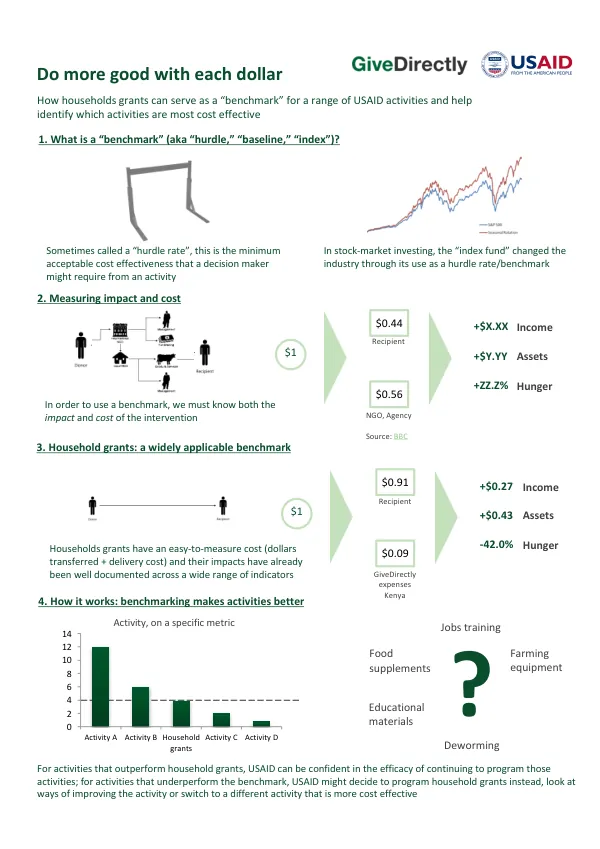
A benchmark serves as a minimum acceptable cost-effectiveness threshold that decision-makers require from an activity. In the context of household grants, this threshold is determined by the cost of transferring dollars to recipients, plus the delivery costs associated with the program. Studies have consistently shown that household grants have a significant impact on income, assets, and hunger levels among recipients. For instance, a study in Kenya found that recipients experienced a 42.0% reduction in hunger levels, while their income and assets increased by $0.27 and $0.43, respectively. These findings have been replicated across various indicators and contexts, making household grants an attractive benchmark for evaluating the efficacy of other activities. To establish a benchmark, it is essential to have a clear understanding of both the impact and cost of the intervention. Household grants meet this criterion, as their costs are easily measurable and their impacts have been well-documented across a range of indicators. By using household grants as a benchmark, USAID can identify which activities are most cost-effective and make informed decisions about program allocation. The use of household grants as a benchmark has been likened to the impact of index funds in the stock market, which revolutionized the industry by providing a widely accepted hurdle rate. Similarly, household grants offer a widely applicable benchmark that can be used to evaluate the cost-effectiveness of various USAID activities. By outperforming the benchmark, activities can demonstrate their efficacy and warrant continued funding. Conversely, activities that underperform the benchmark may be replaced by household grants or improved through targeted interventions. The benefits of using household grants as a benchmark are evident in the context of USAID's activities. By establishing a clear threshold for cost-effectiveness, decision-makers can make informed decisions about program allocation and ensure that resources are directed towards the most effective interventions. This approach also promotes accountability and transparency, as activities are held to a high standard of performance. Ultimately, the use of household grants as a benchmark has the potential to drive greater efficiency and effectiveness in USAID's programming.