FUTURES GROUP INTERNATIONAL, LLC
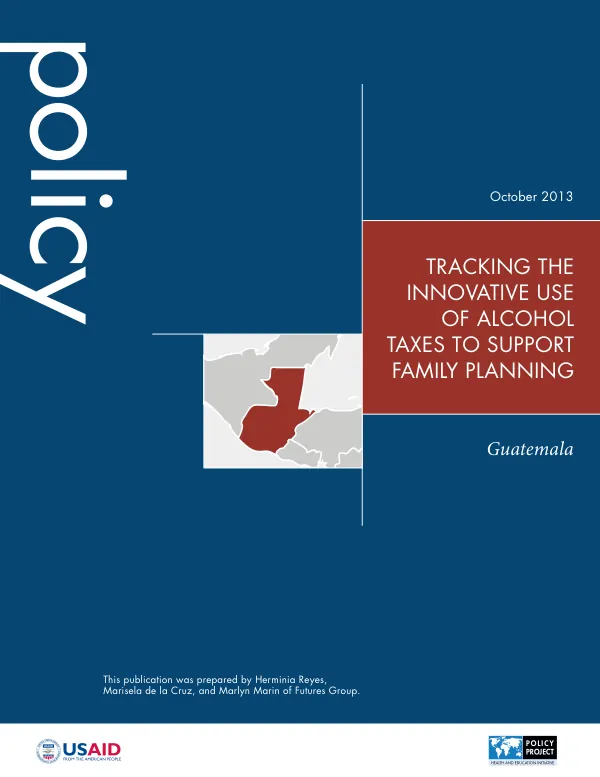
Tracking the Innovative Use of Alcohol Taxes to Support Family Planning: Guatemala
The innovative use of alcohol taxes to support family planning in Guatemala began with the passage of the Distribution of Distilled Spirits, Beer and Other Fermented Beverages Law in 2004.
2013 · 20 pages
Sign in to readA free account is required to download.
Abstract
This law aimed to increase funding for family planning and reproductive health (FP/RH) programs by allocating a minimum of 15 percent of the funds raised through a tax on alcohol to the Ministry of Public Health and Social Assistance (MSPAS) for FP/RH programs, family planning, and alcoholism prevention and treatment services. The law was a result of close collaboration between the government, civil society organizations (CSOs), and other local stakeholders, including the Ministry of Public Health and Social Assistance (MSPAS), the National Contraceptive Security Commission (CNAA), and the Health and Education Policy Project (HEPP). The partnership aimed to support policy changes to redress inequities in access to health services and contribute to improved national and local governance by forging links across government and civil society to strengthen transparency and accountability. In 2005, Congress passed the Universal and Equitable Access to Family Planning Services Law, which had three major provisions related to FP/RH. The law promoted equitable, universal, and affordable access to high-quality FP/RH services and information by focusing on unmet need among people with limited access. It also required that MSPAS create a line item in its general budget for the alcohol tax revenue, which facilitated budget monitoring, and mandated the creation of the CNAA. The CNAA acts as a watchdog for FP/RH-related issues through three main functions: ensuring the availability of funds for the purchase of contraceptives, formulating strategies and mechanisms to ensure that FP methods are purchased competitively on the international market, and ensuring that institutions involved in FP/RH purchases identify and share policies and strategies regarding commodity logistics. Most recently, Congress passed the Law for Healthy Motherhood in 2010, a broad public health law focused on the provision of high-quality, public sector maternal and neonatal care for all of Guatemala's people. This law modified the 2004 Alcohol Tax Law, Article 25, to stipulate that 15 percent of the alcohol tax revenues must be allotted to FP/RH programming, and of which, 30 percent must be used for the purchase of contraceptives. This modification established an additional level of accountability, in that the MSPAS can no longer spend the entire alcohol tax allocation on general programming. Strong advocacy from multisectoral groups such as the CNAA and CSOs has also been a crucial component of the FP/RH policy process in Guatemala by placing consistent pressure on the government to address FP/RH. Organizations such as the Reproductive Health and Nutrition Watchdog (OSAR), the Network of Women for Peace Building (REMUPAZ), and the Alliance of Indigenous Women's Organizations for Reproductive Health, Nutrition, and Education (ALIANMISAR) have lobbied the ministries and Congress to enact and enforce legislation that increases women's access to FP/RH services. The implementation of the alcohol tax law has been a significant step towards increasing funding for FP/RH programs in Guatemala. The law has provided a framework for the procurement of contraceptives and has established an additional level of accountability for the use of alcohol tax revenues. However, the law's implementation has faced challenges, including the need for effective budget monitoring and the allocation of funds for FP/RH programs. The Health and Education Policy Project (HEPP) has played a crucial role in supporting the implementation of the alcohol tax law and the Universal and Equitable Access to Family Planning Services Law. The project has worked closely with the government, CSOs, and other local stakeholders to strengthen transparency and accountability in the allocation of funds for FP/RH programs. The project has also provided technical assistance to the CNAA and other institutions involved in FP/RH purchases to ensure that FP methods are purchased competitively on the international market. Overall, the innovative use of alcohol taxes to support family planning in Guatemala has been a significant step towards increasing funding for FP/RH programs. The law has provided a framework for the procurement of contraceptives and has established an additional level of accountability for the use of alcohol tax revenues. However, the law's implementation has faced challenges, and continued support from the government, CSOs, and other local stakeholders is necessary to ensure the effective implementation of the law and the achievement of its goals.