USAID DEC
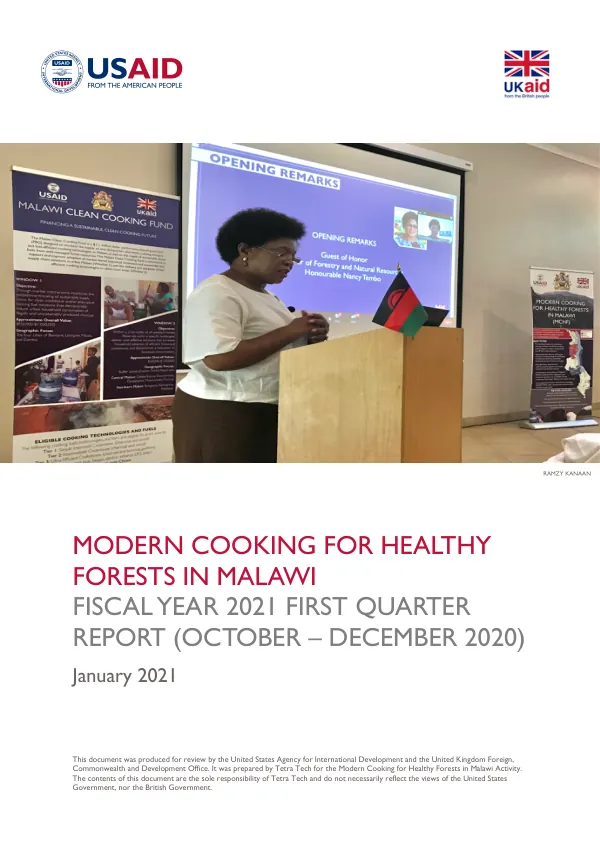
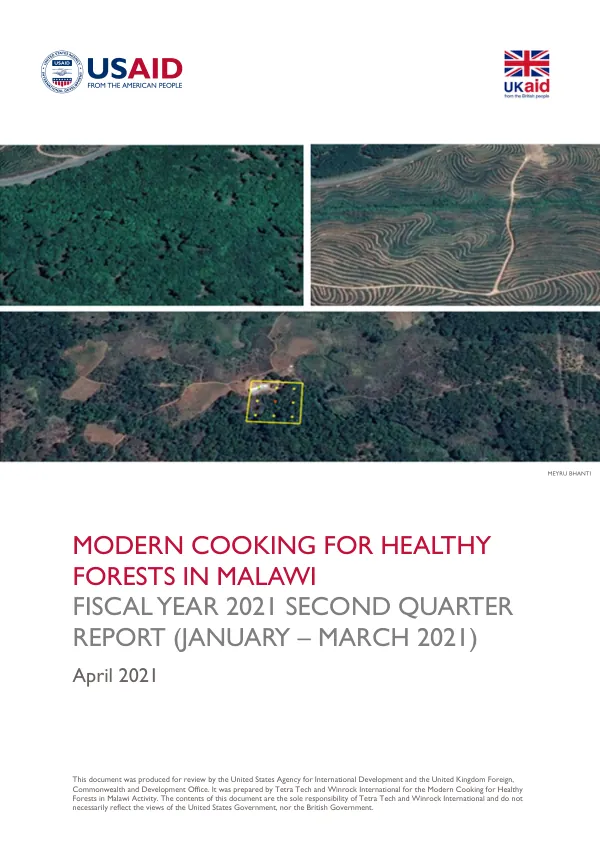
Modern Cooking for Healthy Forests in Malawi Fiscal Year 2021 Second Quarter Report (January – March 2021)
Sign inTETRA TECH
Modern Cooking for Healthy Forests in Malawi Fiscal Year 2021 Second Quarter Report (January – March 2021)
The Modern Cooking for Healthy Forests in Malawi Activity (MCHF) is a program aimed at reducing unsustainable wood fuel demand and promoting sustainable forestry practices in Malawi.
2021 · 41 pages
Sign in to readA free account is required to download.
Abstract
The program is implemented by Tetra Tech and Winrock International, in partnership with the United States Agency for International Development (USAID) and the United Kingdom Foreign, Commonwealth and Development Office (FCDO). The program has five main objectives: to promote alternative energy sources and efficient cooking technologies, to improve local delivery of forestry services and sustainable use of forestry resources, to strengthen regulatory and enforcement frameworks, to increase the Government of Malawi's implementation capacity for low emissions development, and to leverage interventions with USAID and other development partners. In the second quarter of Fiscal Year 2021, MCHF continued to make progress on these objectives. The program initiated or continued various baseline data collection activities, including the Malawi Clean Cooking Fund, the Rapid Rural Cooking Scan, and the MCHF Accelerator Program. These activities aimed to promote the adoption of alternative energy sources and efficient cooking technologies, such as liquified petroleum gas (LPG) and fuel-efficient stoves. MCHF also accelerated work with district and subdistrict level stakeholders, including the Department of Forestry (DoF) and the District Forestry Office (DFO). The program engaged with these stakeholders to improve local delivery of forestry services and sustainable use of forestry resources, including forest landscape restoration and bamboo planting and management demonstrations. In addition, MCHF strengthened regulatory and enforcement frameworks by supporting the development of the Forestry Act, Amendment Bill, and subsidiary regulations. The program also improved capacity for forest law enforcement and promoted fact-based, investigative journalism in the forestry sector. The program's progress was monitored and evaluated through the Activity Monitoring, Evaluation, and Learning Plan (AMELP). The AMELP framework was used to track progress against the program's objectives and to identify areas for improvement. The MCHF program has made significant progress in promoting sustainable forestry practices and reducing unsustainable wood fuel demand in Malawi. The program's continued efforts to engage with stakeholders, promote alternative energy sources, and strengthen regulatory frameworks are expected to contribute to the achievement of its objectives. The program's geographic focus is on Malawi, with a specific emphasis on the Viphya Plantation and the Kaning'ina Forest Reserve. The program's timeframes are aligned with the fiscal year, with the second quarter of Fiscal Year 2021 spanning from January to March 2021. The program's implementation details are outlined in the Activity Monitoring, Evaluation, and Learning Plan (AMELP), which provides a framework for tracking progress against the program's objectives. The AMELP framework includes key performance indicators (KPIs) and milestones that are used to evaluate the program's progress. The program's recommendations for future action are based on the analysis of its progress and the lessons learned from its implementation. The recommendations are aimed at improving the program's effectiveness and efficiency in achieving its objectives.