EQUAL ACCESS INTERNATIONAL
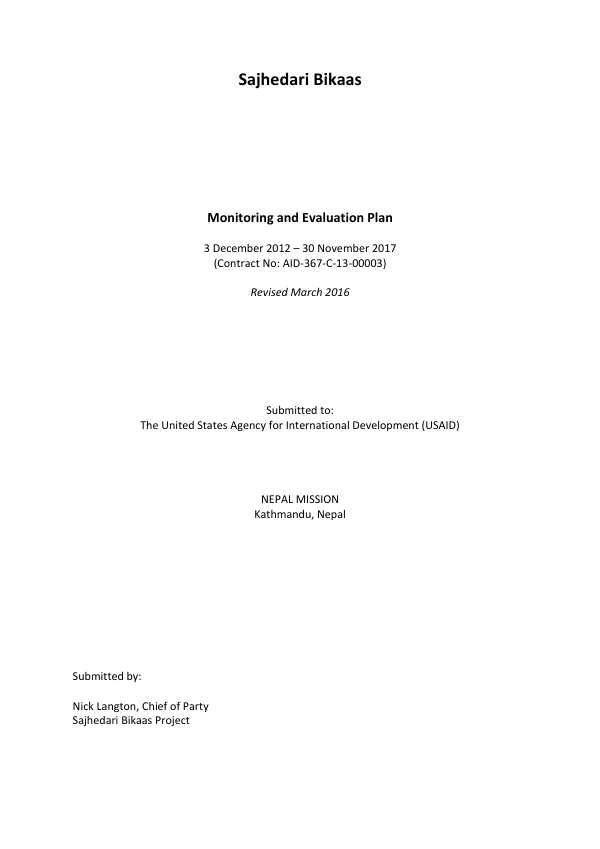
Monitoring and Evaluation Plan for Sajhedari Bikaas
Sajhedari Bikaas is a five-year project funded by the United States Agency for International Development (USAID) from 2012 to 2017.
2012 · 39 pages
Sign in to readA free account is required to download.
Abstract
The project aims to empower communities to direct their own development, offering sustainable and locally-appropriate solutions. To achieve its goal, Sajhedari Bikaas works in four key objectives: establishing and improving the enabling environment for community development, improving communities' ability to access resources for development, improving communities' ability to effectively implement inclusive development projects, and increasing the ability of existing and new government units to function effectively. The project is guided by four key principles: social inclusion, inclusive governance, and inclusive local development; flexibility in program approaches to address changing socio-political dynamics; community-based participation; and a focus on results-based management. Sajhedari Bikaas is implemented by Pact, a non-governmental organization, in partnership with local organizations, including Equal Access, Youth Initiative, and Center for Legal Research and Resource Development. The project's monitoring and evaluation plan was developed collaboratively with national partners and USAID/Nepal staff. The plan involves reviewing and refining the original results framework, validating the project's logic by developing logic models, identifying indicators and data sources, setting target values, and preparing Performance Indicator Reference Sheets (PIRS). The plan is considered a "living document" that will be reviewed and improved on a regular basis. The monitoring and evaluation system for Sajhedari Bikaas includes indicators with annual performance targets, a data indicator table, data management, and a geographic information system. The system also involves perception surveys, evaluation and special studies, and a linkage with USAID's Country Development Cooperation Strategy. The project's performance is tracked and reported through a Performance Monitoring and Evaluation Plan (PMEP), which is revised regularly to ensure that indicators are SMART (Specific, Measurable, Attainable, Relevant, and Time-bound). The revised PMEP includes 48 indicators, with 22 outcome level, 24 output level, and 2 impact level indicators. The indicators are used to track progress towards the project's objectives and to evaluate its effectiveness. The project's results are reported to USAID through the Performance Plan and Report (PPR), which includes the USG Standard Foreign Assistance Indicators or "F" indicators. Sajhedari Bikaas works in four key objectives, with a focus on establishing and improving the enabling environment for community development, improving communities' ability to access resources for development, improving communities' ability to effectively implement inclusive development projects, and increasing the ability of existing and new government units to function effectively. The project's monitoring and evaluation system is designed to track progress towards these objectives and to evaluate the project's effectiveness in achieving its goals.
Related documents