USAID DEC
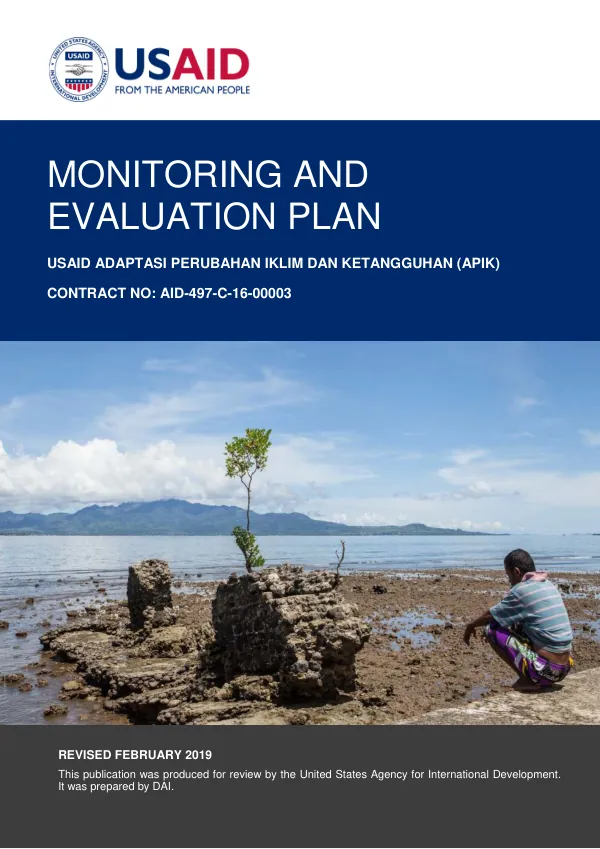
Monitoring and Evaluation Plan – USAID Adaptasi Perubahan Iklim dan Ketangguhan (APIK)
Sign inDAI
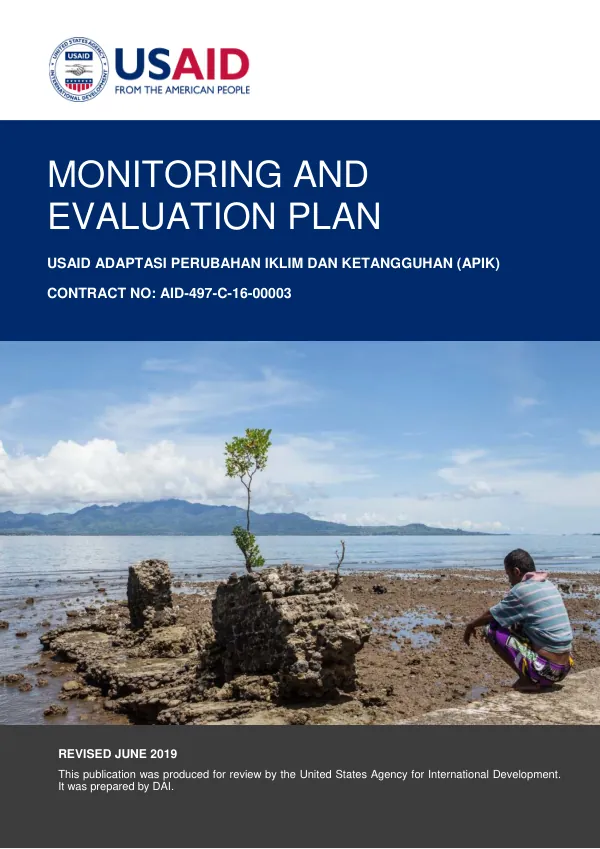
Monitoring and Evaluation Plan – USAID Adaptasi Perubahan Iklim dan Ketangguhan (APIK)
The Adaptasi Perubahan Iklim dan Ketangguhan (APIK) project is a USAID-funded initiative aimed at enhancing climate resilience and adaptability in Indonesia.
2019 · 98 pages
Sign in to readA free account is required to download.
Abstract
The project's primary objective is to support the Indonesian government in addressing the impacts of climate change on the country's environment, economy, and communities. APIK's monitoring and evaluation (M&E) plan is designed to track progress toward the project's goals and objectives. The plan outlines the key performance indicators (KPIs) and monitoring systems that will be used to assess the project's effectiveness. The M&E plan is structured around six high-level results (HLRs) and five task-level results (TLRs), which are further broken down into specific performance indicators and sub-indicators. The HLRs focus on enhancing climate resilience, improving water management, and promoting sustainable landscapes. The TLRs, on the other hand, focus on specific tasks and activities, such as improving water security, enhancing agricultural productivity, and promoting sustainable land use practices. The M&E plan also outlines the roles and responsibilities of various stakeholders, including the project team, partners, and government agencies. The project's M&E system is designed to collect, store, and process data on a regular basis. The data will be used to track progress toward the project's goals and objectives, identify areas for improvement, and inform decision-making. The M&E plan also outlines the procedures for data quality assessments and partner collaboration in monitoring activities. APIK's results framework is based on the Mekong ARCC Resilience Model Framework, which provides a comprehensive approach to assessing climate resilience and adaptability. The framework consists of six HLRs, which are further broken down into specific performance indicators and sub-indicators. The HLRs are: 1. Enhance climate resilience and adaptability in Indonesia 2. Improve water management and security 3. Promote sustainable landscapes and land use practices 4. Enhance agricultural productivity and food security 5. Support climate-resilient infrastructure development 6. Strengthen climate change governance and policy The project's M&E plan is designed to be flexible and adaptable, with regular revisions and updates to reflect changing project circumstances and new information. The plan is also designed to be integrated with other USAID projects and initiatives in Indonesia, ensuring that APIK's efforts are aligned with broader national and regional goals and objectives. Overall, the APIK project's M&E plan provides a comprehensive framework for tracking progress toward the project's goals and objectives. The plan outlines the key performance indicators, monitoring systems, and roles and responsibilities of various stakeholders, ensuring that the project is well-positioned to achieve its objectives and make a meaningful impact in Indonesia.