USAID DEC
Montes de Maria, Trajectory of a Region from 1998 - 2011
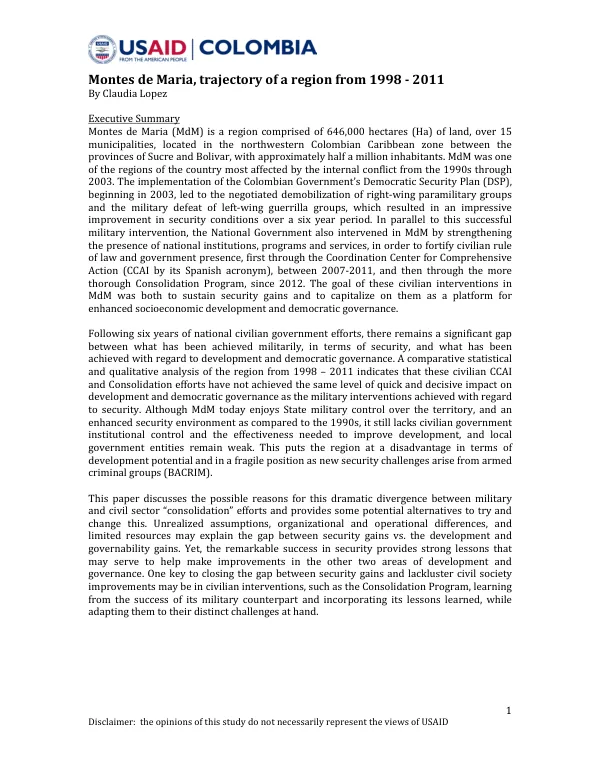
The Montes de Maria region, located in the northwestern Colombian Caribbean zone, spans 646,000 hectares of land across 15 municipalities.
2011 · 23 pages
Sign in to readA free account is required to download.
Abstract
The region has a population of approximately half a million inhabitants. From 1998 to 2003, MdM was one of the most affected regions by the internal conflict in Colombia. The implementation of the Democratic Security Plan (DSP) in 2003 led to the negotiated demobilization of right-wing paramilitary groups and the military defeat of left-wing guerrilla groups, resulting in improved security conditions over a six-year period. The Colombian Government's civilian interventions in MdM, through the Coordination Center for Comprehensive Action (CCAI) from 2007 to 2011 and the Consolidation Program since 2012, aimed to sustain security gains and capitalize on them as a platform for enhanced socioeconomic development and democratic governance. However, a comparative statistical and qualitative analysis of the region from 1998 to 2011 indicates that these civilian efforts have not achieved the same level of impact on development and democratic governance as the military interventions achieved in terms of security. Despite enjoying State military control over the territory and an enhanced security environment compared to the 1990s, MdM still lacks civilian government institutional control and effectiveness to improve development. Local government entities remain weak, putting the region at a disadvantage in terms of development potential and in a fragile position as new security challenges arise from armed criminal groups (BACRIM). The security evolution in MdM has two distinctive periods. During the first period, from 1998 to 2004, the region experienced a spiral of violence, with FARC attacks tripling and the rate of massacres and forced displacement doubling. In contrast, the second period, from 2004 to 2011, saw a sharp decrease in violence and a notable improvement in security, with massacres and FARC attacks completely disappearing in the region. However, the rate of paramilitary/BACRIM attacks in 2011 was higher in MdM than in Sucre, Bolívar, or nationwide, although attacks were not of the same nature or magnitude as previously observed. Regarding municipal fiscal and administrative management, the picture looks grimmer. The level of tax revenue in MdM has not changed significantly, with land property tax revenue per capita increasing from $7,000 (approximately USD 3.7) in 1998 to $8,000 (approximately USD 4.2) in 2011. Business tax collection per capita has increased more sharply, from $500 pesos (USD 0.26) in 1998 to $9,000 pesos (USD 4.7) in 2011, yet both land property and business tax revenue in MdM still fall below provincial and national averages. Fiscal dependency on national resources is still extremely high in MdM's municipalities, with an average of 6 out of every 10 pesos of local budget coming from national government resources. This highlights the need for improved fiscal management and administrative capacity in the region to reduce dependence on national resources and enhance local development.