AECOM INTERNATIONAL
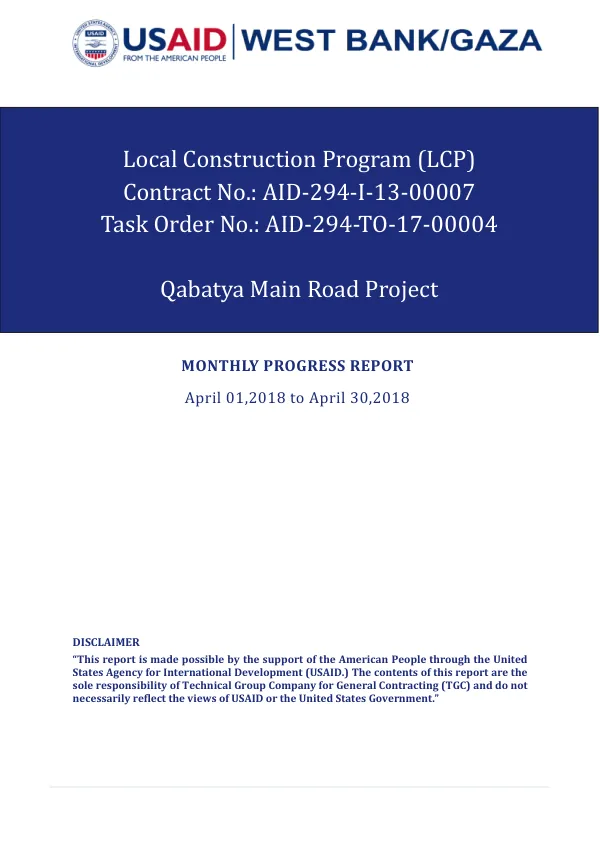
Monthly Progress Report-MPR-17-00004- Qabatya Main Road Project – April 2018
The Local Construction Program (LCP) in West Bank and Gaza focuses on the rehabilitation and construction of roads, water, wastewater, and buildings construction projects.
2018 · 128 pages
Sign in to readA free account is required to download.
Abstract
The USAID mission's objective is to help the Palestinian economy by improving Palestinians' access to basic infrastructure and services. The LCP aims to address the years of neglect and lack of investment in the region's infrastructure. The Qabatya Main Road Project, a Task Order under the LCP, aims to reconstruct approximately 1.2 kilometers of the road in Jenin Government to facilitate the movement of trade and people across Southern Jenin District. The project involves the rehabilitation of the Qabatya Main Road, including the reconstruction of a four-lane road along with access roads, construction of concrete retaining walls and stonewalls, construction of sidewalks and median islands, and supplying and installing lighting poles, drainage systems, and water pipelines. The project's scope includes the reconstruction of 1.2 kilometers of a four-lane road, construction of concrete retaining walls and stonewalls, construction of sidewalks and median islands, supplying and installing lighting poles, drainage systems, and water pipelines. The project's objective is to improve the road's condition and facilitate the movement of trade and people across Southern Jenin District. The project's implementation involves several key activities, including the reconstruction of the road, construction of retaining walls and stonewalls, and installation of lighting poles, drainage systems, and water pipelines. The project's timeline is critical, with a focus on completing the reconstruction of the road and associated infrastructure within a specified timeframe. The project's safety plan and measures are in place to ensure the well-being of workers and the public. The plan includes regular safety meetings, accident reporting, and notices of unsafe conditions. The project's traffic control plan is also in place to manage traffic flow and ensure the safety of workers and the public. The project's environmental compliance plan is designed to minimize the project's impact on the environment and ensure that all necessary permits and approvals are obtained. The project's community outreach plan is designed to engage with local stakeholders and ensure that the project's benefits are shared equitably. The plan includes regular meetings with local leaders and residents, as well as the provision of information on the project's progress and benefits. The project's gender action plan is also in place to ensure that women's needs and perspectives are taken into account in the project's design and implementation. The project's progress and scheduling are closely monitored, with regular updates provided to stakeholders. The project's indicators, including the reconstruction of the road and associated infrastructure, are tracked and reported on a regular basis. The project's working and non-working days are also tracked, with a focus on ensuring that the project is completed within the specified timeframe. The project's quality control status is closely monitored, with regular inspections and testing to ensure that the work meets the required standards. The project's non-compliance reports are tracked and addressed promptly, with a focus on ensuring that the project is completed to the required standards. The project's inspection requests, quality control/quality assurance test results, and project submittals status are also closely monitored and reported on a regular basis.