USAID FAMINE EARLY WARNING SYSTEMS NETWORK
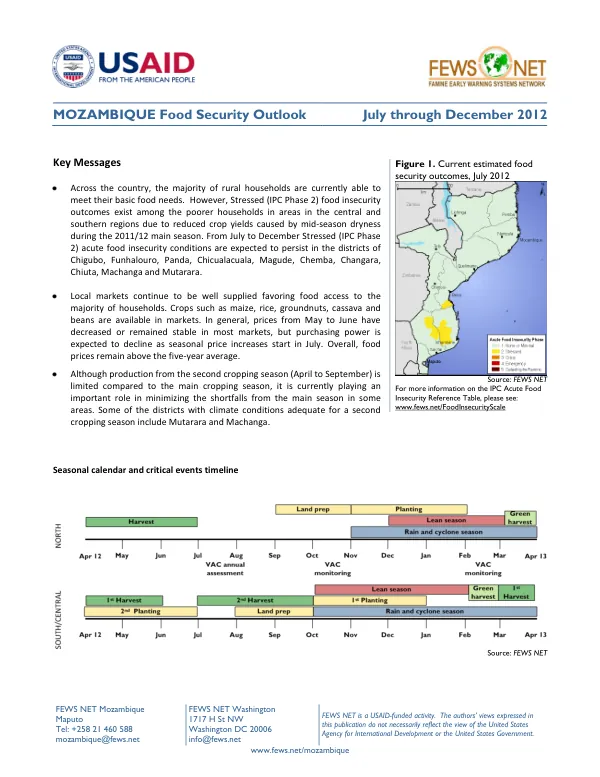
Mozambique Food Security Outlook July through December 2012
The majority of rural households in Mozambique are currently able to meet their basic food needs, thanks to food stocks from the main harvest of the 2011/12 cropping season, continued food availability in markets, and the ongoing second cropping season in limited areas.
2012 · 5 pages
Sign in to readA free account is required to download.
Abstract
However, parts of Chigubo, Funhalouro, Panda, and Machanga districts are experiencing Stressed (IPC Phase 2) acute food insecurity conditions due to mid-season dryness that caused reduced crop yields and crop failure during the main agriculture season of 2011/12. Household resilience in these areas is low due to repeated depletion of productive assets and food stocks over the last 3 years. Crop production in the northern region of Mozambique is assessed to have fared well, but the southern region performed poorly. Most of the central region experienced average crop production, while other parts in the region were below average. The Water Requirement Satisfaction Index (WRSI) calibrated for maize crop shows that the overall crop production is expected to remain the same or larger than the previous year. Food prices from May to June have decreased or remained stable in most monitored markets, but prices remain above the five-year average. The Vulnerability Assessment Group (GAV) of the Technical Secretariat for Food and Nutrition Security (SETSAN) conducted a preliminary vulnerability assessment in July 2012, which indicates that an estimated 255,297 people are at risk of food insecurity. Many are likely to face varying levels of survival and livelihoods protection deficits in mostly semi-arid, arid, and remote areas. The household food insecurity situation will likely continue to deteriorate, reaching its peak towards the lean season within the months of November to January 2013. The most likely food security scenario focuses on parts of the districts of Chicualcuala, Chigubo, Funhalouro, Panda, and Magude in the Upper Limpopo Riverine-Chicualacuala/Mabalane zone, Upper Limpopo Interior-Agriculture and Charcoal zone, Semi-Arid Interior-Sorghum and Millet Livelihood zone, and Semi-Arid Interior-Maize zone and Interior Maputo livelihood zone. These areas are chronically vulnerable to shocks, including drought, floods, and high food prices due to reduced crop production. Prolonged dry spells from January-February 2012 and mild to severe drought conditions affected the overall crop harvest in these particular areas. The most likely food security scenario is based on several assumptions, including decreasing food reserves for poor and very poor households starting in July as a result of a lower than average harvest during the main 2011/12 cropping season, food prices remaining above the five-year average, very limited second season production in the areas of focus due to unfavorable agro-climatic conditions, and a decrease in self-employment opportunities.