USAID FAMINE EARLY WARNING SYSTEMS NETWORK
ZAMBIA Food Security Outlook July through December 2012
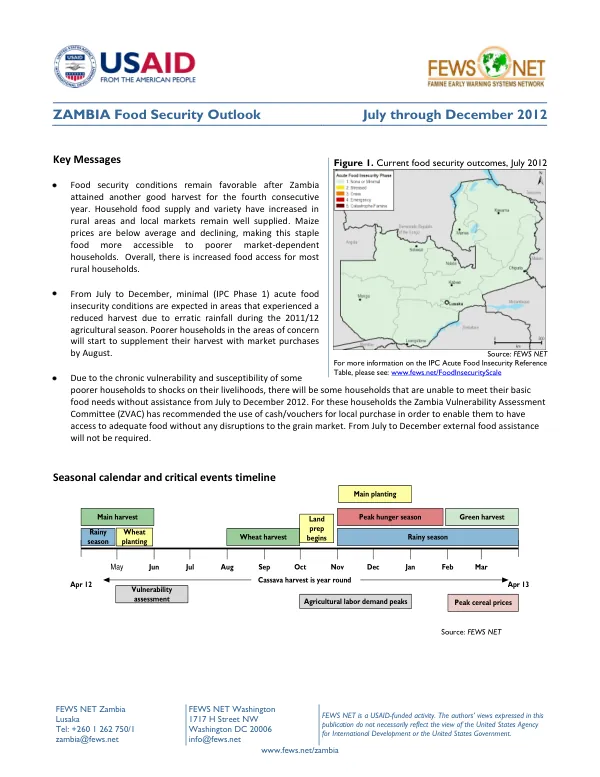
The agricultural sector in Zambia has experienced a fourth consecutive year of surplus cereal production, resulting in favorable food security conditions.
2012 · 4 pages
Sign in to readA free account is required to download.
Abstract
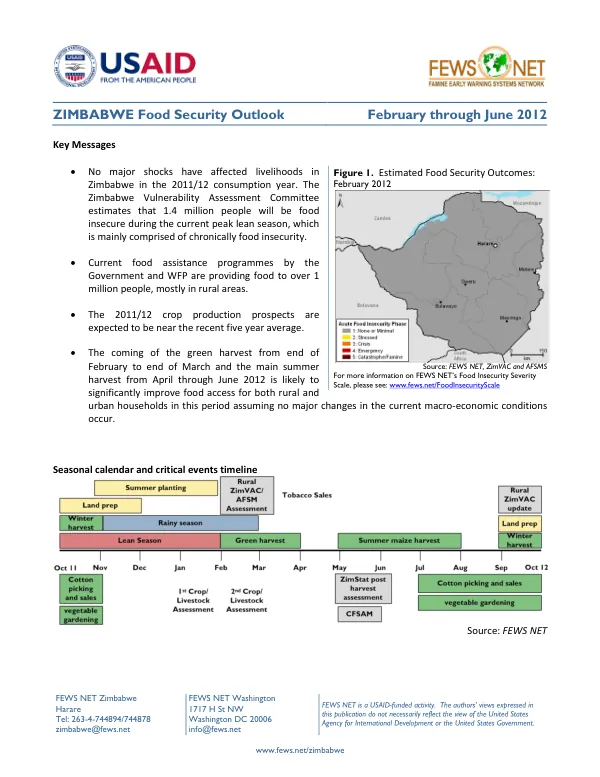
The new harvest has increased both the supply and variety of household foods in rural areas, leading to improved food access for most rural households. Household food supply and variety have increased in rural areas, and local markets remain well supplied. Maize prices are below average and declining, making this staple food more accessible to poorer market-dependent households. The Food Reserve Agency (FRA) is selling maize on the market from the previous marketing season stocks, but the good quality grain stocks with FRA have substantially reduced. The new maize harvest from small scale farmers has started reaching the market, and despite the large harvest this season, the FRA delayed the commencement of the maize purchase program due to high moisture content in the maize. This delay has given small scale traders an opportunity to purchase the maize at lower prices before the FRA, who are offering above market price, move into the market. The districts of Mazabuka, Chikankata, Gwembe, Mambwe, and Chavuma are areas of concern from July to December. The food security situation in these districts is currently stable following the recent harvest, with staple food prices in these districts steady and declining while markets are adequately supplied. Most households in these districts rely on their own production, ensuring that they have immediate access to basic foods. However, in these areas, food stocks are lower than the norm for this time of the year and will run out earlier than usual. The recent annual vulnerability assessment results spearheaded by the Zambia Vulnerability Committee (ZVAC) showed no strong evidence of households engaging in unusual livelihood strategies, such as pulling children out of school and increased sale of assets. The ZVAC results also showed that the majority (80 percent) of households in the assessed districts have good food consumption scores despite most of them being asset poor. This could be the result of increased seasonal food variety which has provided increased diet diversity following the new harvest. The markets within the districts of concern will be well supplied from July to December, and therefore staple food prices are likely to continue to remain below the five-year average. Since poorer households in these areas will have lower food reserves, they will need to depend on the market earlier than usual. As long as the markets remain well supplied and prices remain low, acute food insecurity conditions for most households will continue to be Minimal (IPC Phase 1).