THE WORLD FOOD PROGRAMME
ZIMBABWE Food Security Outlook
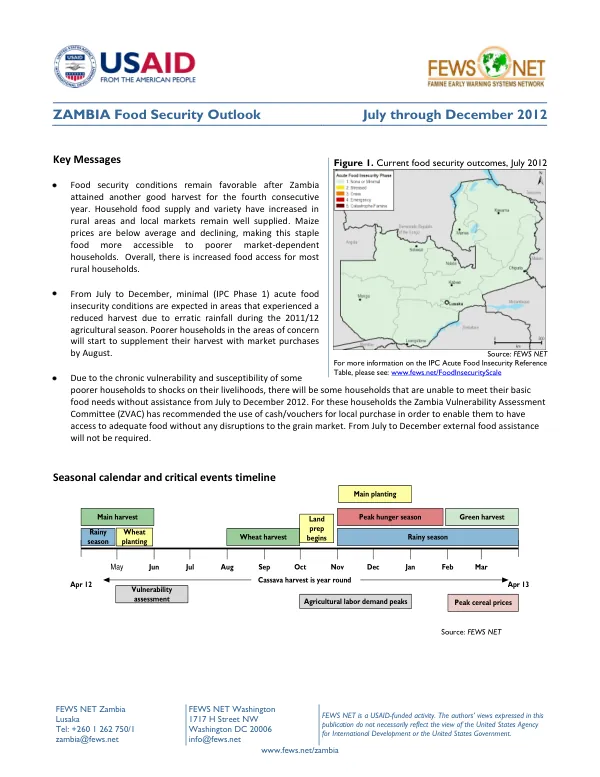
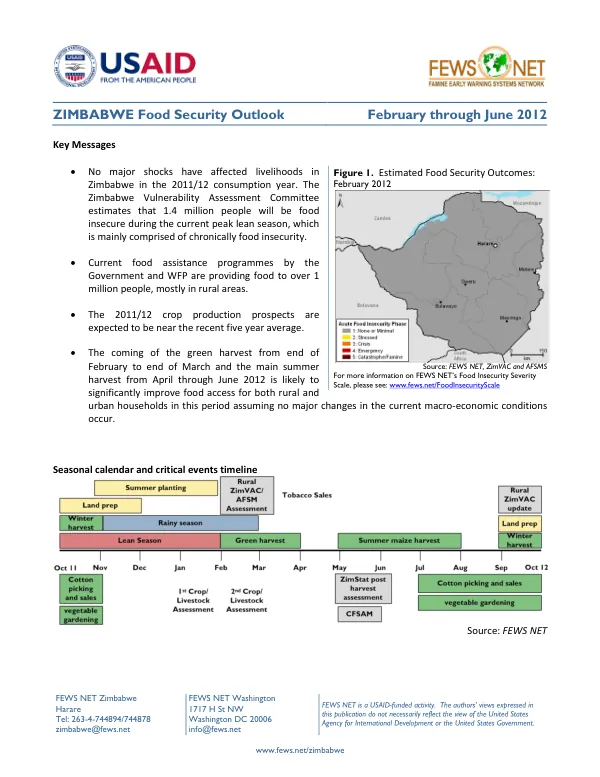
The Zimbabwe Food Security Outlook for February through June 2012 indicates that no major shocks have affected livelihoods in Zimbabwe during the 2011/12 consumption year.
2012 · 6 pages
Sign in to readA free account is required to download.
Abstract
The Zimbabwe Vulnerability Assessment Committee estimates that 1.4 million people will be food insecure during the peak lean season, mainly comprised of chronically food insecure individuals. This projection is based on a household survey of over 10,600 households and 250 community focus group discussions. The primary food security analysis was conducted at the livelihood zone level and then aggregated to the national level. The projection used the following assumptions: basic foodstuffs, including staple cereals, will generally be available in the markets; the rate of inflation will be less than 5% and basic foodstuff prices will be generally stable throughout the 2011/12 consumption year; and the purchasing power of households' incomes will generally be stable throughout the 2011/12 consumption year. These assumptions have generally held up in most parts of the country, making the ZimVAC projections generally still valid. The highest concentration of food insecure rural people (15-25%) was projected to be in areas along the Zambezi Valley in Matabeleland North, Mashonaland Central, and Mashonaland West Provinces, Rushinga district, the northern parts of Mashonaland East provinces, northern parts of Nyanga district, the southern tip of Chipinge district, and the Central parts of Manicaland province covering Buhera, Mutare, and Chimanimani districts, the central and northern parts of Masvingo provinces. Most of these areas were characterized by poor crop production in the 2010/11 summer cropping season, relatively higher staple cereal prices, and limited non-farm income generating opportunities. In urban areas, the highest prevalence of food insecure people was estimated in Mashonaland Central (23%), Bulawayo (17%), and Matabeleland North (16%) provinces. Urban food insecure households were mostly confined in poor peri-urban and high-density areas. Limited households' purchasing power is the primary cause for their food insecurity since food is readily available on the market. Food assistance from WFP and the Government are addressing a significant proportion of the assessed food insecurity in rural areas. In January, WFP distributed full rations of cereal, pulses, and oils to about 873,000 people, cash for cereals, pulses, and vegetable oil to 160,000 people, and food basket vouchers to an additional 160,000 people. The Government, through the Grain Marketing Board (GMB), loaned and sold some subsidized maize from its grain reserves to identified vulnerable rural households in some maize deficit districts. These food assistance programs are addressing most of the acute food insecurity currently in the country, rendering the whole country to fall into the generally food secure IPC food security category. However, some levels of chronic food insecurity remain unassisted. The rainfall season started one to three dekads late in most parts of the country except for central parts of Mashonaland East and Manicaland provinces and the southern parts of Manicaland, Masvingo, and Matabeleland South provinces. A false start of the season occurred in some parts of the country, resulting in some farmers losing their initially sown crops. However, most farmers planted with the mid-November to early-December rains. The rains in the first half of the season were spatially and temporally erratic, with seasonal cumulative rainfall from October to December finishing at normal to below-normal levels for most of the country. Rainfall increased in January, particularly in the northern half of the country, with cumulative rainfall received in these areas improving significantly. Most stations in the north of the Midlands, Mashonaland, Harare, and Manicaland provinces had received more than 300 mm since the beginning of the rainy season by 15 February 2012. Projections to the end of the season, based on USGS Water Requirement Satisfaction Index (WRSI) from mid-February, which assume normal rainfall for the remainder of the season, point to average to above-average water satisfaction for maize crop performance in the central and northern parts of the country.