JHPIEGO
Mozambique MCHIP Technical Briefs: MNCH/RH Integrated In-service Training Package
The Mozambican Ministry of Health's National Integrated Plan to Achieve Millennium Development Goals 4 and 5 highlights the need for a more effective approach to in-service training for health care personnel.
2015 · 2 pages
Sign in to readA free account is required to download.
Abstract
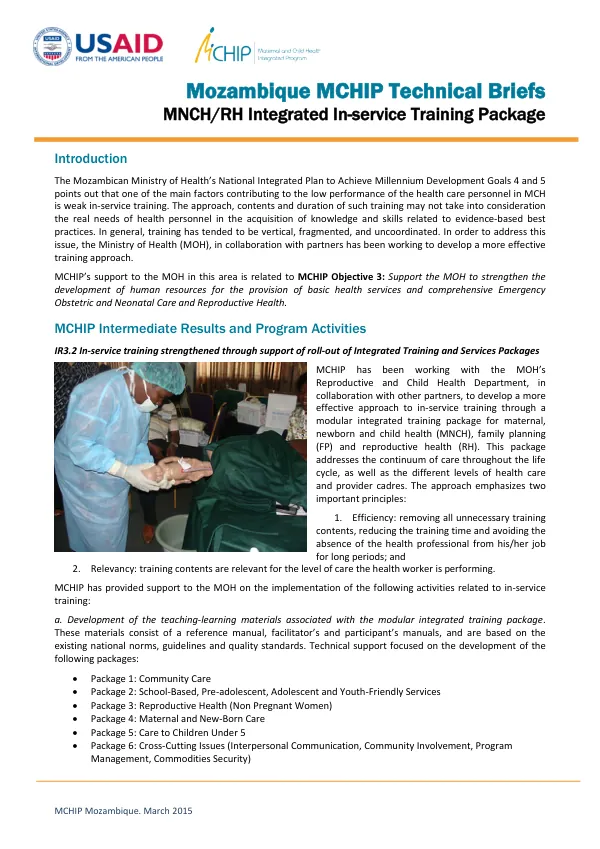
Weak training has been identified as a major factor contributing to low performance in maternal and child health. The current training approach is often vertical, fragmented, and uncoordinated, failing to address the real needs of health personnel. To address this issue, the Ministry of Health, in collaboration with partners, has been working to develop a more effective training approach. MCHIP's support to the Ministry of Health is aligned with Objective 3, which aims to strengthen the development of human resources for the provision of basic health services and comprehensive Emergency Obstetric and Neonatal Care and Reproductive Health. MCHIP has been working with the Ministry of Health's Reproductive and Child Health Department to develop a modular integrated training package for maternal, newborn, and child health, family planning, and reproductive health. This package addresses the continuum of care throughout the life cycle, as well as the different levels of health care and provider cadres. The approach emphasizes efficiency and relevancy, removing unnecessary training contents and reducing training time. The integrated training package consists of six modules: Community Care, School-Based, Pre-adolescent, Adolescent, and Youth-Friendly Services, Reproductive Health for Non-Pregnant Women, Maternal and Newborn Care, and Care for Children Under 5. The implementation of this approach is carried out according to the needs and priorities identified, beginning with a performance evaluation using tools developed and structured according to the six integrated in-service training packages. MCHIP has provided support for the development of teaching-learning materials associated with the modular integrated training package, including reference manuals, facilitator's and participant's manuals, based on existing national norms, guidelines, and quality standards. The implementation of the integrated in-service training package has been rolled out at the provincial level, with trained trainers conducting trainings for health care providers from nine provinces in Child Health and collaborating to facilitate regional trainings for providers from the Northern, Central, and Southern regions of Mozambique. Upcoming plans include finalizing, printing, and disseminating the integrated packages documents, continuing to advocate and provide technical assistance for the implementation of the Integrated In-Service Training Packages at the national level, and documenting, presenting, and publishing best practices, experiences, and lessons learned from the implementation of the integrated in-service training package.
Related documents