DAI
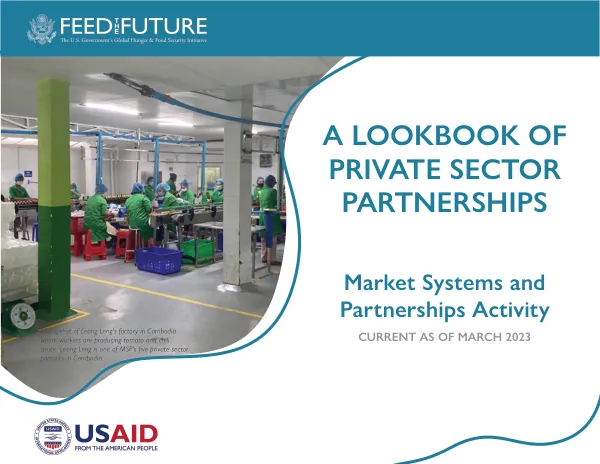
MSP’s Lookbook of Private Sector Partnerships
The USAID-funded Feed the Future Market Systems and Partnerships (MSP) Activity is advancing learning and good practice on market systems development (MSD) and private sector engagement (PSE) within USAID, USAID's implementers, and market actors.
2023 · 21 pages
Sign in to readA free account is required to download.
Abstract
As one component of the Activity, MSP facilitates private sector partnerships through a global Partnership Facility that creates shared value from the alignment of core business objectives and development goals. MSP's Partnership Facility selects concepts based on the strength of five core factors: business concept, development impact, sustainability, scale, and funding justification (additionality). MSP's approach focuses on prioritizing upfront strategic outreach to attract the most impactful partner or coalition of partners and on the most strategic activities that can drive systemic impact. The approach also involves deciding to engage only when MSP's additionality is projected, where MSP's involvement is critical to unlocking market-based solutions. Additionally, MSP draws on relationship management practices to steward partnerships, foster relationship health, and prompt ongoing, partner-led learning that informs decision-making. MSP's approach to gender lens investing focuses on working with partner firms to strengthen their positive impact on women as suppliers, customers, and employees. For each partnership, MSP integrates a gender lens investment approach to inform co-development, while identifying the firm's status on enhancing women's empowerment through MSP's initial partner survey. MSP co-develops tailored strategies with partners aligned with the core partnership activity to support firms to incrementally move along a continuum from 'no awareness' of women's empowerment to 'transformational impact,' with the aim of enhancing firm performance and women's empowerment impacts. MSP has signed partnerships with 11 firms in the Southern Africa, Cambodia, and Solomon Islands facilities. The partnerships aim to increase access to markets, information, goods, and services for smallholder farmers, with a focus on agricultural trade and investment. The anticipated results of the partnerships include benefiting 136,280 smallholder farmers directly and indirectly, leveraging $10 million USD from the private sector towards partnership goals, and achieving $19.2 million USD in sales by firms and smallholders, advancing trade and inclusive growth. The partnerships are focused on various technical themes, including food loss and waste, agricultural-led economic growth, and increasing product quality and value addition of agricultural products. The partnerships are also focused on increasing the uptake and scale of solutions and innovations to improve the resiliency of the Mozambican agriculture sector and increase the uptake and scale of FLW solutions, building food and nutrition security. MSP's partnerships are established in eight countries, including Cambodia, Eswatini, Lesotho, Malawi, Mozambique, Solomon Islands, South Africa, and Zambia. The partnerships are focused on various sectors, including agriculture, financial services, and renewable energy. The partnerships aim to create shared value from the alignment of core business objectives and development goals, with a focus on increasing access to markets, information, goods, and services for smallholder farmers. The partnerships are also focused on increasing the adoption of sustainable agriculture practices, improving the quality and value addition of agricultural products, and increasing the uptake and scale of solutions and innovations to improve the resiliency of the Mozambican agriculture sector. The partnerships are expected to have a positive impact on the lives of smallholder farmers and their communities, with a focus on increasing their income, improving their food security, and enhancing their overall well-being.
Related documents