WORLD WILDLIFE FUND INTERNATIONAL
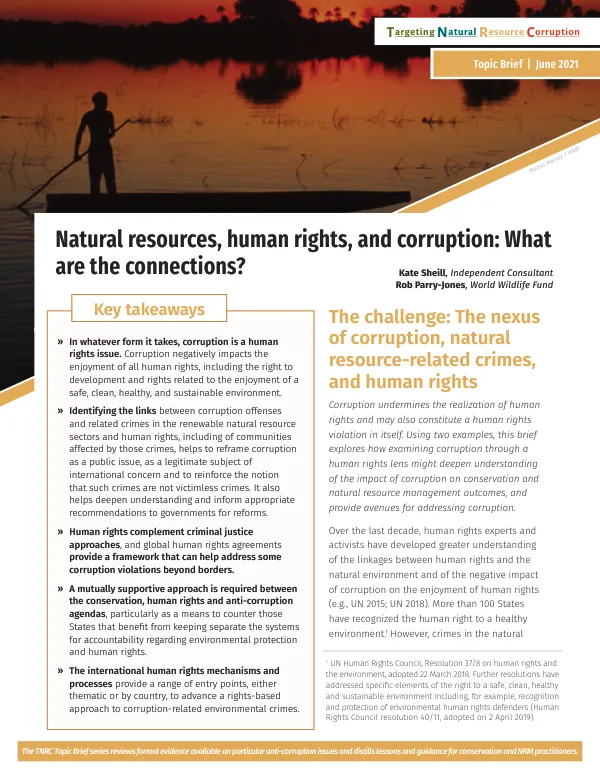
Natural resources, human rights, and corruption: What are the connections?
The nexus of corruption, natural resource-related crimes, and human rights is a complex issue that undermines the realization of human rights and may also constitute a human rights violation in itself.
2021 · 16 pages
Sign in to readA free account is required to download.
Abstract
Corruption is often embedded in natural resource management systems, contributing both as cause and consequence of corruption. Weak institutions, lack of transparency, oversight, and accountability contribute to corruption, while environmental crimes facilitated by corruption result in well-documented harm to the environment. A comprehensive and holistic response to environmental crime requires understanding the factors that contribute to it, including human rights violations and social injustice. Approaching environmental crime and related corruption solely from a criminal justice perspective may omit the role that other factors, such as human rights violations and abuses, may have played in contributing to the context or that may result as a consequence. Understanding the broader context, including the links between a safe environment and human rights, reframes the challenge and provides insight into legal and policy linkages and advocacy entry points for addressing corruption. The situation of illegal abalone harvest and trade in South Africa illustrates the links between natural resource-related crime, corruption, discrimination, and human rights. Corruption facilitated the illegal collection and trade of abalone, from leakage of seized abalone and vessels to corrupt law enforcement officers helping, ignoring, or taking part in poaching activities. The socio-political history behind the legal abalone fishery gives insight into the structural factors that have enabled corruption, environmental crime, and the pervasive violation of human rights. Apartheid-era fisheries policies discriminated against local fisher communities on grounds of race, a clear violation of a core human right of non-discrimination. Corruption facilitated the policies, with the Department of Agriculture, Forestry, and Fisheries being "captured" by private interests. Reform was slow, which helped open space for criminal organizations to recruit local fishers excluded from official fishing rights. Criminal syndicates provided social assistance to fishers, but also paid them with illegal drugs, further undermining their right to health. The case of the illegal abalone harvest and trade in South Africa highlights the need for a human rights-based approach to addressing corruption and environmental crime. A human rights-based approach focuses on the harms and adverse impacts on rights of an individual or community, seeking to understand and address the underlying structural flaws that undermine those rights. In anti-corruption, a human rights-based approach can help move the analysis, critique, and remedy from solely criminal justice to include social justice and promotion and protection of rights. The international human rights mechanisms and processes provide a range of entry points, either thematic or by country, to advance a rights-based approach to corruption-related environmental crimes. The UN Special Rapporteur on human rights and the environment has reported on the links between human rights and the natural environment, highlighting the need for a comprehensive and holistic response to environmental crime. The UN has also adopted several resolutions on tackling illicit trafficking in wildlife, recognizing the need for a coordinated approach to addressing environmental crime. A mutually supportive approach is required between the conservation, human rights, and anti-corruption agendas, particularly as a means to counter those States that benefit from keeping separate the systems for accountability regarding environmental protection and human rights. The TNRC Topic Brief series reviews formal evidence available on particular anti-corruption issues and distills lessons and guidance for conservation and NRM practitioners. The challenge of addressing corruption, natural resource-related crimes, and human rights requires a comprehensive and holistic response that takes into account the complex factors that contribute to these issues.
Related documents