GOVERNMENT OF TAJIKISTAN
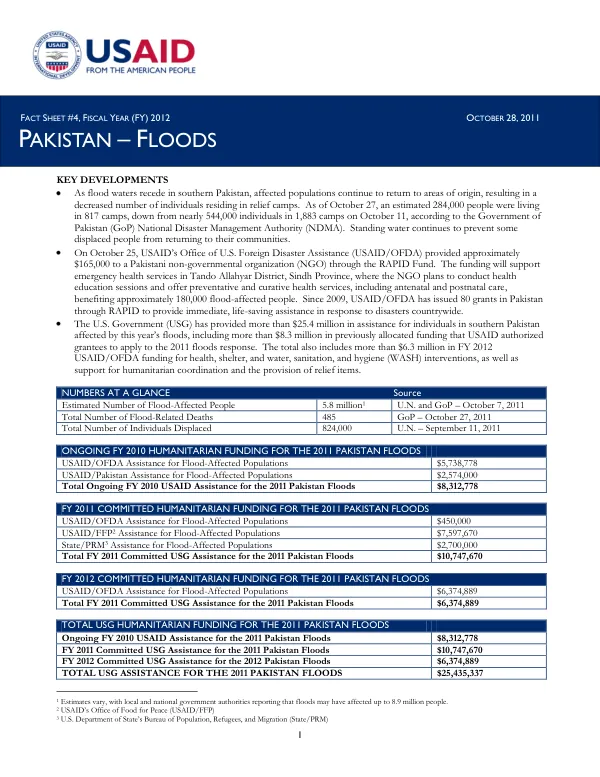
USAID-DCHA Pakistan Floods Fact Sheet #4 - FY 2012
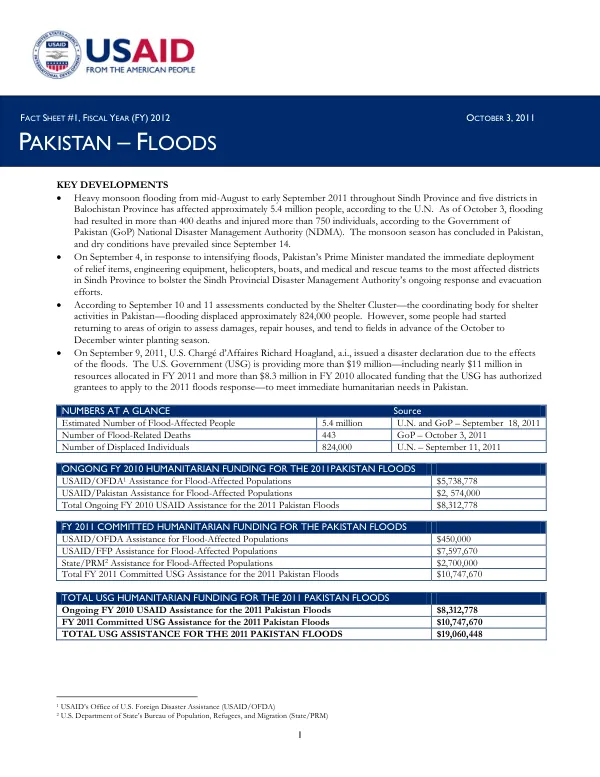
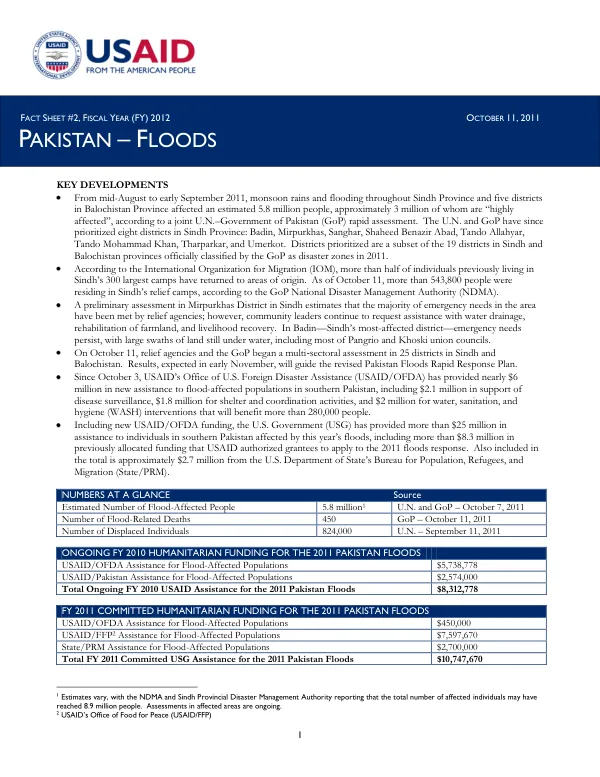
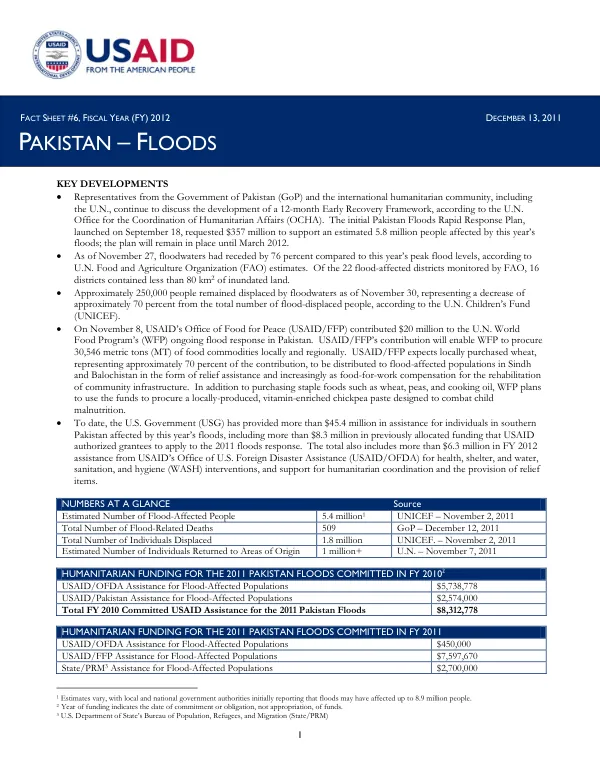
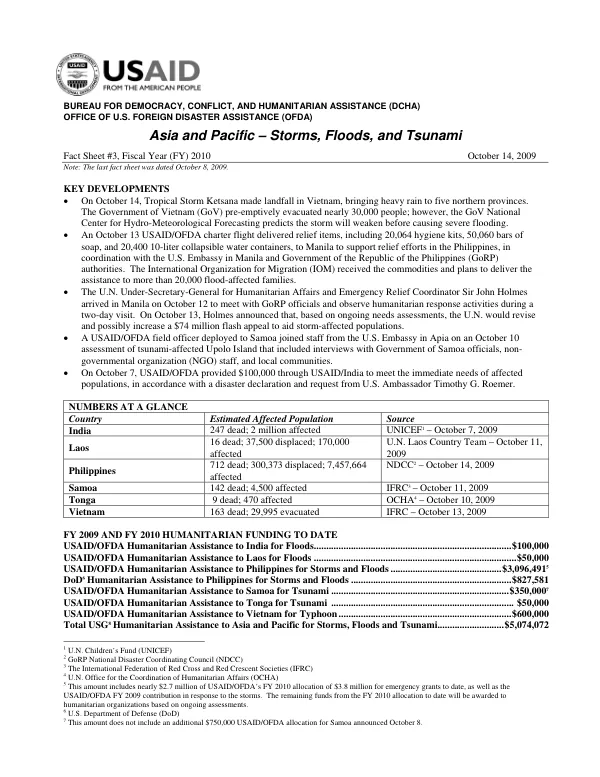
The 2011 floods in Pakistan resulted in widespread destruction and displacement, with more than 820,000 people fleeing to temporary settlements.
2012 · 5 pages
Sign in to readA free account is required to download.
Abstract
Heavy rainfall caused water to breach river banks and irrigation canals, destroying up to 1.6 million houses and more than 2.1 million acres of agricultural land. The floods occurred as Pakistanis continued to recover from the 2010 monsoon floods that affected approximately 18 million people countrywide. The Government of Pakistan's National Disaster Management Authority reported that as of October 27, an estimated 284,000 people were living in 817 relief camps, down from nearly 544,000 individuals in 1,883 camps on October 11. Standing water continues to prevent some displaced people from returning to their communities. The U.S. Government has provided more than $25.4 million in assistance for individuals in southern Pakistan affected by the floods, including more than $8.3 million in previously allocated funding that USAID authorized grantees to apply to the 2011 floods response. The U.N. Office for the Coordination of Humanitarian Affairs, with support from other U.N. agencies and the International Organization for Migration, conducted a multi-sector assessment of flood-affected areas in preparation for the revision of the Pakistan Floods Rapid Response Plan. The WASH Cluster is targeting approximately 2.5 million flood-affected people with WASH assistance, with WASH Cluster members having provided safe drinking water to more than 605,000 people in Sindh Province as of October 20. In addition, WASH Cluster members reached more than 103,000 people through hygiene education and provided more than 111,000 people access to sanitation facilities. The Sindh Public Health Engineering Department is supporting the installation of 40 water treatment units in the province, with eight units functional in most-affected Badin District as of October 20. Water treatment units provided by USAID/OFDA in response to the 2010 floods are also furnishing safe drinking water to communities affected by the current disaster. In Balochistan Province, as of October 20, WASH Cluster members had provided safe drinking water to more than 19,000 people in Kalat, Khudzdar, and Nasirabad districts. The U.N. Children's Fund, in collaboration with the Government of Sindh Ministry of Health, WHO, and the U.N. Population Fund, continues to provide health services for children and new and expectant mothers in seven priority districts in Sindh Province by deploying approximately 7,000 female health workers and an estimated 800 community midwives to affected areas. As of October 20, approximately 19,000 women had received antenatal or postnatal care, and more than 15,000 women had received information on breastfeeding, child and maternal nutrition, and other related health issues. USAID/FFP partner the U.N. World Food Program has reached approximately 2.5 million flood-affected individuals in Sindh Province since operations began in mid-September. In Balochistan Province, WFP has reached 21,000 beneficiaries in three of the four targeted districts—Kalat, Killa Abdullah, and Lasbela. Distribution in Naseerabad has not yet started. WFP continues to provide monthly rations to an estimated 100,000 beneficiaries per day in Sindh Province.
Related documents