INTERNATIONAL CHILDREN'S FUND, INC.
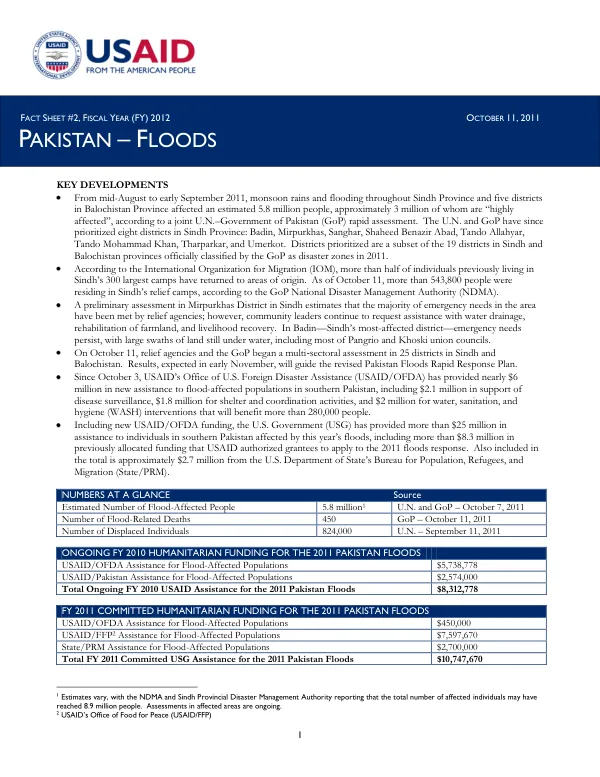
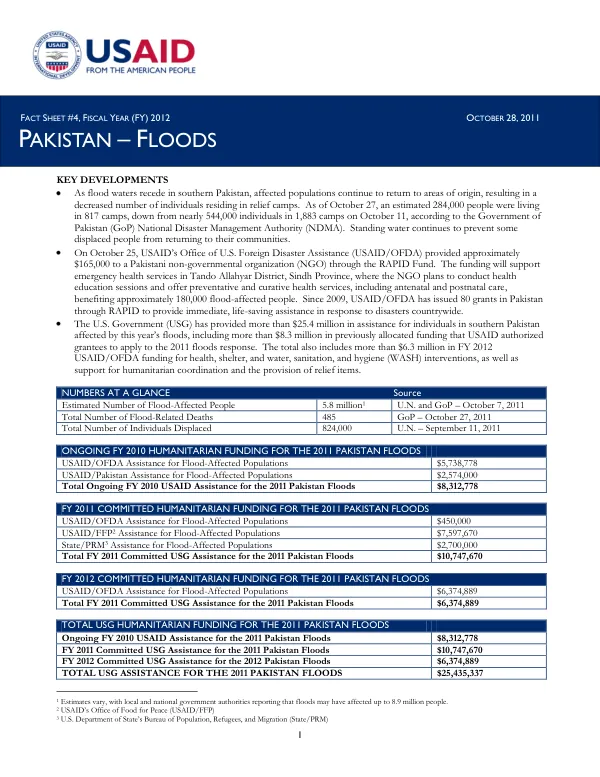
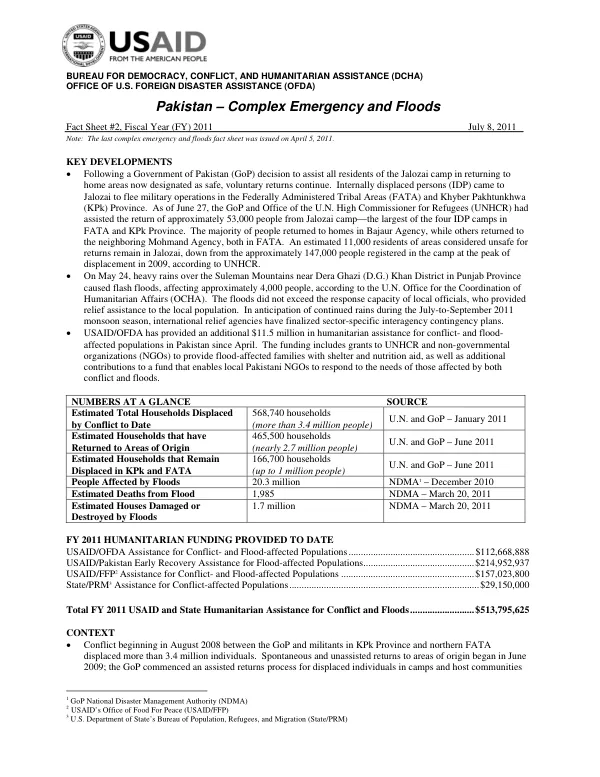
USAID-DCHA Pakistan Floods Fact Sheet #1 - FY 2012
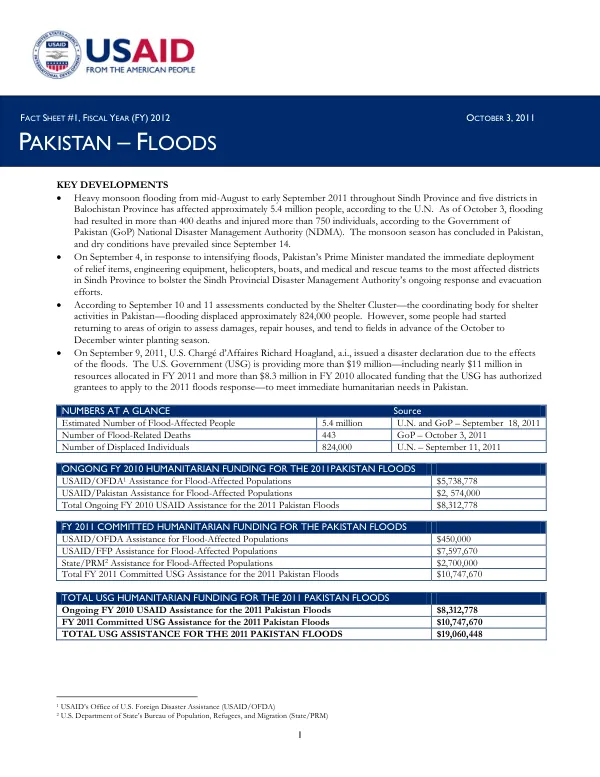
Heavy monsoon flooding in Sindh Province and five districts in Balochistan Province of Pakistan from mid-August to early September 2011 affected approximately 5.4 million people, according to the U.N.
2012 · 5 pages
Sign in to readA free account is required to download.
Abstract
The flooding resulted in more than 400 deaths and injured over 750 individuals, according to the Government of Pakistan's National Disaster Management Authority. The monsoon season concluded in Pakistan on September 14, with dry conditions prevailing since then. In response to the intensifying floods, Pakistan's Prime Minister mandated the immediate deployment of relief items, engineering equipment, helicopters, boats, and medical and rescue teams to the most affected districts in Sindh Province on September 4. The Sindh Provincial Disaster Management Authority was bolstered in its ongoing response and evacuation efforts. Assessments conducted by the Shelter Cluster on September 10 and 11 indicated that flooding displaced approximately 824,000 people, although some individuals had started returning to areas of origin to assess damages, repair houses, and tend to fields in advance of the October to December winter planting season. The U.S. Chargé d'Affaires, Richard Hoagland, issued a disaster declaration on September 9, 2011, due to the effects of the floods. The U.S. Government is providing more than $19 million, including nearly $11 million in resources allocated in FY 2011 and more than $8.3 million in FY 2010 allocated funding, to meet immediate humanitarian needs in Pakistan. The U.S. Government's assistance includes funding for shelter, health, emergency relief items, and water, sanitation, and hygiene (WASH) needs. The 2011 floods occurred as Pakistanis continued to recover from the 2010 monsoon floods that affected approximately 18 million people countrywide. Families continued to rebuild homes and restore livelihoods more than a year after last year's disaster, one of the worst in Pakistan's history. The more than $922 million provided by the U.S. Government in response to the 2010 floods emergency assisted relief organizations in establishing a presence in Balochistan and Sindh provinces, facilitating a timely and more cost-effective response in 2011. In response to the disaster declaration, USAID/OFDA provided an initial $100,000 through USAID/Pakistan to the Rural Support Program Network (RSPN) for distribution of shelter and WASH materials to approximately 4,500 flood-affected families. USAID/OFDA staff in Islamabad, Pakistan; the USAID/OFDA regional office in Bangkok, Thailand; and in Washington, D.C., continued to monitor the ongoing response in collaboration with USAID/Pakistan and the U.S. Embassy in Islamabad. The Disease Early Warning System (DEWS), a U.N. World Health Organization-supported network of permanent and mobile medical clinics, closely monitors, reports, and responds to disease alerts in flood-affected areas of Pakistan. With FY 2010 USAID/OFDA funding, WHO strengthened DEWS and expanded the network to Balochistan, Punjab, and Sindh provinces in response to flooding in 2010. As of September 28, rapid response teams had responded to and contained all DEWS-detected disease alerts in flood-affected areas of Balochistan and Sindh provinces within 48 hours, according to WHO. The Pakistan Red Crescent Society (PRCS) had provided more than 638,000 liters of safe drinking water through three water treatment plants to more than 127,000 flood-affected people in Badin, Mirpurkhas, and Shaheed Benazirabad districts, Sindh Province. PRCS had also distributed more than 39,000 water purification tablets to more than 6,200 people in the province. USAID/Pakistan authorized an existing grantee to apply approximately $2 million in previously provided funding to support mobile health clinics that will provide health services to 500,000 people. The Temporary Settlement Support Unit (TSSU) of the Shelter Cluster continues to reassess temporary settlements in Sindh Province, where many people displaced by the recent floods have been residing. During initial assessments on September 10 and 11, the TSSU discovered approximately 824,000 people residing in 2,547 temporary settlements in the province. The International Organization for Migration (IOM) has relocated 7,000 emergency shelter and relief item kits to Sindh Province, which will complement the 2,000 kits that remained prepositioned in Sindh as of September 27. USAID/FFP is providing 9,000 metric tons of rice to the U.N. World Food Program (WFP), which, when added to a family ration, will meet the immediate food needs of more than 1.2 million people affected by flooding in Sindh Province for approximately one month. WFP began distributing relief food rations to flood-affected populations in Sindh Province on September 12 and continues to scale up its response efforts. As of September 29, WFP had provided emergency food assistance to more than 1
Related documents