INTERNATIONAL CHILDREN'S FUND, INC.
Sri Lanka Complex Emergency Fact Sheet #16, Fiscal Year (FY) 2009
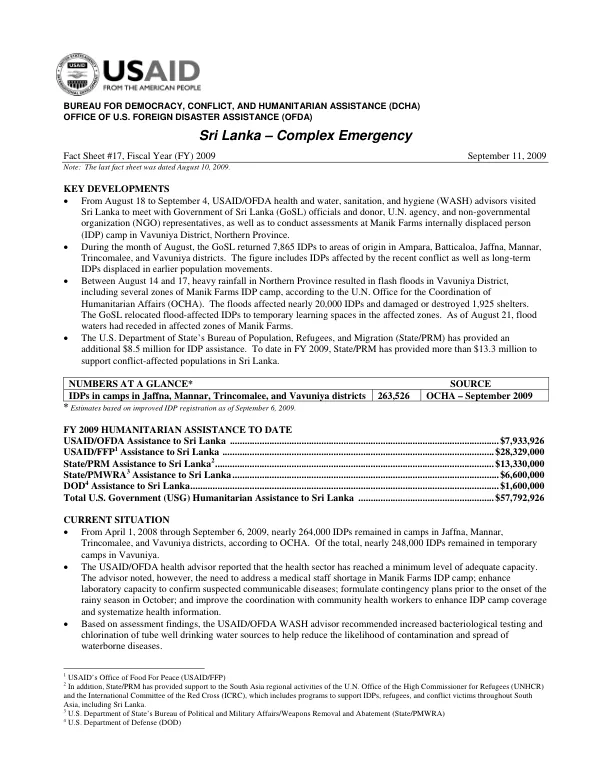
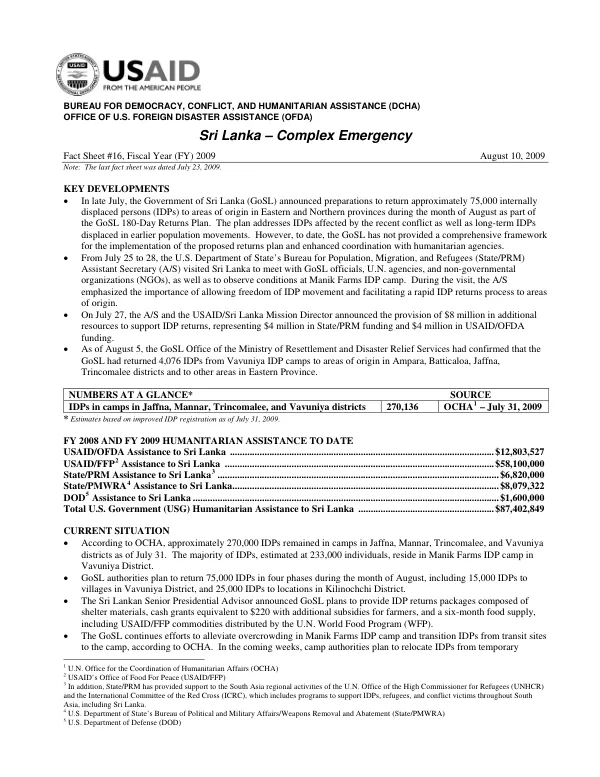
The Government of Sri Lanka (GoSL) announced preparations to return approximately 75,000 internally displaced persons (IDPs) to areas of origin in Eastern and Northern provinces during the month of August as part of the GoSL 180-Day Returns Plan.
2009 · 5 pages
Sign in to readA free account is required to download.
Abstract
The plan addresses IDPs affected by the recent conflict as well as long-term IDPs displaced in earlier population movements. However, to date, the GoSL has not provided a comprehensive framework for the implementation of the proposed returns plan and enhanced coordination with humanitarian agencies. The U.S. Department of State's Bureau for Population, Migration, and Refugees (State/PRM) Assistant Secretary visited Sri Lanka from July 25 to 28 to meet with GoSL officials, U.N. agencies, and non-governmental organizations (NGOs), as well as to observe conditions at Manik Farms IDP camp. During the visit, the A/S emphasized the importance of allowing freedom of IDP movement and facilitating a rapid IDP returns process to areas of origin. The A/S and the USAID/Sri Lanka Mission Director announced the provision of $8 million in additional resources to support IDP returns, representing $4 million in State/PRM funding and $4 million in USAID/OFDA funding. As of August 5, the GoSL Office of the Ministry of Resettlement and Disaster Relief Services had confirmed that the GoSL had returned 4,076 IDPs from Vavuniya IDP camps to areas of origin in Ampara, Batticaloa, Jaffna, Trincomalee districts, and to other areas in Eastern Province. Approximately 270,000 IDPs remained in camps in Jaffna, Mannar, Trincomalee, and Vavuniya districts as of July 31, with the majority residing in Manik Farms IDP camp in Vavuniya District. The GoSL continues efforts to alleviate overcrowding in Manik Farms IDP camp and transition IDPs from transit sites to the camp. In the coming weeks, camp authorities plan to relocate IDPs from temporary shelters at schools to three newly-established zones pending completion of water, sanitation, and hygiene (WASH) facilities, and continue shifting IDPs to existing, less crowded zones within Manik Farms. The GoSL has authorized the departure of 5,980 IDPs, including elderly persons, people with learning disabilities, and individuals from other vulnerable groups, from IDP camps to host families and elders' welfare centers. The U.S. Government (USG) has provided significant humanitarian assistance to Sri Lanka in response to the complex emergency. USAID/OFDA has provided nearly $8 million to assist IDPs and returnees, including support for health, logistics, protection, disaster risk reduction, agriculture and food security, economic recovery and market systems, shelter and settlements, humanitarian coordination and information management, and WASH programs. USAID/FFP has provided 38,550 metric tons (MT) of P.L. 480 Title II emergency food assistance, valued at nearly $30 million, to the World Food Program (WFP). State/PRM has provided more than $4.8 million to the International Committee of the Red Cross (ICRC) and the United Nations High Commissioner for Refugees (UNHCR) to support conflict-affected Sri Lankans.
Related documents