INTERNATIONAL ORGANIZATION FOR MIGRATION
Sri Lanka Complex Emergency – January 25, 2010
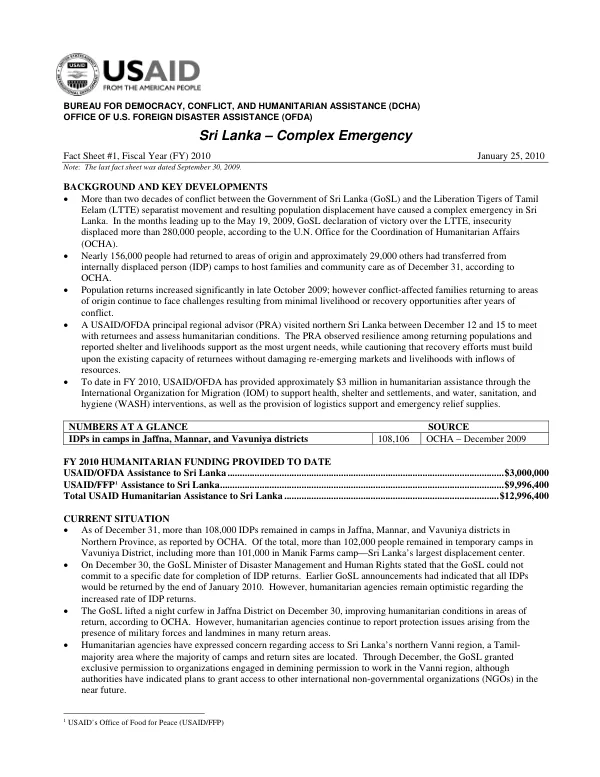
The complex emergency in Sri Lanka has been ongoing for more than two decades due to conflict between the Government of Sri Lanka (GoSL) and the Liberation Tigers of Tamil Eelam (LTTE) separatist movement.
2010 · 3 pages
Sign in to readA free account is required to download.
Abstract
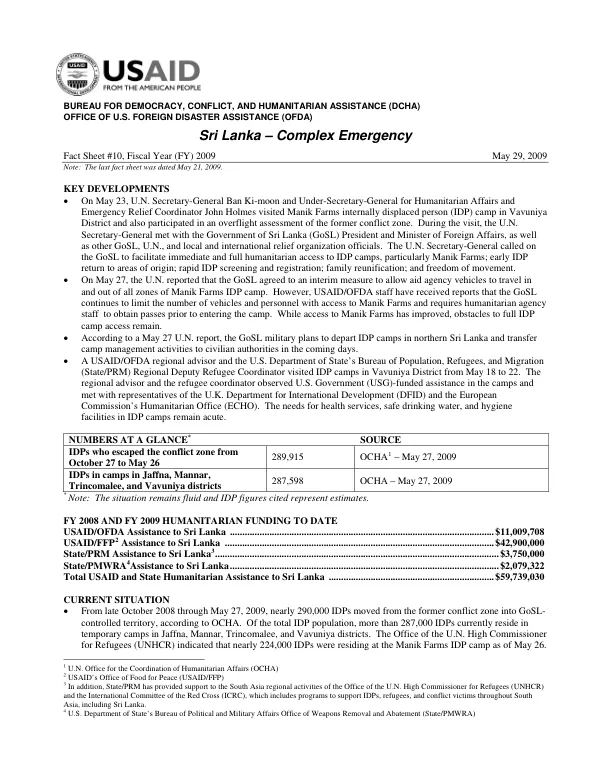
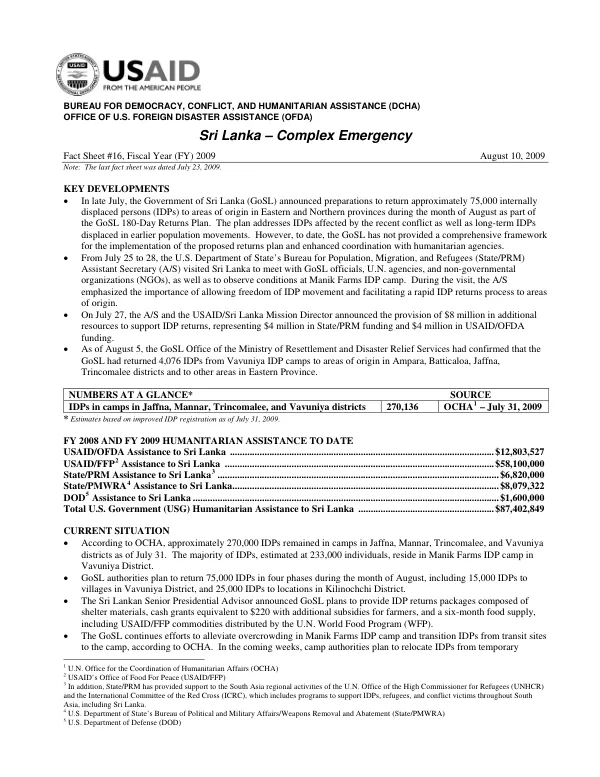
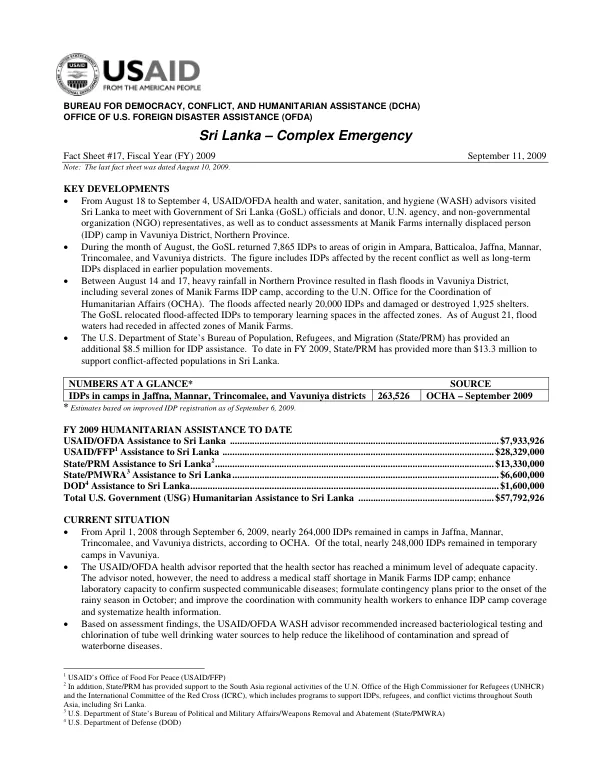
This conflict has resulted in significant population displacement, with more than 280,000 people displaced in the months leading up to the May 19, 2009, GoSL declaration of victory over the LTTE. As of December 31, 2009, nearly 156,000 people had returned to areas of origin, and approximately 29,000 others had transferred from internally displaced person (IDP) camps to host families and community care. Population returns increased significantly in late October 2009, but conflict-affected families returning to areas of origin continue to face challenges resulting from minimal livelihood or recovery opportunities after years of conflict. A USAID/OFDA principal regional advisor (PRA) visited northern Sri Lanka between December 12 and 15 to meet with returnees and assess humanitarian conditions. The PRA observed resilience among returning populations and reported shelter and livelihoods support as the most urgent needs, while cautioning that recovery efforts must build upon the existing capacity of returnees without damaging re-emerging markets and livelihoods with inflows of resources. To date in FY 2010, USAID/OFDA has provided approximately $3 million in humanitarian assistance through the International Organization for Migration (IOM) to support health, shelter and settlements, and water, sanitation, and hygiene (WASH) interventions, as well as the provision of logistics support and emergency relief supplies. As of December 31, more than 108,000 IDPs remained in camps in Jaffna, Mannar, and Vavuniya districts in Northern Province, with more than 102,000 people remaining in temporary camps in Vavuniya District. The GoSL has lifted a night curfew in Jaffna District, improving humanitarian conditions in areas of return, but humanitarian agencies continue to report protection issues arising from the presence of military forces and landmines in many return areas. Humanitarian agencies have expressed concern regarding access to Sri Lanka's northern Vanni region, a Tamil-majority area where the majority of camps and return sites are located. The GoSL has granted exclusive permission to organizations engaged in demining to work in the Vanni region, although authorities have indicated plans to grant access to other international non-governmental organizations (NGOs) in the near future. The influx of returnees is reviving markets in return areas, where co-operative shops sell inventory acquired at GoSL-supported concessionary prices to help avert inflation. The recovery process may also assist in creating income opportunities for returnees. The World Bank has approved a $65 million Sri Lanka Emergency Northern Recovery Project, which will provide varied assistance to IDPs, including achieving economic security through the rehabilitation of livelihood assets, as well as restoring and improving public infrastructure. An outbreak of dengue fever in Vavuniya District that began in September remained ongoing as of late December, with 547 new dengue fever cases reported in December out of a total of 876 cases in 2009. The governor of Northern Province has appointed a taskforce to implement and supervise dengue fever control measures, and humanitarian agencies have expressed concern regarding access to Sri Lanka's northern Vanni region, a Tamil-majority area where the majority of camps and return sites are located. The GoSL and UNHCR have established a shelter grant of approximately $220 per returnee family to assist shelter construction, but returnees interviewed by the USAID/OFDA PRA reported that many families used the grant to meet immediate needs, including the purchase of clothing and vegetables to supplement food rations, rather than to acquire shelter materials. IOM and the U.N. Office for Project Services (UNOPS) currently provide transitional shelter to vulnerable populations within the returnee community, and with USAID/OFDA support, IOM plans to provide transitional shelters to 1,500 returnee families and to train returnees, local authorities, and host communities in shelter reconstruction skills during the next six months. To date in FY 2010, USAID/OFDA has committed $3 million in humanitarian assistance through IOM to support health, shelter and settlements, and WASH interventions, as well as the provision of logistics support and emergency relief supplies. In FY 2010 to date, USAID/FFP has provided 11,890 metric tons (MT) of emergency food assistance, valued at nearly $10 million.