USAID DEC
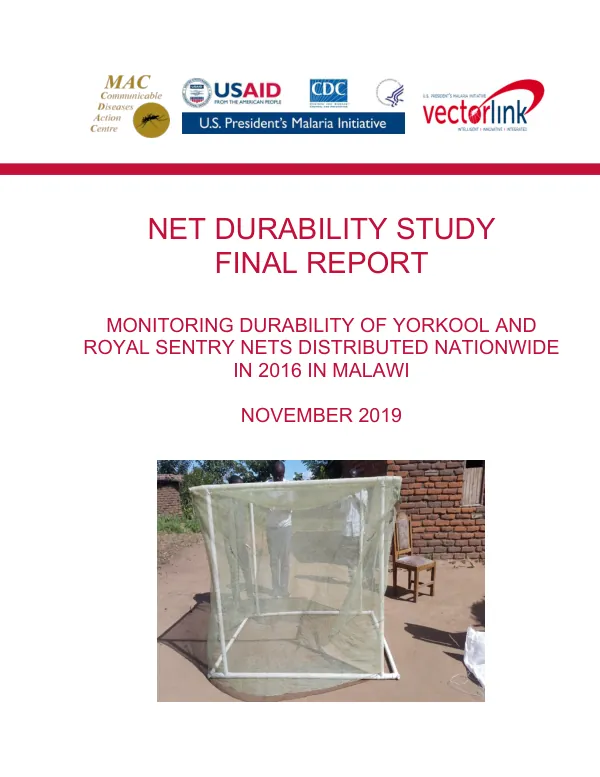
Net Durability Study Final Report: Monitoring Durability of Yorkool and Royal Sentry Nets Distributed Nationwide in 2016 in Malawi
Sign inABT ASSOCIATES
Net Durability Study Final Report: Monitoring Durability of Yorkool and Royal Sentry Nets Distributed Nationwide in 2016 in Malawi
The President's Malaria Initiative VectorLink Project conducted a nationwide study in Malawi to monitor the durability of Yorkool and Royal Sentry nets distributed in 2016.
2019 · 39 pages
Sign in to readA free account is required to download.
Abstract
The study aimed to assess the effectiveness of these long-lasting insecticide-treated nets (LLINs) in reducing malaria transmission. The study was conducted in two districts, Mangochi and Kasungu, and involved the District Health Management teams, the National Malaria Control Program, and the U.S. Peace Corps. The Centers for Disease Control and Prevention provided technical assistance to the project. The study was subcontracted under the PMI VectorLink Project, Contract: AID-OAA-I-17-00008 and Task Order: AID-OAA-TO-17-00027. The study design involved pre-shipment testing of the nets, field work to collect data on net use and ownership, and analysis of the data to determine the determinants of durability. The study also assessed the insecticidal effectiveness of the campaign nets. The sample size for the study was not specified, but it included a representative sample of households in the two districts. The study found that the nets were used by a significant proportion of households, with 85% of households reporting the use of LLINs. However, the study also found that the nets were not used consistently, with 30% of households reporting that they did not use the nets every night. The study also found that the nets were not used by all members of the household, with 20% of households reporting that some members did not use the nets. The study found that the durability of the nets was affected by several factors, including the type of net, the frequency of use, and the storage conditions. The study found that the Royal Sentry nets were more durable than the Yorkool nets, with a median lifespan of 36 months compared to 24 months. The study also found that the nets that were used consistently and stored properly were more durable than those that were not. The study concluded that the LLINs distributed in 2016 were effective in reducing malaria transmission, but that their durability was affected by several factors. The study recommended that the National Malaria Control Program should implement strategies to improve the durability of the nets, including providing education and training to households on the proper use and storage of the nets. The study also recommended that the program should consider replacing the Yorkool nets with more durable alternatives.
Related documents