USAID DEC
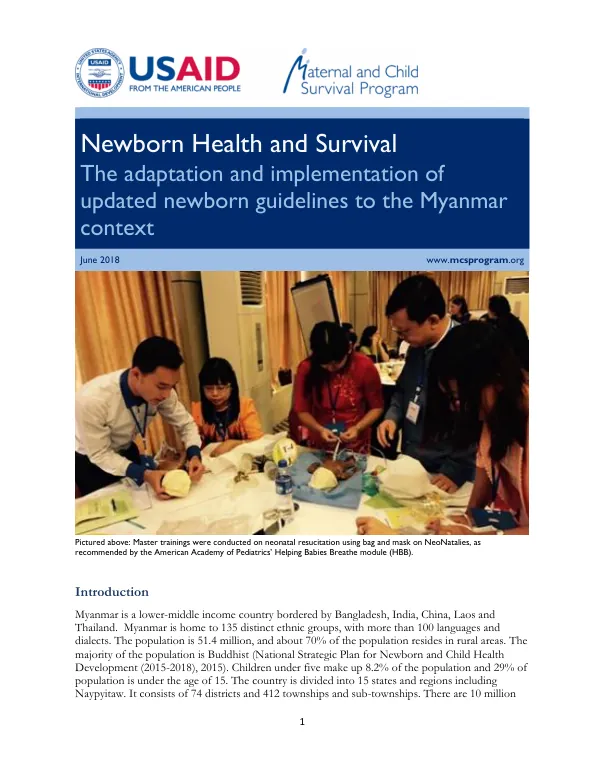
Newborn Health and Survival: The adaptation and implementation of updated newborn guidelines to the Myanmar context
Sign inUSAID DEC
Newborn Health and Survival: The adaptation and implementation of updated newborn guidelines to the Myanmar context
The Myanmar government has implemented various initiatives to improve newborn health and survival in the country.
2018 · 19 pages
Sign in to readA free account is required to download.
Abstract
The Ministry of Health and Sports (MOHS) has been working to strengthen the health workforce in life-saving practices through the roll out of updated Integrated Management of Neonatal and Child Illness (IMNCI) and Family Integrated Newborn and Child Care (F-IMNCI) trainings. These trainings are based on competency-based guidelines for newborn health and survival. The Myanmar government has set a goal to reduce the neonatal mortality rate to 12 per 1,000 live births by 2030, in line with the Sustainable Development Goals (SDGs). To achieve this goal, the MOHS aims to strengthen the enabling environment for the implementation of updated newborn guidelines. The government has also identified the need to improve the quality of care for newborns, particularly in rural areas where access to healthcare services is limited. According to the Myanmar Demographic and Health Survey 2015-2016, the country has made significant progress in reducing under-five mortality rate and infant mortality rate. However, the neonatal mortality rate has not shown a significant reduction over the past 15 years. The survey also found that the majority of newborn deaths are preventable and treatable, with causes such as prematurity/low birth weight, birth asphyxia, neonatal jaundice, and neonatal sepsis accounting for 89% of all newborn deaths. The MOHS has implemented various interventions to improve newborn health and survival, including the provision of antenatal care, institutional delivery, and postnatal care. However, the coverage of these interventions is not universal, with rates ranging from 36% to 94% depending on the intervention and the location. The government has also identified the need to improve the quality of care for newborns, particularly in rural areas where access to healthcare services is limited. The Myanmar health system is divided into three main levels: national, state or regional level, and township level. The Department of Medical Service focuses on care at tertiary and secondary levels, while the Department of Public Health is concerned with care at primary levels. The health system also includes three main levels of care providers: medical doctors, public health personnel, and midwives. The Myanmar government has also implemented various initiatives to improve the quality of care for newborns, including the provision of training and support for healthcare providers. The government has also established a system for monitoring and evaluating the quality of care, including the use of indicators such as antenatal care, institutional delivery, and postnatal care. The Myanmar government has set a goal to reduce the neonatal mortality rate to 12 per 1,000 live births by 2030, in line with the SDGs. To achieve this goal, the MOHS aims to strengthen the enabling environment for the implementation of updated newborn guidelines and improve the quality of care for newborns. The government has also identified the need to improve the coverage of essential interventions for newborns, including antenatal care, institutional delivery, and postnatal care. The Myanmar health system is facing various challenges in providing quality care for newborns, including limited access to healthcare services in rural areas. The government has implemented various initiatives to address these challenges, including the provision of training and support for healthcare providers and the establishment of a system for monitoring and evaluating the quality of care. The Myanmar government has also implemented various initiatives to improve the coverage of essential interventions for newborns, including antenatal care, institutional delivery, and postnatal care. The government has also identified the need to improve the quality of care for newborns, particularly in rural areas where access to healthcare services is limited.
Related documents
![Regional Disparities and Determinants of Anemia and Modern Contraceptive Use among Women in Myanmar [FA126]](https://covers.devme.ai/gen/143956.webp)