USAID DEC
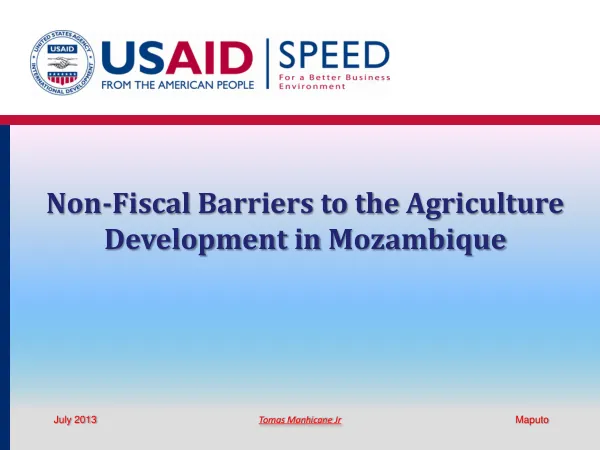
Non Fiscal Barriers to Agriculture Development in Mozambique
Agricultural growth is a government priority in Mozambique due to its significant impact on employment, revenue, and food security.
2013 · 17 pages
Sign in to readA free account is required to download.
Abstract
Approximately 70% of the economically active population is engaged in agriculture, and the sector accounts for 24% of the country's GDP, with a budget of about $12.79 billion. The government has implemented a package of incentives to promote agriculture, including VAT exemption for internal supply of goods and services, exemption from import fees for equipment, and fiscal loans with favorable interest rates. Additionally, the government has reduced the incidence fee on diesel by 50% and lowered tax revenue to investment companies by 20%. Access to land is also relatively low-cost, with a 50-year duration of usufruct agreement. However, the private sector has expressed concerns that the incentives and business environment are not adequate for the development of agriculture in Mozambique. Two studies conducted on the tributary system and the impact of VAT on agriculture have shown the existence of non-fiscal barriers (NFBs) and structural distortions in the agrarian economy. These NFBs have created a low competitiveness of agriculture in Mozambique. The study aims to complement earlier research through an empirical approach, focusing on the operators of the private sector in four provinces and development corridors. The objectives of the study are to identify the main NFBs to the development of the agriculture sector in Mozambique, make consultations and verify preliminary results with private sector partners, NGOs, and government, and make recommendations for the removal of NFBs. The methodology employed in the study includes a retrospective and comparative analysis of nationally and internationally relevant statistics, documentation, and legislation. Interviews were conducted with companies, government institutions, and development agencies working in the production chain value of agriculture. An analytical matrix of NFBs was configured based on the type of problem, economic impact, involvement of policy framework, the group/affected value chain, and recommendations. Validation workshops were held based on the analytical matrix, and a final report was drafted. The study identified several NFBs, including the increase in transaction costs and time due to the deterioration of retained commodities for lack of documentation or transit permit for goods. The study recommends revising and repealing legal decrees, clarifying the application of guidelines, and decentralizing the incentive system at provincial and district directorates' level to allow access to companies. Other NFBs identified include the proliferation of control posts, which constrains trade and makes products more expensive, and the high costs of installing a diesel tank at production locations. The study also highlights the low investment rate, which creates a chain effect in competitiveness, productivity, and production, and the inexistence of a campaign insurance.
Related documents