USAID
Scaling Off-Grid Energy's Grantees: A Look at d.light and Fenix International
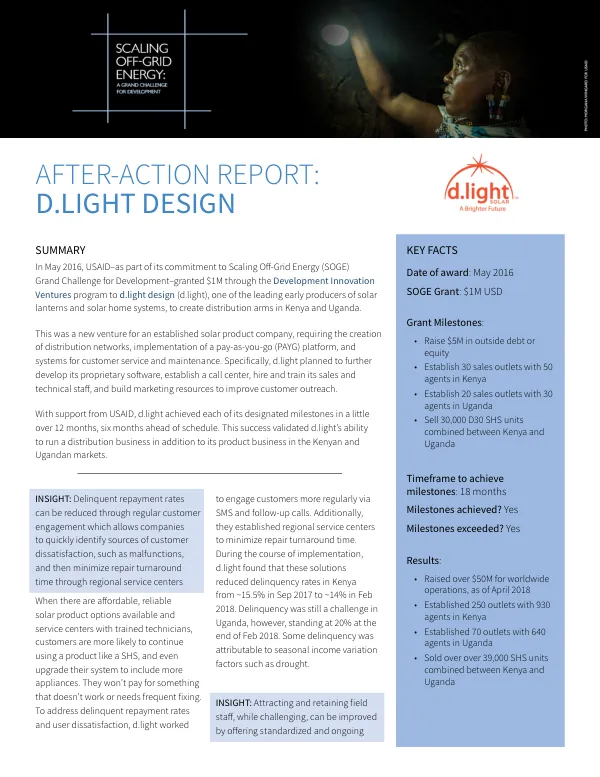
Scaling Off-Grid Energy's Grantees In May 2016, USAID granted $1 million to d.light, a leading producer of solar lanterns and home systems, to create distribution arms in Kenya and Uganda.
2024 · 12 pages
Sign in to readA free account is required to download.
Abstract
This new venture required the establishment of sales networks, implementation of a pay-as-you-go (PAYG) platform, and customer service and maintenance services. With USAID's support, d.light achieved its designated milestones in 12 months, six months ahead of schedule, validating its ability to run a distribution business in addition to its product business in the Kenyan and Ugandan markets. The grant's objectives were to raise $5 million in outside debt or equity, establish 30 sales outlets with 50 agents in Kenya, and sell 30,000 D30 home system units combined between Kenya and Uganda. d.light successfully raised over $50 million for worldwide operations, established 250 outlets with 930 agents in Kenya, and sold over 39,000 home system units combined between Kenya and Uganda. Regular customer engagement and regular communication through SMS and follow-up calls helped reduce delinquency rates in Kenya from 15.5% in September 2017 to 14% in February 2018. However, delinquency rates in Uganda remained a challenge, standing at 20% at the end of February 2018. Some delinquency was attributed to factors such as drought. In areas with limited mobile coverage, keypad-based solar home systems proved to be more affordable than comparable GSM systems, with initial costs being $10 less. Keypad technology also reduced recurring data costs and improved accessibility for customers. Remote activation of a GSM system required stronger network coverage, which was not always available in the Kenyan and Ugandan markets. The project also highlighted the importance of preparing business plans to adjust to changing enabling and regulatory environments, which can limit disruptions along supply chains. Kenya's changing tax regulations and political environment had a significant impact on operating costs, which d.light could not always mitigate. In rural communities, customers' willingness to pay is driven by the level of utility a solar home system can provide and the accessibility of pay-as-you-go technology. This supports sales of larger solar systems, such as those with additional lighting or TVs. d.light tested its PAYG model to see if it would effectively support sales of larger solar systems, and the results showed that customers are willing to pay for higher-quality systems that provide more utility. In September 2016, USAID granted $750,000 to Fenix International to expand its operations into Zambia. At the time, Fenix was finalizing its plans to enter the Zambian market, though it had not yet organized a country team nor launched sales. The grant's objectives were to create 8 in-country sales branches, create 8,000 new customer connections, and raise $750,000 in new debt. Fenix successfully achieved its milestones, establishing 25 branches, selling 39,000 units, and raising $6 million in debt. Fenix's ability to successfully do business in multiple markets contributed to its attractiveness to ENGIE, securing its long-term financial stability and allowing for further investment and expansion. Maintaining discipline and adjusting to changing operational realities was critical during delays in operations, which took almost eight months longer than initially planned. Fenix focused on moving forward with critical logistical processes, ensuring that the business was not further impacted by delays. Fenix's success in Zambia was attributed to its ability to secure funding from multiple sources, creating confidence in its long-term financial stability. The company prioritized distribution through MTN and service centers to rapidly establish a nationwide presence, and grew quickly in the remainder of priority districts by setting up its own points of sale in district centers.