AVENIR HEALTH
Oral Pre-Exposure Prophylaxis Modeling Results: Mozambique
Oral pre-exposure prophylaxis (PrEP) is a preventive measure used by HIV-negative individuals to prevent HIV acquisition.
2018 · 2 pages
Sign in to readA free account is required to download.
Abstract
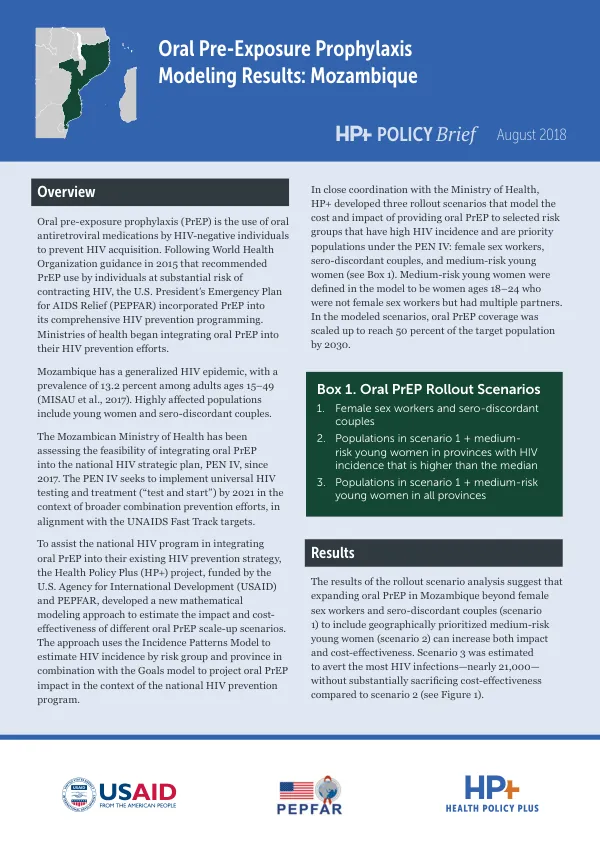
Following World Health Organization guidance in 2015, the U.S. President's Emergency Plan for AIDS Relief (PEPFAR) incorporated PrEP into its comprehensive HIV prevention programming. Ministries of health began integrating oral PrEP into their HIV prevention efforts. Mozambique has a generalized HIV epidemic, with a prevalence of 13.2 percent among adults ages 15-49. Highly affected populations include young women and sero-discordant couples. The Mozambican Ministry of Health has been assessing the feasibility of integrating oral PrEP into the national HIV strategic plan, PEN IV, since 2017. The PEN IV seeks to implement universal HIV testing and treatment by 2021 in the context of broader combination prevention efforts, in alignment with the UNAIDS Fast Track targets. To assist the national HIV program in integrating oral PrEP into their existing HIV prevention strategy, the Health Policy Plus (HP+) project, funded by the U.S. Agency for International Development (USAID) and PEPFAR, developed a new mathematical modeling approach to estimate the impact and cost-effectiveness of different oral PrEP scale-up scenarios. The approach uses the Incidence Patterns Model to estimate HIV incidence by risk group and province in combination with the Goals model to project oral PrEP impact in the context of the national HIV prevention program. The results of the rollout scenario analysis suggest that expanding oral PrEP in Mozambique beyond female sex workers and sero-discordant couples can increase both impact and cost-effectiveness. Providing oral PrEP to medium-risk young women in provinces with HIV incidence higher than the median was nearly as cost-effective as PrEP for sero-discordant couples. Providing oral PrEP to medium-risk young women across the country was projected to have the greatest impact, averting a projected 13,000 HIV infections from 2018 to 2030. These estimates were sensitive to changes in oral PrEP adherence and unit cost differences across risk groups. Oral PrEP is an important component of combination HIV prevention programs, given its potential to protect highly vulnerable and underserved populations. The modeling results encouraged Mozambique's Ministry of Health to consider expanding oral PrEP beyond female sex workers and sero-discordant couples to include higher-risk young women, a population not previously prioritized for oral PrEP rollout. The projected cost per HIV infection averted was lowest for sero-discordant couples, at US$22,000, and highest for medium-risk young women, at US$33,000.