USAID
Pacto Hambre Cero: Del Plan a la Acción
The Pacto Hambre Cero is an initiative launched by the Government of Guatemala to reduce chronic malnutrition in children under the age of five.
2013 · 1 pages
Sign in to readA free account is required to download.
Abstract
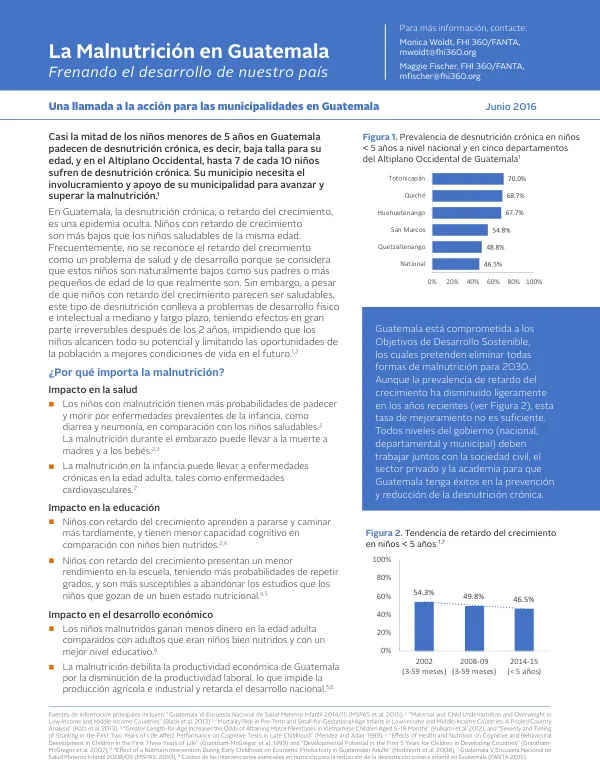
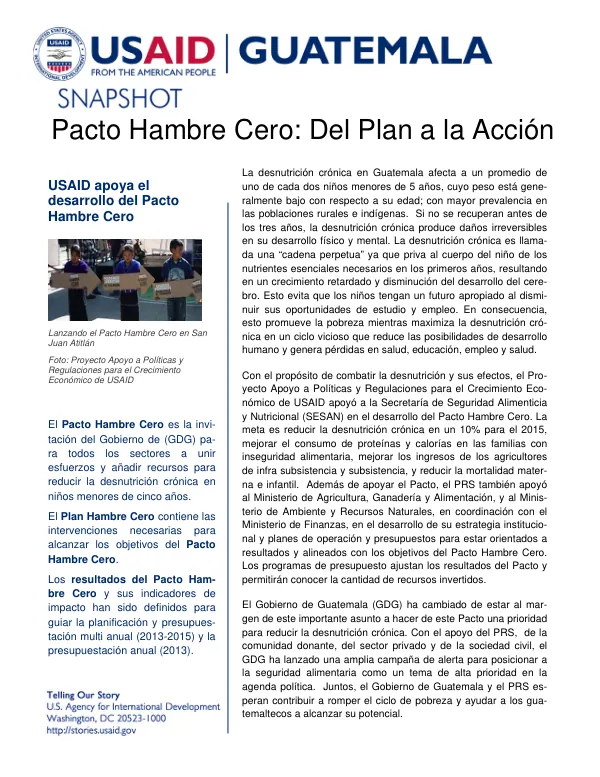
The plan aims to bring together various sectors and add resources to address this issue. The Pacto Hambre Cero is guided by a set of interventions outlined in the Plan Hambre Cero, which is designed to achieve the initiative's objectives. Chronic malnutrition affects approximately half of Guatemala's children under the age of five, with a higher prevalence in rural and indigenous populations. If left untreated, chronic malnutrition can cause irreversible damage to a child's physical and mental development. The condition is often referred to as a "perpetual chain" because it deprives the body of essential nutrients, leading to stunted growth and reduced brain development. This, in turn, limits a child's opportunities for education and employment, perpetuating poverty and increasing the risk of chronic malnutrition in a vicious cycle. The Project for Support to Policies and Regulations for Economic Growth, supported by USAID, collaborated with the Secretariat of Food and Nutritional Security (SESAN) to develop the Pacto Hambre Cero. The goal is to reduce chronic malnutrition by 10% by 2015, improve protein and calorie consumption in food-insecure households, increase the income of subsistence farmers, and reduce maternal and infant mortality. Additionally, the project supported the Ministry of Agriculture, Livestock, and Food, and the Ministry of Environment and Natural Resources, in coordination with the Ministry of Finance, to develop their institutional strategy and operational plans aligned with the objectives of the Pacto Hambre Cero. The government of Guatemala has shifted its stance on this critical issue, making the Pacto Hambre Cero a priority to address chronic malnutrition. With the support of the PRS, the donor community, the private sector, and civil society, the government has launched a comprehensive awareness campaign to position food security as a high-priority issue on the political agenda. Together, the government of Guatemala and the PRS aim to break the cycle of poverty and help Guatemalans reach their full potential.
Related documents
Documents in this collection
 2015
2015USAID DEC
Informe: Costeo de Intervenciones de Nutricion en el Primer y Segundo Nivel de Atencion en el Marco del Convenio de Gestion por Resultados entre el Ministerio de Finanzas Publicas y el Ministerio de Salud Publica y Asistencia Social
Open record 2015
2015USAID DEC