USAID DEC
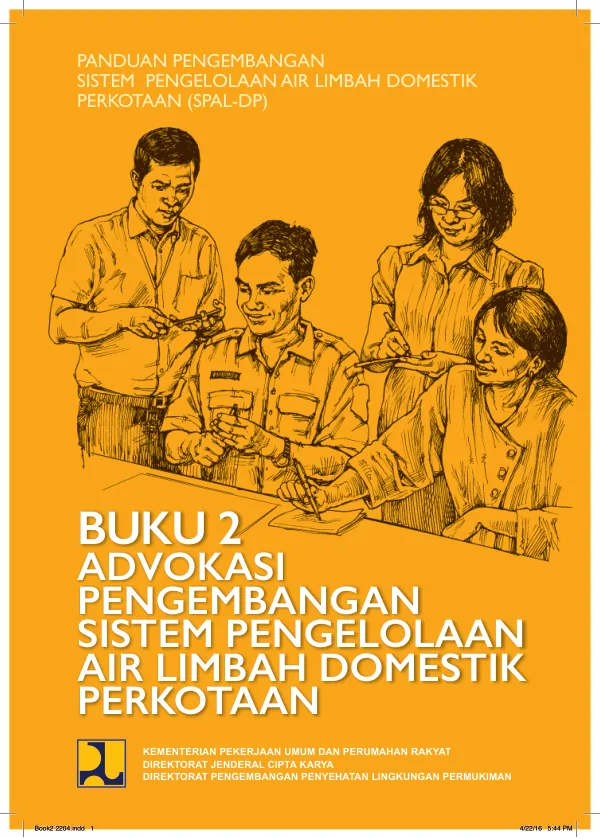
Panduan Pengembangan Sistem Pengelolaan Air Limbah Domestik Perkotaan (SPAL-DP)
The Indonesian government has committed to improving access to domestic wastewater management in urban areas.
2016 · 86 pages
Sign in to readA free account is required to download.
Abstract
This effort aims to enhance the quality of life for citizens and the environment. The Ministry of Public Works and Housing, in collaboration with local governments, has undertaken initiatives to develop infrastructure for domestic wastewater management, including on-site and off-site systems, and the construction of septage treatment plants. The development of domestic wastewater management systems in urban areas is crucial due to the increasing population and density of cities. The government has recognized the need for a framework that integrates various options, such as on-site sanitation and off-site sewer systems, into the city's spatial development plans. This approach will ensure that the level of technology applied is commensurate with the city's growth, impacting the quality of residual effluent. The choice of technology for domestic wastewater management must consider socio-economic conditions and the capacity of target groups to participate. The government needs to balance the affordability of capital expenditures and operational expenditures with the need for effective technologies that produce lower levels of pollution and require less space. The integration of vulnerable and marginalized households into the service chain is also essential to ensure that sanitation services reach all levels of the urban community. In the next 25 years, it is expected that domestic wastewater management in urban Indonesia will be dominated by individual household systems, in addition to the increasing number of centralized sewer systems. No city in Indonesia will solely rely on centralized domestic wastewater management systems, but rather will adopt a range of technical options. To provide effective services for the expansion and growth of urban populations, a comprehensive approach is necessary, integrating planning, design, construction, and operation of these systems. The development of domestic wastewater management systems in urban Indonesia requires a multifaceted approach, considering spatial planning, regulatory and institutional settings, technology options, financing, social and cultural aspects, and services management. The government must make a framework available that integrates various options, such as on-site sanitation and off-site sewer systems, into the city's spatial development plans. This will ensure that the level of technology applied is commensurate with the city's growth, impacting the quality of residual effluent. The choice of technology for domestic wastewater management must be linked to affordability in terms of capital expenditures and operational expenditures by both the government and the communities at large. The government needs to consider socio-economic conditions of the target groups and their capacity to participate in the selection of technologies. The integration of vulnerable and marginalized households into the service chain is also essential to ensure that sanitation services reach all levels of the urban community.