ABT ASSOCIATES
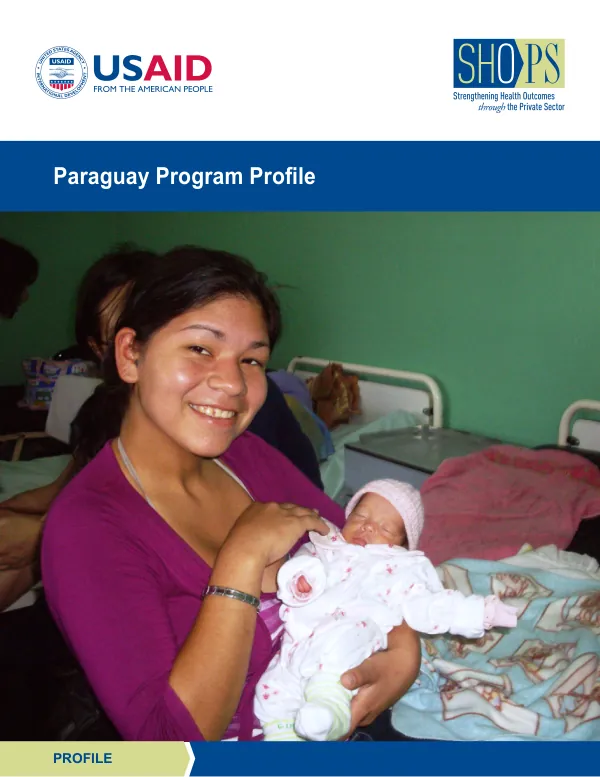
Paraguay Program Profile
The Paraguayan family planning market is characterized by a favorable public-private mix, with the public sector playing a growing role in providing family planning services and products.
2015 · 28 pages
Sign in to readA free account is required to download.
Abstract
The public sector's share of the market increased from 36% in 2004 to 42% in 2008, primarily due to government support and investments from the United States Agency for International Development (USAID). However, the private sector experienced less substantial growth, putting the existing equilibrium between sectors at risk. The private sector assessment conducted by the Strengthening Health Outcomes through the Private Sector (SHOPS) project found that Paraguay still enjoys a favorable public-private mix in the provision of family planning methods, although there has been a shift toward resupply methods and away from long-term methods. Private sector clinical service providers are not emerging as a preferred source of family planning because many Paraguayans are managing their own contraceptive use through direct purchase. However, it is essential to maintain the presence of private providers in the service industry to manage the balance between short-term and long-term methods and encourage the correct use of hormonal contraceptives. The SHOPS project used a total market approach to prepare the main stakeholders of the Paraguayan family planning market for graduation from USAID funding. The project had three main goals: to improve the positioning of the Paraguayan Center for Population Studies (CEPEP) in the health marketplace, to increase the provision of family planning services from the Paraguayan Social Security Institute (IPS), and to assist Paraguay's Contraceptive Security Committee (DAIA) to assume a sustainable leadership role in overseeing the whole family planning marketplace. The program involved training 12 IPS providers as trainers in postpartum IUD insertions and initiating a qualitative study of IPS client perceptions. CEPEP approved a new business strategy based on a SHOPS market analysis, and the project supported a balanced and sustainable family planning method mix in preparation for USAID's graduation in 2012. The SHOPS project also emphasized the importance of market segmentation and targeting, strengthening NGOs, improving family planning and reproductive health service delivery, and increasing dialogue between the sectors. The SHOPS project's lessons learned from the Paraguayan program include the importance of reexamining NGOs' roles in the marketplace and realigning their business models in the face of declining donor funds. The project also highlighted the need to recapture beneficiaries who seek family planning services elsewhere and to maintain the presence of private providers in the service industry to manage the balance between short-term and long-term methods.
Related documents