ABT ASSOCIATES
Sources of Family Planning: Rwanda
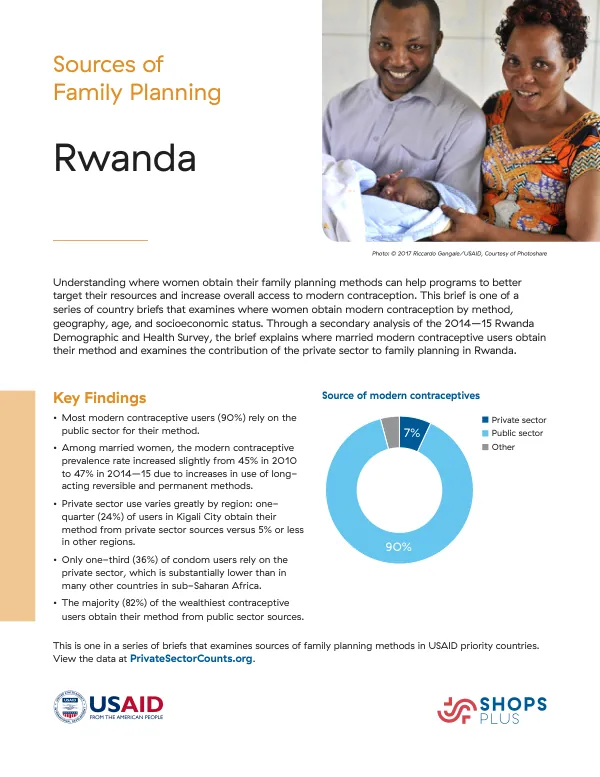
The public sector is the primary source of modern contraceptives for married women in Rwanda, with 90% of users relying on public sector sources.
2019 · 4 pages
Sign in to readA free account is required to download.
Abstract
The Rwandan government's efforts to make family planning accessible through multiple outlets, including the creation of health posts and a robust community health worker program, have contributed to high public sector reliance. Private sector use varies greatly by region, with one-quarter (24%) of users in Kigali City obtaining their method from private sector sources, compared to 5% or less in other regions. Among married women, the modern contraceptive prevalence rate (mCPR) increased slightly from 45% in 2010 to 47% in 2014-15, primarily due to increases in use of long-acting reversible and permanent methods. The leading method in Rwanda is injectables, used by 24% of married women, followed by implants and pills, each used by 8%. Use of short-acting methods has remained stable at 36%, with almost all growth in the mCPR attributable to long-acting reversible contraceptives and permanent methods. The public sector is the primary source of modern contraceptives for all population segments in Rwanda, contrasting with patterns in most other sub-Saharan African countries, where the private sector often plays a more substantial role. The government of Rwanda has voiced intentions to deepen its collaboration with the private sector to provide contraceptive services and has committed to increase demand for contraception, particularly among young couples. To help meet these goals, Rwanda could consider increasing the private sector's role and engagement, including through public-private partnerships and expanded inclusion in decision making at the national, regional, and community levels. In Kigali City, the urban hub of the country, one in four women (24%) obtain their method from a private source, with private sector use ranging from 3% in the north to 5% in the east in the remaining regions. Despite the higher private sector use in Kigali City, the modern contraceptive prevalence rate (mCPR) there is similar to the national average (49%). Contraceptive users in Kigali City are not substantially more likely to rely on methods commonly accessed from private sources, such as condoms. The modern contraceptive prevalence rate (mCPR) is slightly higher among married women in urban (51%) than in rural (47%) areas, with urban users more likely to purchase their method from the private sector (20%) compared with rural users (4%). There are some differences in method mix between urban and rural users, with injectables more common among rural than urban users and LARCs and PMs more popular among urban than rural users. The modern contraceptive prevalence rate (mCPR) is similar across age groups, with 48% of contraceptive users ages 25 and older and 43% of those younger than 25 using modern contraception. Contraceptive sources are similar for married women across age groups, with the public sector being the primary source of modern contraceptives for all age groups.
Related documents