USAID DEC
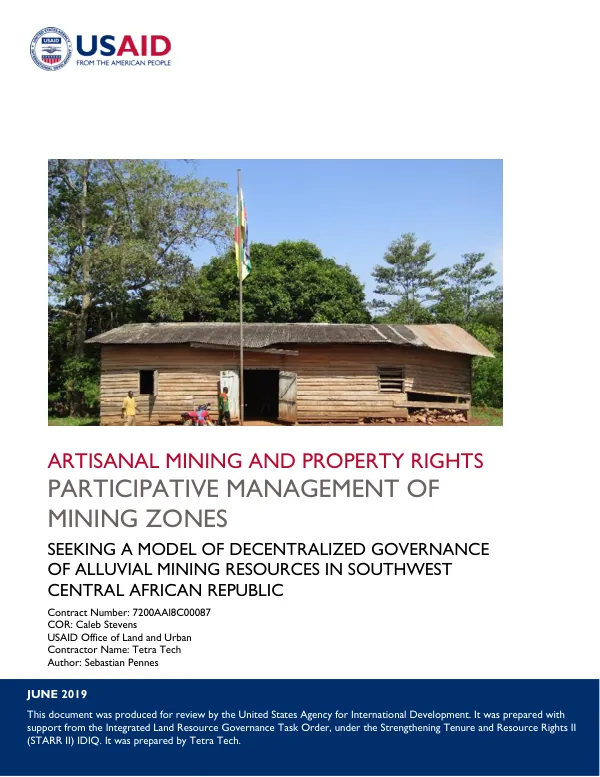
Participative Management of Mining Zones: Seeking a model of decentralized governance of alluvial mining resources in Southwest Central African Republic
Sign inTETRA TECH
Participative Management of Mining Zones: Seeking a model of decentralized governance of alluvial mining resources in Southwest Central African Republic
The artisanal mining and property rights project in the Central African Republic aims to improve land and resource governance and strengthen property rights for all members of society, particularly women.
2019 · 33 pages
Sign in to readA free account is required to download.
Abstract
The project is structured around four objectives: assisting the government to improve compliance with Kimberley Process requirements, strengthening community resilience and social cohesion, increasing awareness of responsible gold supply chains, and improving USAID programming. The project's component 1, AMPR Activity 1.2.3, focuses on piloting a system for taxing diamond revenues for community development. This activity is based on the successful "SODEMI Model" from Cote d'Ivoire, where communities organized as cooperatives participate in mine site monitoring in exchange for a percentage of revenue for community-led infrastructure projects. The study aims to analyze how local features of southwestern Central African mining communities might respond to the core components of the "SODEMI" model from a socio-cultural and economic perspective. The "SODEMI" model involves several key components, including community organization, mine site monitoring, and revenue sharing. The model has been successful in Cote d'Ivoire, but its applicability to the Central African Republic is uncertain due to differences in socio-economic contexts. The study aims to provide insights into the potential effectiveness of the "SODEMI" model in the Central African Republic and to identify any necessary adaptations. The study focuses on a few preselected southwestern Central African mining communities, gathering field information to analyze how local features might respond to the core components of the "SODEMI" model. The study's aim is not to design a model of local governance to reform the Central African legislation, but to propose a practical and programmatic approach to improving land and resource governance in the artisanal and small-scale mining sector. The study's findings are expected to provide valuable insights into the potential effectiveness of the "SODEMI" model in the Central African Republic and to inform the development of a decentralized governance system for alluvial mining resources. The study's results will also contribute to the improvement of USAID programming and the strengthening of community resilience and social cohesion in the Central African Republic. The study's methodology involves a combination of field research and analysis of existing data. The field research will involve gathering information from local communities, mine sites, and government agencies to understand the current state of land and resource governance in the artisanal and small-scale mining sector. The analysis of existing data will involve reviewing relevant literature and reports to identify best practices and lessons learned from similar projects. The study's expected outcomes include the development of a decentralized governance system for alluvial mining resources, improved land and resource governance, and strengthened property rights for all members of society, particularly women. The study's results will also contribute to the improvement of USAID programming and the strengthening of community resilience and social cohesion in the Central African Republic. The study's findings will be presented in a report that will provide a detailed analysis of the potential effectiveness of the "SODEMI" model in the Central African Republic. The report will also provide recommendations for the development of a decentralized governance system for alluvial mining resources and for the improvement of land and resource governance in the artisanal and small-scale mining sector.