USAID DEC
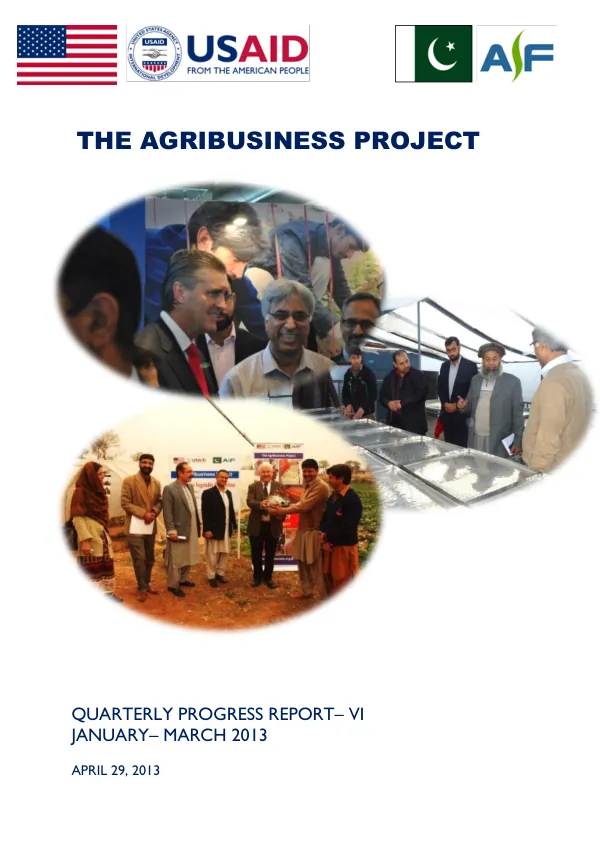
Quarterly Progress Report– VI (January– March 2013)
The Agribusiness Project, funded by USAID Pakistan, aims to increase the competitiveness and productivity of horticulture and livestock sub-sectors in Pakistan.
2013 · 36 pages
Sign in to readA free account is required to download.
Abstract
The project, implemented by the Agribusiness Support Fund (ASF) in collaboration with international and national partner organizations, commenced on November 10, 2011, and is scheduled to run for five years. The overall goal of the project is to support improved conditions for broad-based economic growth, create employment opportunities, and contribute to poverty alleviation through the increase in competitiveness of horticulture and livestock value chains in partnership with all stakeholders. The project was designed to address priority problems and constraints impeding the development of the agriculture sector in Pakistan. Interventions under the project focus on improving and strengthening off-farm and on-farm services, including business development services, market access, and value chain development. The project also aims to enhance the capacity of farmers, farmer enterprise groups, and other stakeholders to improve their productivity and competitiveness. During the reporting period from January 1 to March 31, 2013, the project achieved significant milestones. A total of 2,487 direct jobs were created as a result of the implementation of project activities, including the establishment of tunnel farms, pomegranate orchards, supply and installation of milk chillers, and rearing of goats provided by the project. Additionally, 10,234 rural households benefited directly from project interventions, making a total of 12,007 rural households benefited till the end of the reporting quarter. The project also leveraged new private sector investment of USD 432,700 for agribusiness, including tunnel farming, pomegranate orchards, milk chillers, and rearing of goats. The female beneficiaries accounted for 41% of the total project beneficiaries in the reporting quarter. The project's Environmental Assessment was conducted and the Environmental Assessment report was submitted to USAID for approval. A total of 996 EDFs (855 during the reporting quarter) for various grant activities were developed and got approved from USAID. The project conducted Rapid Market Assessments of all Value Chains in project regions, and the findings of these RMAs are being used to organize FEGs in line with the market dynamics. Four studies were conducted, including cold chain assessment, dairy value chain assessment, apricot value chain assessment, and chilli value chain assessment. Through partner organizations, the project formed 507 FEGs (organizing 6,078 small farmers) within targeted value chains, making a total of 575 FEGs formed since the project inception. In addition, 63 newly formed FEG members were provided with matching grant support, i.e., 58 FEGs for Tunnel Farming, and 5 FEGs for pomegranate orchards. The project supported six companies (fruits and vegetables) regarding their participation in Fruit Logistica 2013 (Berlin, Germany, February 6-8, 2013) for the promotion of Pakistani horticulture products. Another eleven companies were supported to participate in AgraME 2013 (Dubai, UAE, March 26-28, 2013) facilitating an exposition of horticulture and livestock products, technology, and inputs. Value Chain Platforms for Banana and Chilli were established, and one meeting each of VCPs on chilli & Banana was held. The second meeting of the Executive Steering Committee of the National Agribusiness Forum (NAbF) was held at Lahore. The capacity need assessment and strategic workshops were organized in Peshawar and D.I.Khan project regions and attended by 80 and 41 members respectively to deliberate on the development of long-term institutional strengthening plans for Farms Services Centers, Agriculture and Livestock Extension Services of FATA. Developed and initiated procurement processes for grant products, including Animal Feed Mill, Improvised Reefers, Aero Tubes, Apricot Commercial Orchards, Grape Orchards, Portable Milking Machine, Tunnel Farming for HV/OSV, Dairy Processing, and Integrated Livestock Production, Dhakki dates orchards, and Grape Orchards for FEG. Provision of 33 milk chillers (500 liters capacity) and in-kind support to Pomegranate FEGs was undertaken.
Related documents