USAID DEC
Participatory survey of youth in Niger and analysis of the effectiveness of policies in support of youth and their employment
Sign inUNICEF
Participatory survey of youth in Niger and analysis of the effectiveness of policies in support of youth and their employment
Niger is a vast country with an area of 1,267,000 square kilometers located in the Sahel region, with a population estimated at 21.48 million inhabitants in 2018.
2019 · 94 pages
Sign in to readA free account is required to download.
Abstract
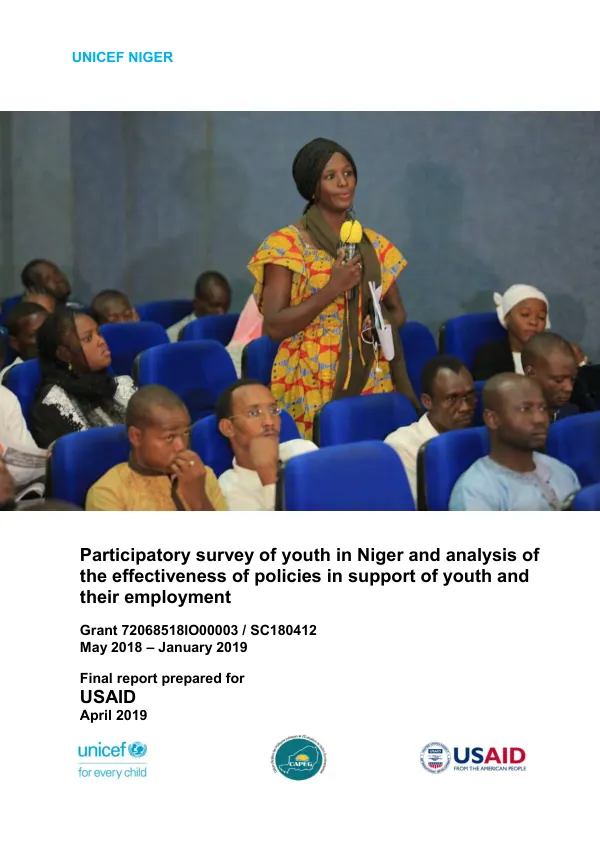
The country has the most youthful population in the world, with 80% of the population living in rural areas. Approximately 58% of the population are under the age of 18, and 31.6% are aged 15 to 35 years. Every year, around 500,000 young people enter the labor market. Niger's economy is primarily driven by the primary sector, which accounts for more than 8 out of 10 Nigeriens. Despite this, the country faces significant challenges, including high levels of poverty, both monetary and multidimensional. In 2014, 44% of the population was living in poverty, and 2/3 of children under the age of five were deprived of at least three essential rights. The north of the country is a desert, while the southern region is subject to cyclical rainfall, making agriculture and livestock vulnerable to weather conditions. The country's agricultural sector is not modernized, leading to food insecurity. Niger has diverse natural resources, including mining, but many remain unexploited. The country has one of the lowest fiscal bases in the West African Economic and Monetary Union (WAEMU) region, with a fiscal base of 17% of GDP. The government's heavy reliance on revenues from the natural resource sector makes it vulnerable to commodity price shocks. As a result, economic growth in Niger has experienced significant fluctuations due to its dependence on agriculture and lack of a diversified economy. The country's per capita GDP is relatively low, with a significant gap between the rich and the poor. The "Participatory survey of youth in Niger and analysis of the effectiveness of policies in support of youth and their employment" project was implemented from May 2018 to January 2019, with a grant from USAID. The project aimed to contribute to the improvement of the effectiveness of policies supporting youth in Niger, increasing their participation in the economic, social, and sustainable development of the country. The project was implemented in partnership with the Public Policy Analysis and Government Action Evaluation Unit (CAPEG) of the Prime Minister's Office, USAID, and UNICEF. The project involved a participatory survey of youth in Niger, which was conducted in three sequential phases. The survey was designed to give a voice to young people in Niger and capture their perceptions about their aspirations and the constraints they face in fulfilling them. The research team held consultations with different youth groups, representatives of local authorities, civil society, and other stakeholders between February and May 2018. The survey engaged 1,124 people, including 1,036 youth, through 96 focus groups and 89 individual interviews. Regional validation workshops were held in the eight regions of Niger between September and October 2018, with a total of 440 participants, including 72% youth. The workshops allowed young people to discuss their future with each other and propose solutions that would engage themselves, the community, and the government. A national youth forum was held in Niamey in December 2018, which validated the key messages of the study, proposed recommendations and actions, and identified responsibilities at the national and regional levels to implement the roadmap. The participatory youth assessment contributed to giving a voice to young people as key actors, allowing them to express their perceptions about themselves, their aspirations, the effects of their environment on their aspirations, the constraints they face, and their perceptions of government policies. The findings and recommendations were disseminated through various channels, including a film screened on national television in December 2018 and a governmental workshop underway in Somdo in April 2019. The project's findings and recommendations encourage a change of perceptions of policy makers and all stakeholders involved on young people in Niger, proposing a new way of thinking, engaging with, and rethinking public policies in favor of young people. The project's outcomes will contribute to the implementation of the roadmap, which was handed to the Head of Government by young people themselves on December 1, 2018.