USAID DEC
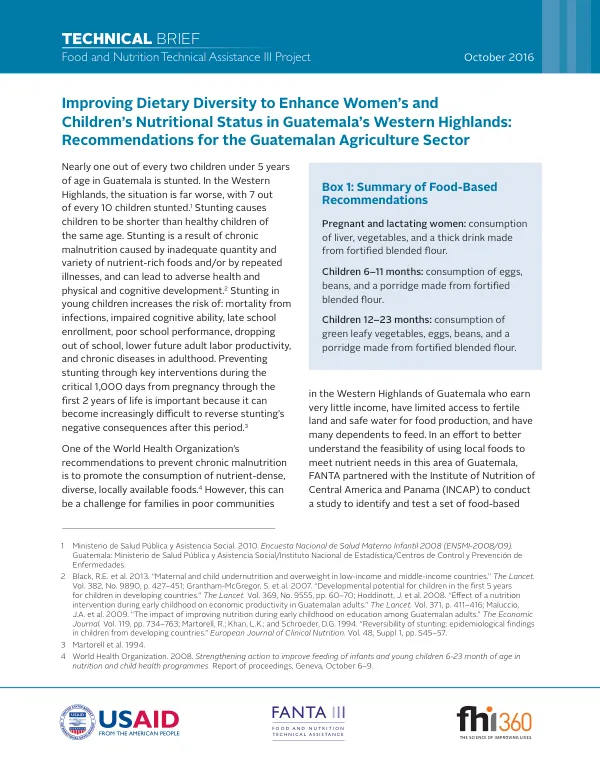
Improving Dietary Diversity to Enhance Women's and Children's Nutritional Status in Guatemala's Western Highlands: Recommendations for the Guatemalan Agriculture Sector
Sign inFANTA
Improving Dietary Diversity to Enhance Women's and Children's Nutritional Status in Guatemala's Western Highlands: Recommendations for the Guatemalan Agriculture Sector
The agricultural sector in Guatemala's Western Highlands plays a crucial role in improving the nutritional status of women and children.
2016 · 4 pages
Sign in to readA free account is required to download.
Abstract
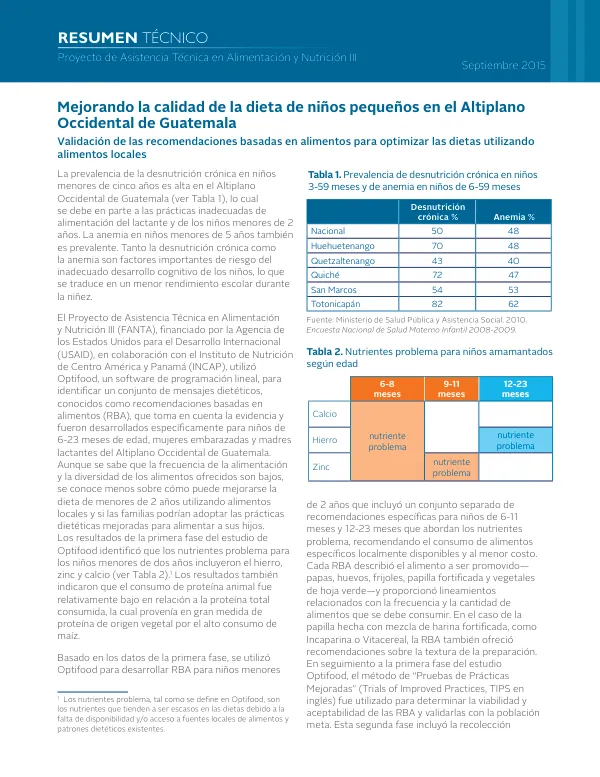
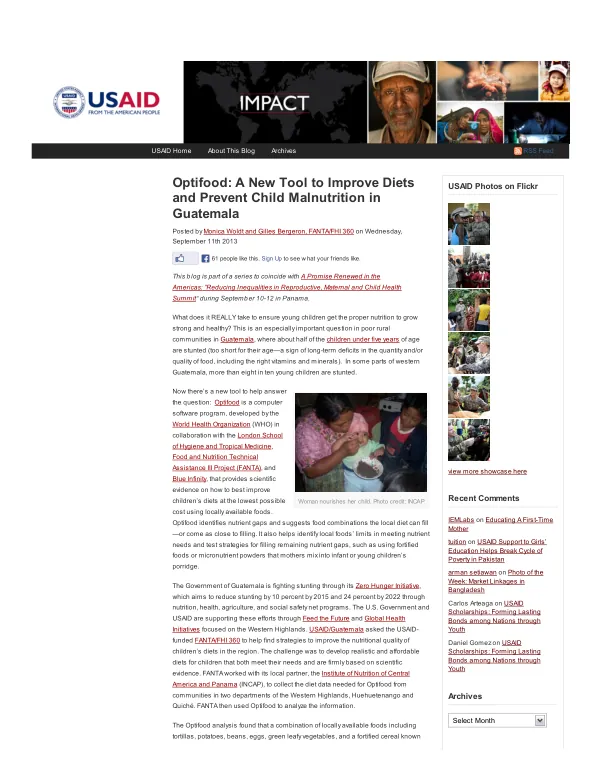
Stunting affects nearly one out of every two children under 5 years of age in Guatemala, with 7 out of every 10 children in the Western Highlands being stunted. Stunting is a result of chronic malnutrition caused by inadequate quantity and variety of nutrient-rich foods and/or repeated illnesses. It can lead to adverse health and physical and cognitive development, increasing the risk of mortality from infections, impaired cognitive ability, and chronic diseases in adulthood. The World Health Organization recommends promoting the consumption of nutrient-dense, diverse, locally available foods to prevent chronic malnutrition. However, families in poor communities in the Western Highlands face significant challenges in accessing and consuming these foods due to limited income, access to fertile land and safe water for food production, and many dependents to feed. In an effort to better understand the feasibility of using local foods to meet nutrient needs in this area, FANTA partnered with the Institute of Nutrition of Central America and Panama (INCAP) to conduct a study to identify and test a set of food-based recommendations (FBRs). The FBRs were specifically targeted to fill nutrient gaps among women and young children in the Western Highland departments of Huehuetenango and Quiché. The FBRs included the consumption of liver, vegetables, eggs, black beans, and green leafy vegetables for pregnant and lactating women and children 6-23 months of age. However, the feasibility tests revealed challenges that women experienced when trying to access, prepare, and consume the recommended foods, including lack of economic access, household constraints, lack of production of recommended foods in the home, and cultural barriers. The results of the FBR feasibility testing and the challenges that families experienced with putting the FBRs into practice point to a number of actions that the agricultural sector in Guatemala can take to improve the nutritional status of women and children. Key actions include improving production of FBR foods, improving access to markets, promoting improved storage of FBR foods, and promoting consumption of FBR foods. These actions can be achieved through various agricultural sector activities, such as increasing focus on production of and production support for FBR foods, improving agricultural sector staff knowledge on the importance of FBR foods, and providing technical assistance for raising laying hens. Improving production of FBR foods can be achieved by increasing focus on production of and production support for FBR foods that can make a real difference in addressing nutrition gaps at the household and community level. These include eggs, black beans, vegetables, and green leafy vegetables. Improving agricultural sector staff knowledge on the importance of FBR foods can be achieved through training and capacity building programs. Providing technical assistance for raising laying hens can help decrease hen mortality and improve access to nutrient-dense foods. Improving access to markets can be achieved by supporting establishment of low-cost, local markets or access to mobile vendors/butchers or community stores to reduce the transportation cost and time it takes for families to purchase FBR foods. Promoting improved storage of FBR foods can be achieved by identifying low-cost, appropriate technologies to improve storage of perishable foods and training community members in their use to decrease spoilage of high-nutrient foods. Promoting consumption of FBR foods can be achieved by promoting home or commercial processing of FBR foods, targeting social and behavior change strategies to key family decision makers, and promoting consumption of nutrient-rich dark green leafy native plants. These actions can help fill nutrient gaps for women, especially pregnant and lactating women and young children, and improve their nutritional status.