USAID DEC
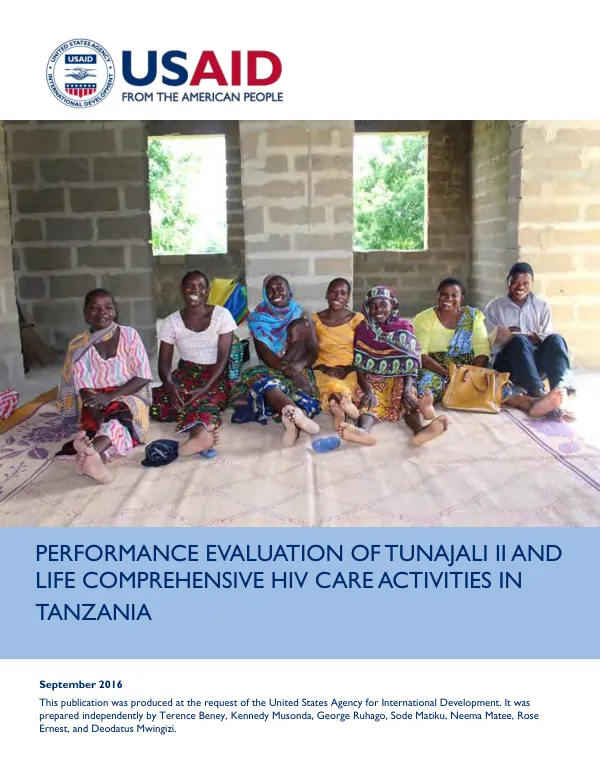
Performance Evaluation of TUNAJALI II and LIFE Comprehensive HIV Care Activities in Tanzania
Sign inDELOITTE INC.
Performance Evaluation of TUNAJALI II and LIFE Comprehensive HIV Care Activities in Tanzania
The TUNAJALI II and LIFE Comprehensive HIV Care Activities in Tanzania were implemented to address the country's HIV/AIDS epidemic.
2016 · 145 pages
Sign in to readA free account is required to download.
Abstract
The initiative began in 2014 and was supported by the United States Agency for International Development (USAID) under the President's Emergency Plan for AIDS Relief (PEPFAR). The program aimed to improve access to HIV care and treatment services, particularly for pregnant women and children. The evaluation of TUNAJALI II and LIFE Comprehensive HIV Care Activities in Tanzania was conducted in 2016 to assess the program's performance and effectiveness. The evaluation team used a mixed-methods approach, combining both quantitative and qualitative data collection and analysis methods. The team collected data from various sources, including interviews with program staff, community leaders, and patients, as well as review of program documents and records. The evaluation found that TUNAJALI II and LIFE Comprehensive HIV Care Activities in Tanzania made significant progress in improving access to HIV care and treatment services. The program increased the proportion of HIV-positive pregnant women enrolled on antiretroviral therapy (ART) from 22% in 2014 to 55% in 2015. Additionally, the program increased the number of adults and children with advanced HIV infection newly enrolled on ART from 1,500 in 2014 to 3,500 in 2015. The evaluation also found that the program's capacity development interventions were effective in strengthening the capacity of healthcare providers to deliver high-quality HIV care and treatment services. The program's support to clinical services, including the provision of ART and other essential medicines, was also effective in improving health outcomes for people living with HIV. However, the evaluation identified several challenges that hindered the program's effectiveness, including inadequate funding, limited access to healthcare services, and inadequate infrastructure. The evaluation recommended that the program should prioritize the strengthening of healthcare systems, including the provision of essential medicines and equipment, and the training of healthcare providers. The evaluation also recommended that the program should focus on improving access to HIV care and treatment services for vulnerable populations, including pregnant women and children. Additionally, the evaluation recommended that the program should prioritize the use of data to inform program decision-making and improve health outcomes. The TUNAJALI II and LIFE Comprehensive HIV Care Activities in Tanzania were implemented in several regions of the country, including Mtwara, Nachingwea, Iringa, Njombe, Morogoro, Sikonge, and Nzega. The program was implemented by a consortium of local and international partners, including the Elizabeth Glaser Pediatric AIDS Foundation and Deloitte. The evaluation of TUNAJALI II and LIFE Comprehensive HIV Care Activities in Tanzania provides valuable insights into the effectiveness of the program and identifies areas for improvement. The evaluation's findings and recommendations can inform future programming and policy decisions aimed at addressing the HIV/AIDS epidemic in Tanzania.
Related documents