ELIZABETH GLASER PEDIATRIC AIDS FOUNDATION
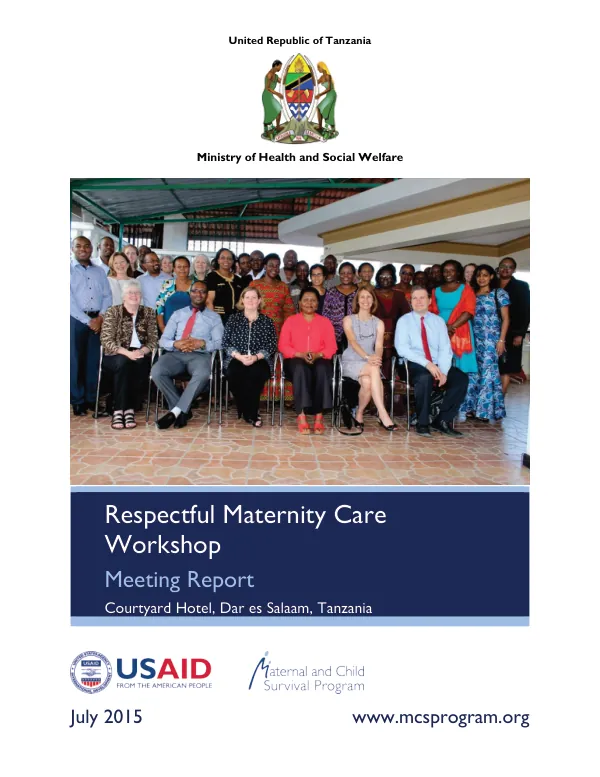
Respectful Maternity Care Workshop Meeting Report
Respectful Maternity Care (RMC) is a critical component of quality maternal and newborn health services in Tanzania.
2015 · 36 pages
Sign in to readA free account is required to download.
Abstract
The Ministry of Health and Social Welfare (MOHSW) has highlighted the need to improve access to quality health services for mothers, newborns, and children. Despite achieving Millennium Development Goal (MDG) 4, the burden of newborn deaths remains high, and prioritizing newborn survival is a priority of the MOHSW. Progress toward MDG 5 has been slower, with the percentage of women who deliver in a facility stagnating at or below 51% for more than 20 years. Respectful maternity care is essential for addressing disrespect and abuse (D&A) during childbirth, which is a significant barrier to increasing facility-based births and a breach of rights-based approaches to care. Even among the 49% of Tanzanian women who deliver in facilities, various forms of D&A, including verbal abuse, neglect, discrimination, non-confidential care, and detention, are prevalent. The Maternal and Child Survival Program/Tanzania (MCSP/TZ) convened a meeting of stakeholders to review the available evidence related to RMC and D&A in Tanzania and the region. The meeting aimed to review outcomes and experiences from existing RMC research and program experience in Tanzania and selected East African countries. Participants also discussed significant contextual variables that influence RMC program effectiveness and built consensus on promising evidence-informed RMC approaches in the context of MCSP/TZ maternal and newborn health (MNH) quality-of-care (QOC) programming. The meeting brought together representatives from the MOHSW, USAID, MCSP, and various non-governmental organizations (NGOs) working in the field of RMC in Tanzania. The MOHSW has emphasized the need to improve access to quality health services for mothers, newborns, and children. The meeting aimed to inform the development of a strategy relevant to the Tanzania context that will enable provision of RMC in maternity services. The specific objectives of the meeting were to review outcomes and experiences from existing RMC research and program experience in Tanzania and selected East African countries, review significant contextual variables that influence RMC program effectiveness, and discuss and build consensus on promising evidence-informed RMC approaches. The meeting was attended by representatives from various organizations, including the MOHSW, USAID, MCSP, Africa Academy for Public Health, EngenderHealth, Elizabeth Glaser Pediatric AIDS Foundation, Tanzania National Nursing Association, Private Nurses Midwives Association of Tanzania, Management and Development for Health, Tanzania Midwives Association, Comprehensive Community Based Rehabilitation, Ifakara Health Institute, Averting Maternal Death and Disability Program, World Lung Foundation, World Ribbon Alliance Tanzania Charter, Johns Hopkins University, Maternal Health Task Force, Korogwe District Hospital, Sumbawanga Regional Hospital, and Population Council. The meeting aimed to leverage the national RBF program and draw from national and global initiatives to inform the development of a strategy relevant to the Tanzania context. The meeting was opened by Dr. Dunstan Bishanga, MCSP/TZ Chief of Party, who welcomed participants from Tanzania, the US, and other East African countries. Dr. Raz Stevenson, Senior Maternal Child Health Specialist, USAID/Tanzania Mission, provided an overview of the meeting objectives and introduced the first speaker, Dr. Senga Pemba, Director General of the Tanzania Ministry of Health and Social Welfare. The meeting aimed to review the available evidence related to RMC and D&A in Tanzania and the region and to inform the development of a strategy relevant to the Tanzania context that will enable provision of RMC in maternity services.
Related documents