USAID DEC
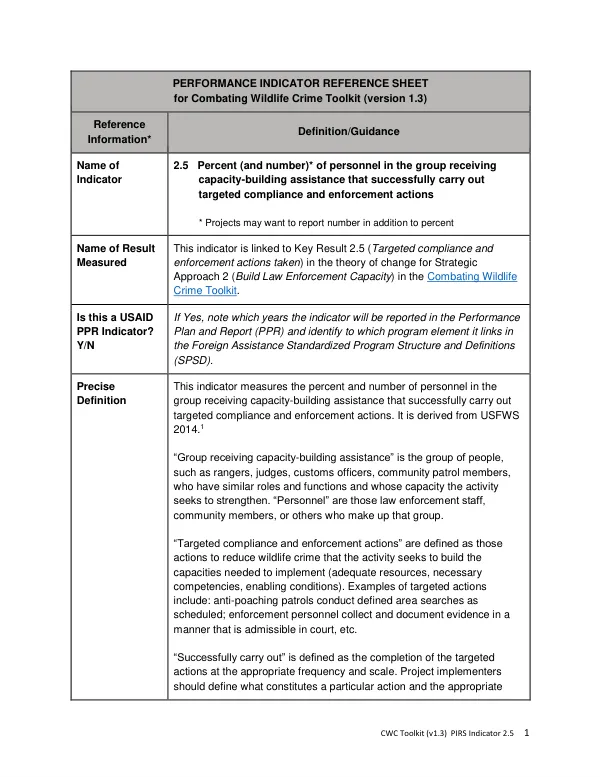
Performance Indicator Reference Sheet for Combating Wildlife Crime Toolkit (version 1.3)
Sign inUSAID DEC
Performance Indicator Reference Sheet for Combating Wildlife Crime Toolkit (version 1.3)
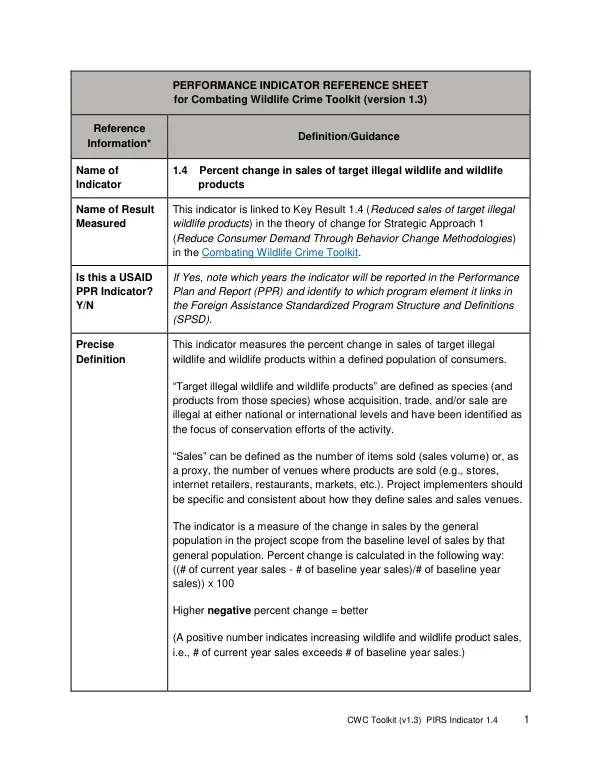
The Combating Wildlife Crime Toolkit (version 1.3) includes a performance indicator reference sheet for PIRS Indicator 1.4, which measures the percent change in sales of target illegal wildlife and wildlife products.
4 pages
Sign in to readA free account is required to download.
Abstract
This indicator is linked to Key Result 1.4 (Reduced sales of target illegal wildlife products) in the theory of change for Strategic Approach 1 (Reduce Consumer Demand Through Behavior Change Methodologies) in the Combating Wildlife Crime Toolkit. The indicator measures the percent change in sales of target illegal wildlife and wildlife products within a defined population of consumers. Target illegal wildlife and wildlife products are defined as species and products whose acquisition, trade, and/or sale are illegal at either national or international levels and have been identified as the focus of conservation efforts of the activity. Sales can be defined as the number of items sold or, as a proxy, the number of venues where products are sold. The indicator is a measure of the change in sales by the general population in the project scope from the baseline level of sales by that general population. Percent change is calculated in the following way: ((# of current year sales - # of baseline year sales)/# of baseline year sales)) x 100. Higher negative percent change indicates better performance, as it represents a decrease in sales of target illegal wildlife and wildlife products. Project teams should consider that the number of sales reflects availability, which is a function of law enforcement efforts to shut down sales venues of illegal wildlife and wildlife products, as well as consumer demand. The indicator is a measure of the change in sales by the general population in the project scope from the baseline level of sales by that general population. Data sources for this indicator may include implementing partner surveys and/or data available from government agencies or NGOs. The means of data collection will be dependent on how "sales" are defined for a particular situation. For example, measuring the number of items sold on the internet is significantly different in practice than measuring the number of live animals sold in an open-air market. Project teams should determine the most appropriate methodology and provide clear descriptions. Data should be collected on an annual basis, and implementers may want to consider collecting data on a biannual or more frequent basis due to temporal differences in product availability. A baseline number of sales must be established, and targets for the indicator should be set based on a general basis. Dates of data quality assessments and the name of the reviewer should be indicated, as well as the date of future planned DQAs. Known data limitations include validity, reliability, timeliness, precision, and integrity issues.