U.S. NATIONAL RENEWABLE ENERGY LABORATORY
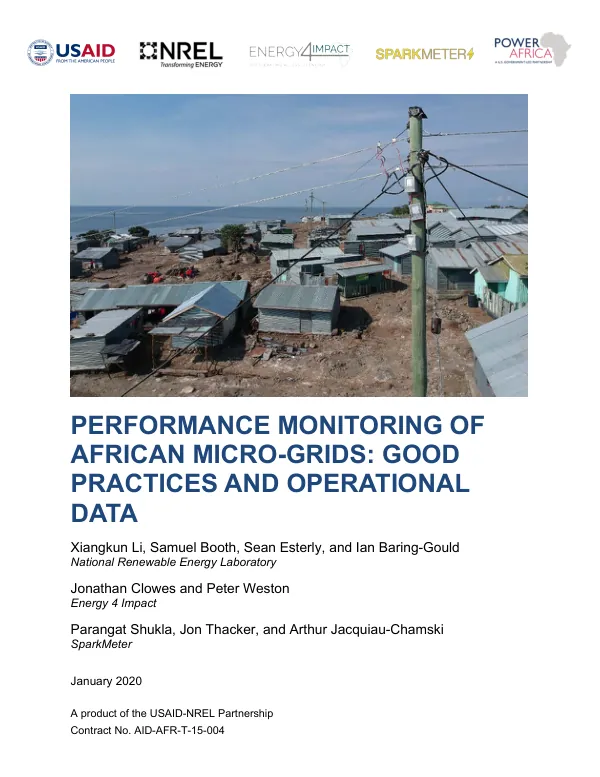
Performance Monitoring of African Micro-Grids: Good Practices and Operational Data
Micro-grids are expected to play a critical role in providing energy access to the roughly 600 million people in sub-Saharan Africa who currently live without electricity.
2020 · 55 pages
Sign in to readA free account is required to download.
Abstract
Growth of investments in the sector is necessary but has been slow to materialize. Investment is inhibited by a perception of risk, a lack of proven business models, and a limited understanding of the actual performance of operating systems. Standardized and systematic performance monitoring provides an opportunity to lower risks, validate business models, and demonstrate the technical and financial performance of micro-grids. This report highlights the importance of performance monitoring for micro-grids, focusing on the operations phase of micro-grid projects, as that is when the bulk of the data is generated and most performance monitoring benefits are realized. Furthermore, this report supports a major need in the micro-grid sector by providing a standardized list of performance monitoring indicators for collection and reporting. These parameters are provided for three key functional areas during micro-grid operation: commercial and financial monitoring; customer/utility accountability; and technical performance. Some examples of these key parameters include: number of customers, system revenues, power costs, energy sales, voltage violations, system downtime, and customer satisfaction. Additionally, this report provides advice on data collection and contains a comprehensive list of metrics from TFE Energy's Quality Assurance Framework (QAF) project with the African Development Bank. To help demonstrate the potential benefits of performance monitoring, this report also presents the analysis of the performance data of 36 micro-grids (with 4,660 meters) currently operating in Africa, in cooperation with SparkMeter, in one of the largest assessments conducted to date within the sector. The analysis of the performance data reveals several key findings. Figure ES-1 shows the percentage of meters across all sites in each QAF service level for energy consumption, power consumption, and power availability. Higher QAF service levels indicate higher levels of consumption and availability. The data show that micro-grid operators generally set much higher power limits (largely Level 4) compared to what customers are consuming (largely Levels 1 and 2), in part to incentivize growth. Grid operators can use performance monitoring data to analyze their risk exposure and determine appropriate power limits to ensure systems are not overbuilt or oversubscribed. The report also presents the distributions of power factor measurements for all meters at each site. Power factor values range from a minimum of 0.042 to a maximum of 1, with median values between 0.6 and 0.7. Power factors in this range indicate an underestimation of the reactive power demand of the micro-grid system and/or the presence of highly nonlinear loads. This could lead to potential technical issues with supplying reactive power from inverters, and potential revenue issues for developers who only get paid for real power and may want to adjust billing to account for loads that require high levels of reactive power support. The report also includes an analysis of the average frequency profile for a specific site in the SparkMeter data set. The plot on the left shows how frequency varies over a typical 24-hour period with relatively low standard deviation. Frequency appears to follow the trajectory of a typical PV generation profile. The site may need to adjust droop control settings to maintain a tighter frequency band. Greater frequency variations across meters are seen on a monthly basis, which could be caused by differences in the data logged at each meter over a period of a month. This report was developed by the National Renewable Energy Laboratory (NREL) and Energy 4 Impact (E4I) in support of the Power Africa Beyond the Grid Program. It is a companion document to NREL's QAF for Mini-Grids (Baring-Gould et al. 2016). The report presents best practices for conducting performance monitoring along with possible sets of indicators to measure and examples results from performance monitoring activities. To better integrate performance monitoring into the micro-grid sector, the report makes the following recommendations: - Creation and dissemination of a standardized performance monitoring guide for the micro-grid sector, along with harmonization of the reporting requirements between stakeholders; - Creation of open source tools to help expedite and streamline analysis and data collection from different devices (e.g., smart meters and inverters from different equipment manufacturers); - Sharing of performance indicators and data across the industry; and - Increased training for micro-grid developers and regulators on performance monitoring. The report is a resource that developers, donors, investors, and governments can use to understand the benefits of micro-grid performance monitoring.