INTERNATIONAL ORGANIZATION FOR MIGRATION
Performance Monitoring Plan Report
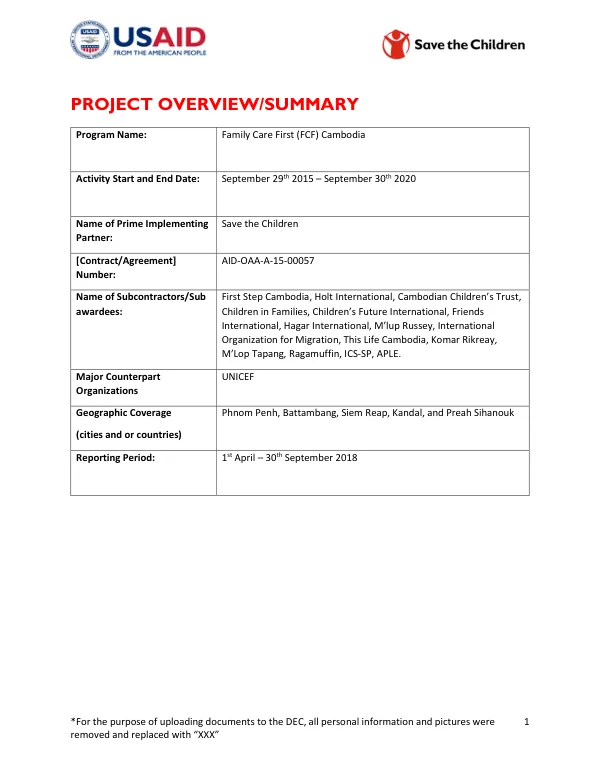
The Family Care First project, implemented by Save the Children International (SCI) in Cambodia, aimed to improve the well-being of vulnerable children and families.
2018 · 16 pages
Sign in to readA free account is required to download.
Abstract
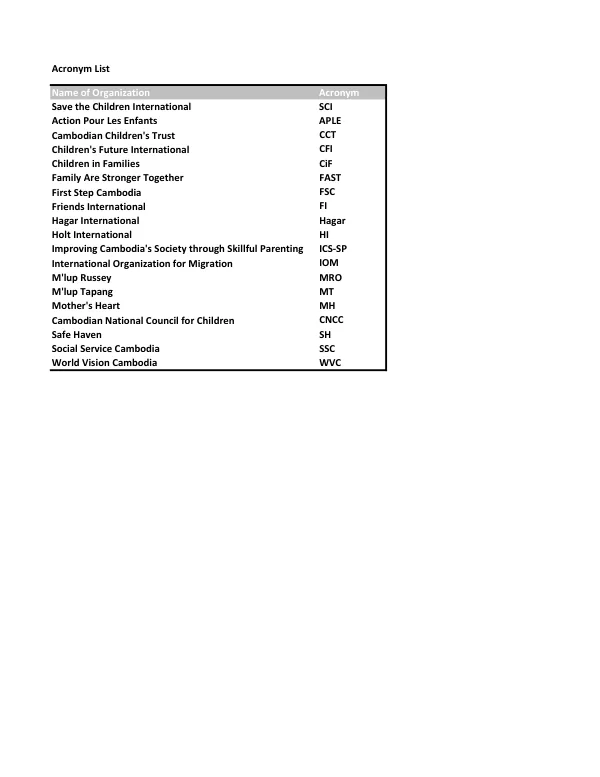
The project began in October 2015 and concluded in September 2018. SCI partnered with various organizations, including Action Pour Les Enfants (APLE), Cambodian Children's Trust (CCT), and Holt International (HI), to achieve the project's objectives. The project focused on three main results: FCFC Governance and Working Groups, Research Plan, Shared Measurement, Program Learning, and Data Collection, and Internal and External Communications/Outreach. The FCFC Governance and Working Groups result aimed to engage members and partners to act effectively. The project established thematic sub-groups, conducted thematic mapping, and developed action plans to address learning questions. However, the project faced challenges in implementing these plans, particularly in the areas of thematic sub-group functions and action plan development. The Research Plan, Shared Measurement, Program Learning, and Data Collection result aimed to capture and share learning amongst members and the community. The project conducted research on online child sexual exploitation (OCSE) in Cambodia, which aimed to improve understanding of the characteristics and extent of OCSE in the country. The research protocol was finalized, and the inception report was approved. However, the final research report was not completed due to delays in the consultant's submission. The Internal and External Communications/Outreach result aimed to engage stakeholders through regular and effective communication. The project conducted various activities, including partner/member visits, meetings with thematic sub-group members, and meetings with the Ministry of Social Affairs, Veterans, and Youth Rehabilitation (MoSVY). The project also produced external communication pieces, including Facebook posts and a case study. The Family and Child Vulnerability Index (FCVI) was another key component of the project. The FCVI aimed to identify and prioritize villages based on their vulnerability to family and child separation. The project selected villages, identified key stakeholders, and conducted village meetings to assess the risk and strengths of each village. However, the project faced challenges in completing these activities, particularly in the areas of village selection and key stakeholder identification. The project also reported on various indicators, including the number of members participating in thematic sub-groups, the number of partnership assessments completed, and the number of sub-awards granted. The project made significant progress in these areas, with 80% of members participating in thematic sub-groups and 92% of sub-awards granted. However, the project faced challenges in implementing some of these activities, particularly in the areas of thematic sub-group functions and action plan development. Overall, the Family Care First project made significant progress in improving the well-being of vulnerable children and families in Cambodia. However, the project faced challenges in implementing some of its activities, particularly in the areas of thematic sub-group functions and action plan development. The project's research on OCSE in Cambodia provided valuable insights into the characteristics and extent of OCSE in the country. The project's FCVI component aimed to identify and prioritize villages based on their vulnerability to family and child separation.