THE UNITED STATE CENTERS FOR DISEASE CONTROL AND PREVENTION
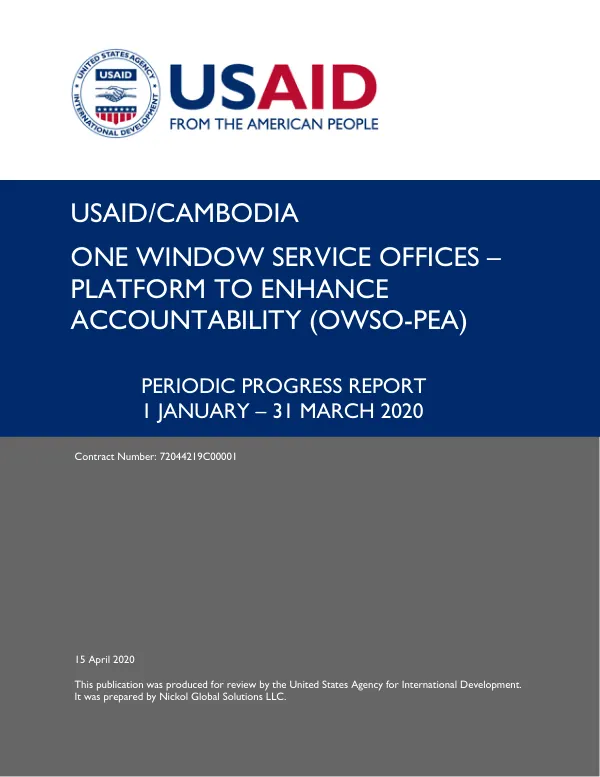
Periodic Progress Report – OWSO-PEA – 1 January – 31 March 2020
The One Window Service Offices – Platform to Enhance Accountability (OWSO-PEA) project aims to increase the capability of civil society to engage in political processes through a series of tested interventions.
2020 · 20 pages
Sign in to readA free account is required to download.
Abstract
The project's goal is to provide citizens with real-time access to reliable information about the Royal Government of Cambodia's One Window Service Office (OWSO) services through civic tech innovations. This will enable citizens to hold government accountable to improved public service through the OWSO. The project's development hypothesis is that if citizens have real-time access to reliable information and are engaged through meaningful processes, they will more effectively hold government accountable to improved public service. To achieve this goal, the project will identify, develop, and promote tech-enabled solutions to broaden public access and awareness about OWSO services and the role of the District Ombudsperson. Monitoring tools will be developed to enable citizens and businesses to report on their efficiency/satisfaction of OWSO services, allowing government authorities to better measure progress on service delivery and respond to citizen service needs. During the 1 January – 31 March 2020 reporting period, several key activities were achieved. A baseline survey was conducted on 499 citizens, and an OWSO Community Scorecard was conducted in 12 communes across the five districts in Battambang, engaging 294 citizens. Of those citizens, OWSO service satisfaction surveys were conducted with 159 citizens who had used OWSO services previously. Additionally, two cohorts of youth were trained on data collection and community scorecard methodology, and a Facebook Chatbot and an Interactive Voice Response (IVR) were approved by USAID for project tech solutions. The IVR and Chatbot will have two primary functions: providing users access to information on OWSO services and allowing for feedback on the services received. In Kamrieng District, both technologies will pilot a citizen application status feature. The Battambang Provincial Government agreed in cooperation with project design and declared the support of District Governors, OWSO Chiefs, and District Ombudspersons. Cambodia registered its first case of COVID-19 in January 2020, but the infected traveler and his family were quickly identified, quarantined, and thus this did not lead to a broader outbreak. Between 13 – 16 March, the country saw the manifestation of 20 confirmed cases, leading to active messaging by Cambodia's Ministry of Health, the WHO, and the CDC on suggested prevention measures, including social distancing. In response to the outbreak situation in Cambodia, OWSO-PEA implemented several actions, including teleworking for project staff and suspending all field travel and community work. The project's tech solutions, including the IVR and Chatbot, are designed to provide citizens with real-time access to information on OWSO services and allow for feedback on the services received. The project's monitoring tools will enable citizens and businesses to report on their efficiency/satisfaction of OWSO services, allowing government authorities to better measure progress on service delivery and respond to citizen service needs. The project's development hypothesis is that if citizens have real-time access to reliable information and are engaged through meaningful processes, they will more effectively hold government accountable to improved public service through the OWSO. The project's progress during the 1 January – 31 March 2020 reporting period demonstrates the project's commitment to increasing the capability of civil society to engage in political processes. The project's tech solutions and monitoring tools are designed to provide citizens with real-time access to information and enable them to hold government accountable to improved public service. The project's response to the COVID-19 outbreak situation in Cambodia demonstrates the project's commitment to the health and safety of staff and the community.