CATHOLIC RELIEF SERVICES ORGANIZATION
PHILIPPINES - TROPICAL STORM
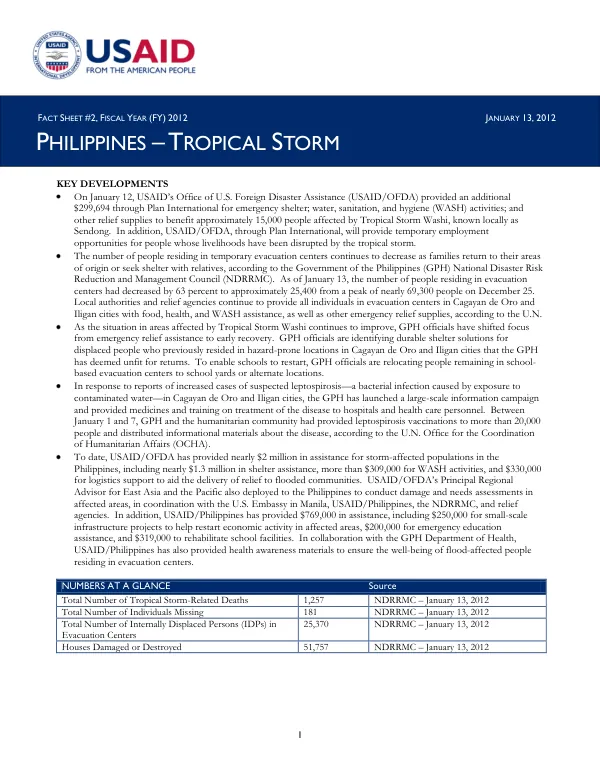
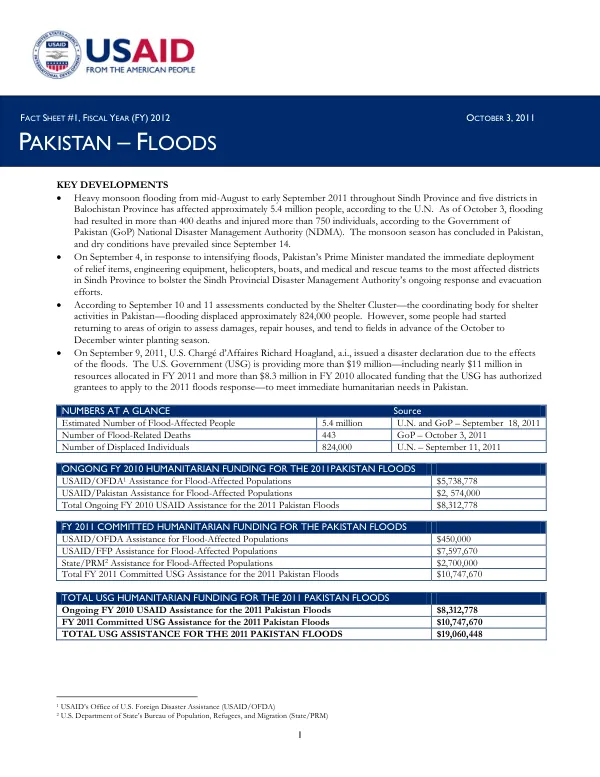
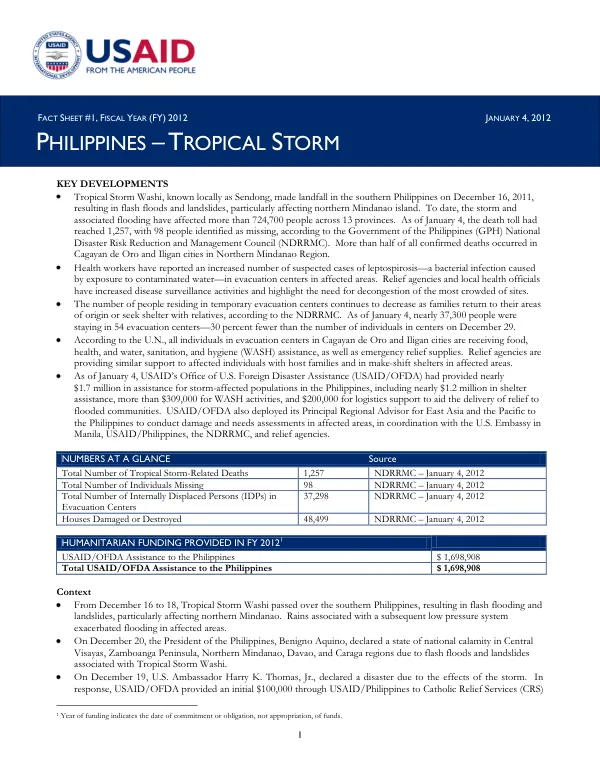
Tropical Storm Washi, also known as Sendong, made landfall in the southern Philippines on December 16, 2011, resulting in flash floods and landslides, particularly affecting northern Mindanao island.
2012 · 3 pages
Sign in to readA free account is required to download.
Abstract
The storm and associated flooding have affected more than 724,700 people across 13 provinces. As of January 4, the death toll had reached 1,257, with 98 people identified as missing, according to the Government of the Philippines (GPH) National Disaster Risk Reduction and Management Council (NDRRMC). More than half of all confirmed deaths occurred in Cagayan de Oro and Iligan cities in Northern Mindanao Region. Health workers have reported an increased number of suspected cases of leptospirosis, a bacterial infection caused by exposure to contaminated water, in evacuation centers in affected areas. Relief agencies and local health officials have increased disease surveillance activities and highlighted the need for decongestion of the most crowded of sites. The number of people residing in temporary evacuation centers continues to decrease as families return to their areas of origin or seek shelter with relatives. As of January 4, nearly 37,300 people were staying in 54 evacuation centers, 30 percent fewer than the number of individuals in centers on December 29. The Government of the Philippines has prioritized the repair of several bridges to expedite delivery of humanitarian assistance. The electrical supply had been restored to 98 percent of Cagayan de Oro and Iligan cities as of January 4. USAID's Office of U.S. Foreign Disaster Assistance (USAID/OFDA) is providing logistical support to the GPH and the humanitarian community through the U.N. World Food Program (WFP), which leads the Logistics Cluster. With $200,000 in USAID/OFDA assistance, WFP will identify and address logistics deficiencies, coordinate logistics activities, and augment the storage capacity in flood-affected areas. The water supply has been restored to some areas in Cagayan de Oro, but an estimated 63 percent of the population in western parts of the city will remain without piped water until January 20 or later, according to the U.N. Office for the Coordination of Humanitarian Affairs (OCHA). The WASH Cluster has assigned agencies to provide WASH support in all existing evacuation centers. Various agencies, including the GPH and the Philippines National Red Cross Society, are working to reestablish the water supply and distribute water in areas that sustained damage to water infrastructure. Since an emergency disease surveillance system was established in the Philippines on December 21, approximately 260 suspected cases of leptospirosis have been reported and referred to health workers for further evaluation. The GPH Department of Health (DoH) has declared leptospirosis outbreak due to the unusual increase in reported cases. The DoH and city health departments continue to deploy medical teams to all evacuation centers in affected areas. In response to increased reports of leptospirosis in recent days, the U.N. World Health Organization (WHO) is providing rapid diagnostic test kits to city health departments in Region X to aid mobile medical teams in screening possible cases. The number of individuals in evacuation centers continues to decrease as families return home or move in with host families. However, an unknown number of individuals remain unable to go back to their areas of origin due to the GPH ban on returns to flood-prone communities near the river in Cagayan de Oro and Iligan cities. The Shelter Cluster and GPH agencies are currently working to identify the number of families that require resettlement, the number of shelter units and amount of land required for relocations, and options for housing. USAID/OFDA is supporting the construction of transitional shelters for more than 4,000 people through CRS. The program will focus on vulnerable families in Cagayan de Oro and Iligan cities whose homes were destroyed by Tropical Storm Washi and associated floods. USAID/OFDA is also providing emergency shelter kits for more than 1,100 displaced families, or nearly 6,000 people, through the International Organization for Migration (IOM). The kits—containing plastic sheeting, sleeping mats, and other household items—will help individuals repair damaged houses, enabling their families to depart temporary evacuation centers and safely return to their homes. The $600,000 in USAID/OFDA funding to IOM also supports temporary employment for flood-affected people through cash-for-work activities to improve evacuation centers, clean up debris, and rehabilitate storm-damaged infrastructure in affected communities.