INTERNATIONAL CHILDREN'S FUND, INC.
USAID-DCHA Pakistan Floods Fact Sheet #2 - FY 2012
The 2011 floods in Pakistan occurred from mid-August to early September, affecting Sindh Province and five districts in Balochistan Province.
2012 · 5 pages
Sign in to readA free account is required to download.
Abstract
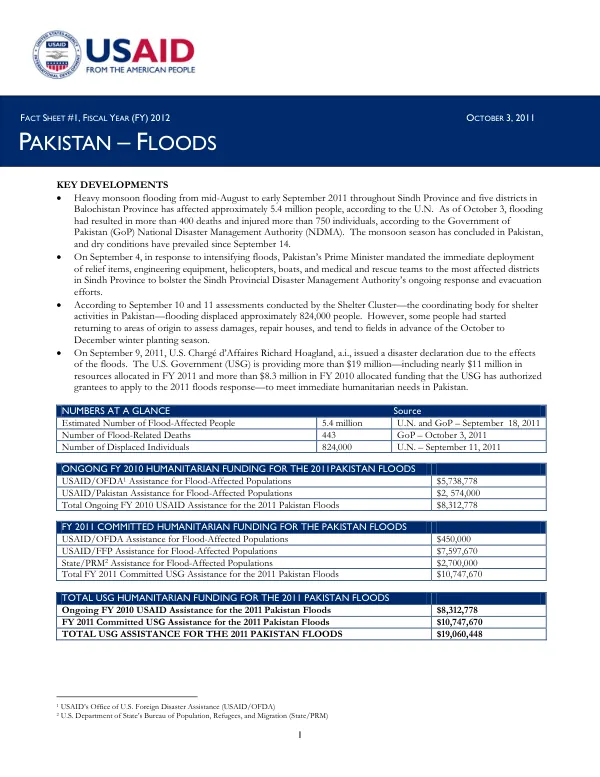
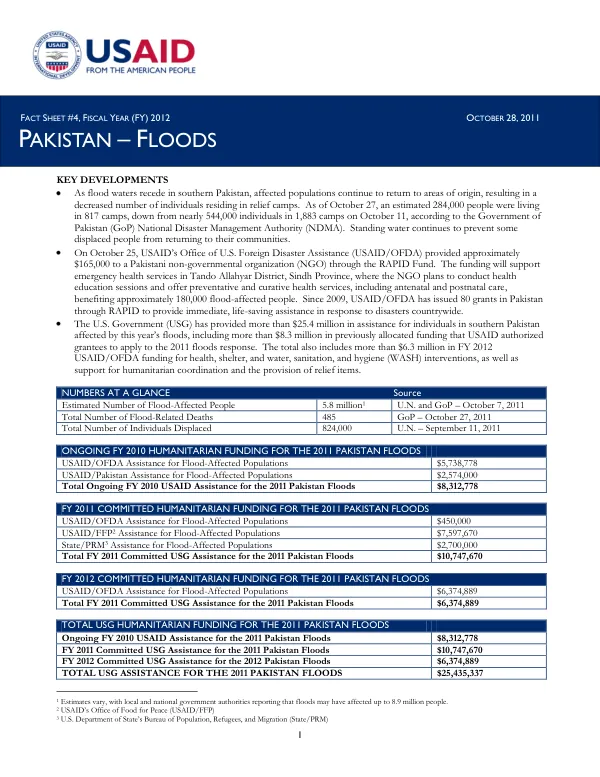
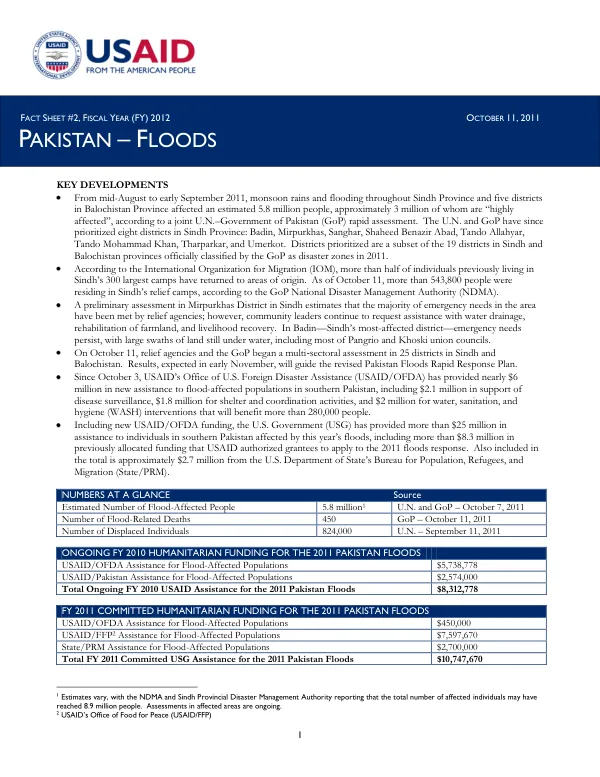
The disaster resulted in an estimated 5.8 million people being affected, with approximately 3 million classified as "highly affected." The United Nations and the Government of Pakistan (GoP) prioritized eight districts in Sindh Province for assistance, including Badin, Mirpurkhas, Sanghar, Shaheed Benazir Abad, Tando Allahyar, Tando Mohammad Khan, Tharparkar, and Umerkot. According to the International Organization for Migration (IOM), more than half of individuals previously living in Sindh's 300 largest camps have returned to areas of origin. As of October 11, over 543,800 people were residing in Sindh's relief camps, according to the GoP National Disaster Management Authority (NDMA). A preliminary assessment in Mirpurkhas District estimated that the majority of emergency needs in the area have been met by relief agencies, but community leaders continue to request assistance with water drainage, rehabilitation of farmland, and livelihood recovery. In Badin, Sindh's most-affected district, emergency needs persist, with large swaths of land still under water, including most of Pangrio and Khoski union councils. On October 11, relief agencies and the GoP began a multi-sectoral assessment in 25 districts in Sindh and Balochistan, with results expected in early November to guide the revised Pakistan Floods Rapid Response Plan. Since October 3, USAID's Office of U.S. Foreign Disaster Assistance (USAID/OFDA) has provided nearly $6 million in new assistance to flood-affected populations in southern Pakistan. The U.S. Government (USG) has provided more than $25 million in assistance to individuals in southern Pakistan affected by this year's floods, including more than $8.3 million in previously allocated funding that USAID authorized grantees to apply to the 2011 floods response. The USG has also provided approximately $2.7 million from the U.S. Department of State's Bureau for Population, Refugees, and Migration (State/PRM). The ongoing FY 2010 humanitarian funding for the 2011 Pakistan floods totals $8,312,778, while the FY 2011 committed humanitarian funding totals $10,747,670. The 2011 floods occurred as Pakistanis continued to recover from the 2010 monsoon floods that affected approximately 18 million people countrywide. Families continue to rebuild homes and restore livelihoods more than a year after last year's disaster, one of the worst in Pakistan's history. The more than $922 million provided by the USG in response to the 2010 floods emergency assisted relief organizations in establishing a presence in Balochistan and Sindh provinces, facilitating a timely and more cost-effective response in 2011. In response to the September 9, 2011, disaster declaration for floods, USAID/OFDA provided an initial $100,000 through USAID/Pakistan to the Rural Support Program Network (RSPN) and authorized several existing grantees to focus a portion of FY 2010 flood assistance on families affected by 2011 floods. USAID/OFDA staff in Islamabad, Pakistan, the USAID/OFDA regional office in Bangkok, Thailand, and Washington, D.C., continue to monitor the ongoing response, in collaboration with USAID/Pakistan and the U.S. Embassy in Islamabad. Following disasters, particularly floods, the spread of communicable diseases is a significant concern, as many populations lack access to safe drinking water, sanitation facilities, and adequate healthcare. Providing access to safe drinking water and sanitation facilities continues to be a priority for relief agencies. Funded in part by USAID, the Disease Early Warning System (DEWS) closely monitors, reports, and responds to disease alerts in Pakistan. Between September 23 and 29, DEWS investigated and responded to 105 alerts or outbreaks in Sindh Province, of which 42 were the result of waterborne diseases. As of the end of September, members of the WASH Cluster had provided more than 208,000 of the targeted 587,000 beneficiaries in flood-affected areas with safe drinking water, including 91 percent of targeted beneficiaries in most-affected Badin District. Through two non-governmental organizations (NGOs), USAID/OFDA recently provided more than $2 million in support for WASH programs in Sindh, benefiting more than 280,000 people. WASH Cluster lead agency the U.N. Children's Fund (UNICEF) also continues to respond to WASH and health needs in southern Pakistan. To date, UNICEF has provided 37,000 people with access to sanitation facilities, hygiene kits for 43,000 beneficiaries, as well as other WASH-related items—such as soap and water containers—for 30,000 others. As of October 6
Related documents