USAID
Power Week Social Media Toolkit
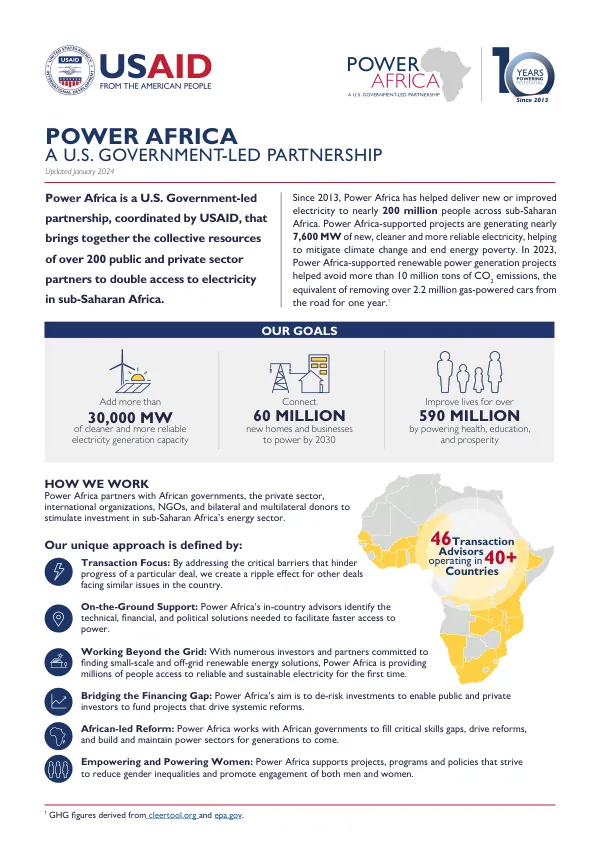
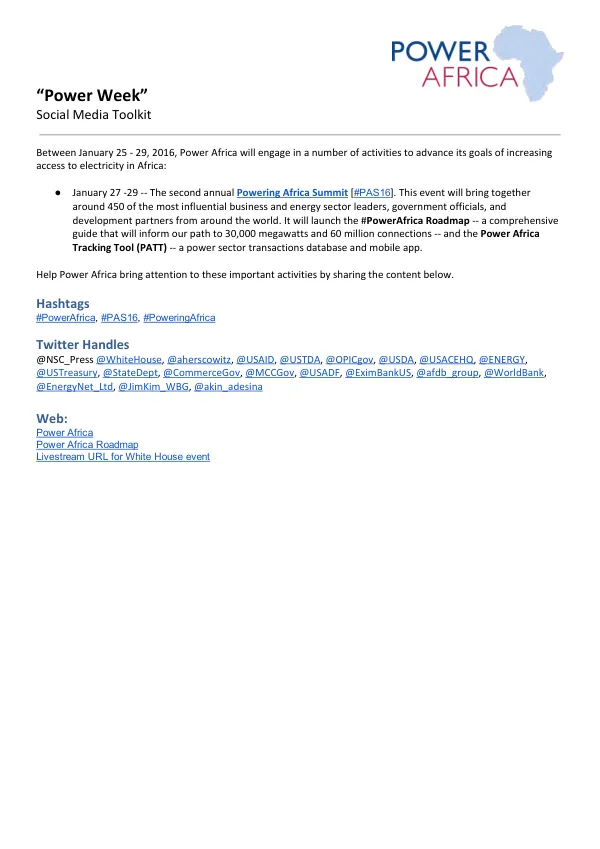
Power Africa is a US government initiative aimed at increasing access to electricity in Africa.
2016 · 4 pages
Sign in to readA free account is required to download.
Abstract
The initiative began in 2013 with the goal of adding 60 million new electricity connections to the continent by 2030. To achieve this goal, Power Africa has developed a comprehensive roadmap that outlines the steps necessary to reach 30,000 megawatts of power generation capacity. The Power Africa Roadmap serves as a guide for the initiative's path forward, outlining key strategies and interventions to be implemented over the next several years. The roadmap focuses on three main areas: increasing power generation capacity, improving transmission and distribution infrastructure, and enhancing access to energy for households and businesses. Power Africa has also developed a tracking tool, known as the Power Africa Tracking Tool (PATT), to monitor and track the progress of energy deals across the continent. The PATT is a mobile app that provides real-time data on energy transactions, allowing stakeholders to track the status of projects and identify areas for improvement. In addition to the Power Africa Roadmap and PATT, the initiative has also launched several other programs and initiatives aimed at increasing access to energy in Africa. These include the Power Africa Off-Grid Energy Challenge, which provides grants and technical assistance to entrepreneurs and small businesses working on off-grid energy projects. Interagency announcements and partnerships have also played a key role in the Power Africa initiative. For example, the US African Development Foundation (USADF) has partnered with GE Africa and USAID to provide grants and technical assistance to energy entrepreneurs in nine African countries. The US Trade and Development Agency (USTDA) has also announced several new projects aimed at increasing access to energy in Africa, including a pilot project to deploy 1,000 US smart meters in Port Harcourt, Nigeria. The Millennium Challenge Corporation (MCC) has also committed to investing $1.5 billion in Africa's energy sector over the next five years, with a focus on supporting private sector investment and promoting economic growth. The MCC's Ghana compact is expected to catalyze $4 billion in new private investment, including from companies such as General Electric and Endeavor Energy. Overall, the Power Africa initiative represents a major effort to increase access to electricity in Africa and promote economic growth and development across the continent. By providing a comprehensive roadmap and tracking tool, as well as supporting partnerships and initiatives, Power Africa aims to achieve its goal of adding 60 million new electricity connections to Africa by 2030.
Related documents