USAID DEC
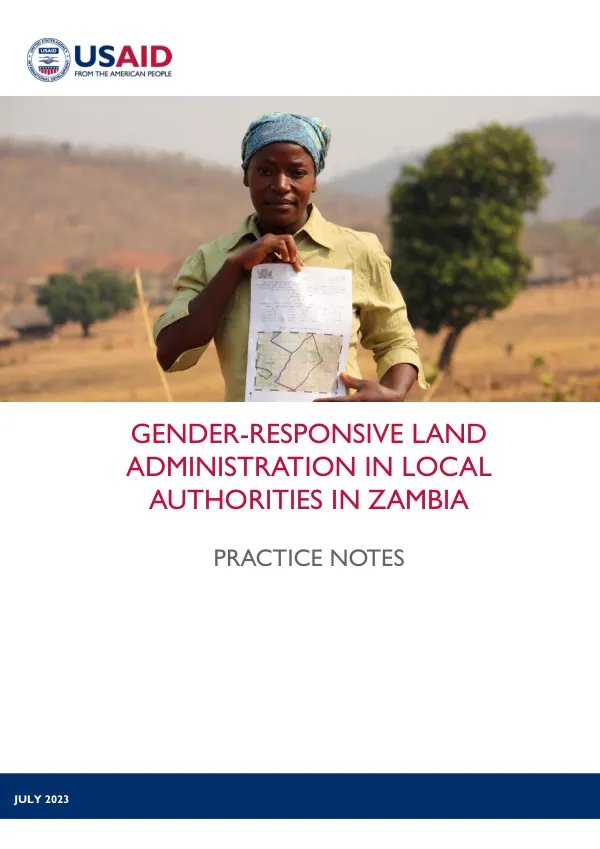
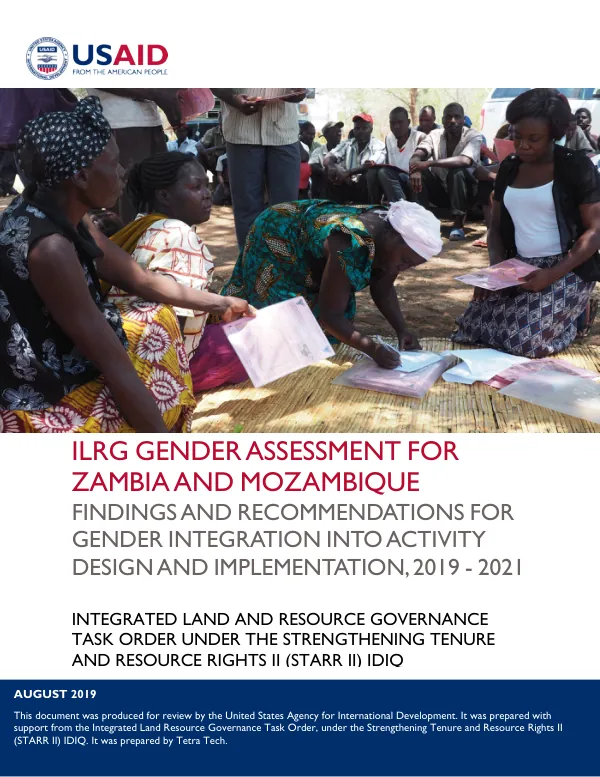
Practical Implementation Guide on Gender Equality and Social Inclusion in Customary Land Documentation in Zambia
Sign inTETRA TECH
Practical Implementation Guide on Gender Equality and Social Inclusion in Customary Land Documentation in Zambia
The agricultural development initiative in Zambia began with a focus on promoting gender equality and social inclusion in customary land documentation processes.
2023 · 32 pages
Sign in to readA free account is required to download.
Abstract
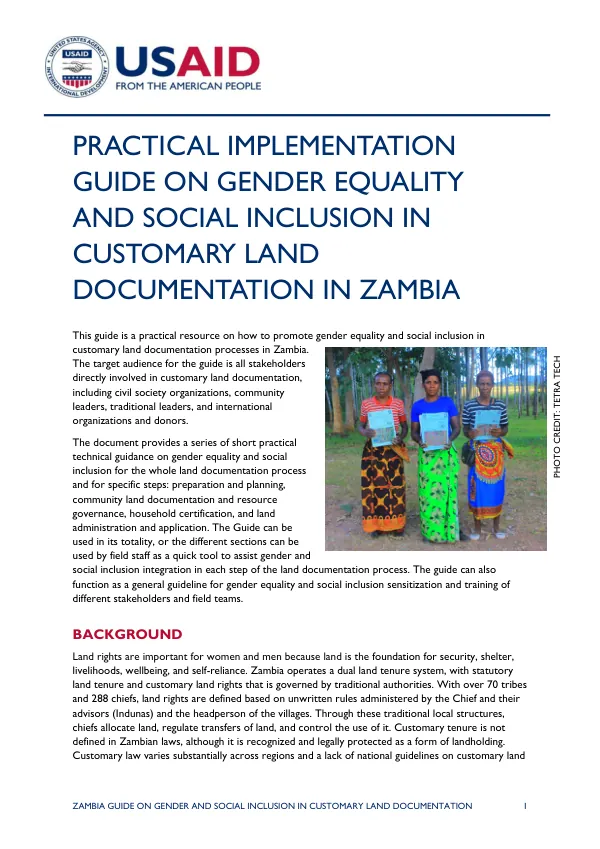
The initiative aimed to address the challenges faced by women in accessing and controlling land, particularly in rural areas where customary land tenure systems prevail. In Zambia, land rights are governed by a dual system, with statutory land tenure and customary land rights administered by traditional authorities. The country has over 70 tribes and 288 chiefs, with land rights defined by unwritten rules administered by chiefs and their advisors. Customary tenure is not defined in Zambian laws, although it is recognized and legally protected as a form of landholding. Women in Zambia face significant challenges in accessing and controlling land, with limited rights to own and inherit land. In patrilineal systems, land is inherited by men through the paternal line, while in matrilineal systems, land inheritance follows the maternal line. However, women's rights to land are often limited, and they are expected to be married and access land through their husbands. The consequences of women's lack of secure land rights are severe, including decreased ability to pursue economically independent livelihoods, exclusion from decisions about land and property, and greater vulnerability to dispossession and land grabbing. Women are also more likely to experience gender-based violence and be denied inheritance rights in case of divorce or spouse death. To address these challenges, the guide emphasizes the importance of adopting gender-sensitive and gender-responsive approaches to customary land documentation. This involves recognizing and addressing procedural and social barriers that affect women and other marginalized groups, ultimately delivering truly inclusive and equal customary land documentation in Zambia. The guide provides general guidance on gender equality and social inclusion that applies to overall land documentation, as well as specific guidance for individual steps in the land documentation process. Key topics include unconscious biases and gender-sensitive language, organizing inclusive meetings and events, and engaging traditional authorities. Unconscious biases, or implicit biases, are underlying attitudes and stereotypes that people unconsciously attribute to another person or group of people, affecting how they perceive and engage with them. Everyone has unconscious biases, stemming from their process of socialization since childhood. It is essential to be aware of this and make active efforts to identify when/how our own biases are influencing our interactions with others. The guide also highlights the importance of using gender-sensitive language and avoiding language that perpetuates stereotypes or biases. This includes using inclusive language, avoiding assumptions about gender roles, and using language that acknowledges the diversity of experiences and perspectives. In addition, the guide emphasizes the need to organize inclusive meetings and events that allow for the participation of all stakeholders, including women and other marginalized groups. This involves creating a safe and respectful environment, using accessible language, and ensuring that all stakeholders have an opportunity to contribute to the discussion. Engaging traditional authorities is also crucial in promoting gender equality and social inclusion in customary land documentation. This involves building relationships with traditional leaders, providing training and support, and working together to develop policies and procedures that promote equality and inclusion. Overall, the guide provides a comprehensive framework for promoting gender equality and social inclusion in customary land documentation in Zambia. By adopting a gender-sensitive and gender-responsive approach, the guide aims to deliver truly inclusive and equal customary land documentation, ultimately benefiting women and other marginalized groups.