USAID DEC
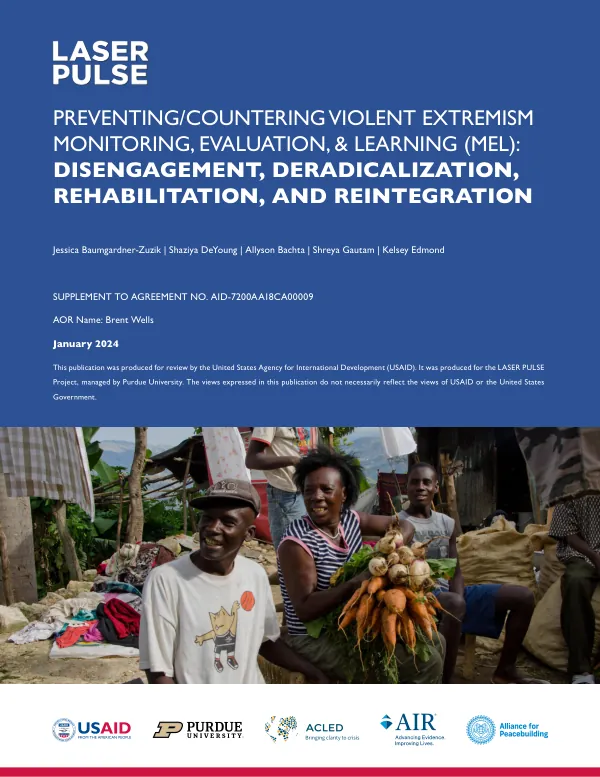
Preventing/Countering Violent Extremism Monitoring, Evaluation, & Learning (MEL): Disengagement, Deradicalization, Rehabilitation, and Reintegration
Sign inUNIVERSIT6 DE PURDUE
Preventing/Countering Violent Extremism Monitoring, Evaluation, & Learning (MEL): Disengagement, Deradicalization, Rehabilitation, and Reintegration
Disengagement, deradicalization, rehabilitation, and reintegration (DDRR) programming is a critical component of preventing/countering violent extremism (P/CVE) efforts.
2023 · 26 pages
Sign in to readA free account is required to download.
Abstract
This research aims to better understand the current state of measurement in DDRR programming, exploring the general characteristics of DDRR studies, including explicit indicators, common measurement trends, and indicator examples. The studies analyzed for this research were curated from a P/CVE systematic mixed method review that contained 25 DDRR-related studies, of which 10 (40%) contained explicit indicators. These studies were synthesized to identify the characteristics of DDRR programming, including the types of indicators used to measure changes in attitudes and behaviors. A total of 130 indicators were extracted for analysis, illustrating the diversity of approaches to DDRR in addressing immediate challenges posed by radicalized individuals, as well as tackling the underlying factors contributing to their extremist inclinations. The findings from the DDRR studies reveal a broad spectrum of measures addressing varied themes, predominantly focused on measuring changes in attitudes and behaviors. The indicators highlight the intricate journey of reintegrating individuals who have been radicalized, including the need to address both immediate concerns and underlying extremist motivations. The multifaceted nature of DDRR interventions is evident in the findings, which demonstrate the importance of addressing the complex needs of individuals who have been radicalized. The research also identifies common measurement trends in DDRR programming, including the use of indicators to measure changes in attitudes and behaviors. The indicators used in DDRR programming are diverse, reflecting the complexity of the issue and the need for a comprehensive approach to addressing radicalization. The findings of this research have important implications for P/CVE efforts, highlighting the need for a more nuanced understanding of DDRR programming and the importance of using evidence-based approaches to measure the effectiveness of these interventions. By better understanding the characteristics of DDRR programming and the indicators used to measure its effectiveness, P/CVE practitioners can develop more effective strategies for preventing and countering violent extremism. The research also highlights the importance of addressing the underlying factors contributing to radicalization, including poverty, lack of education, and social exclusion. By addressing these underlying factors, DDRR programming can help to prevent radicalization and promote the reintegration of individuals who have been radicalized. In conclusion, this research provides a comprehensive overview of DDRR programming, highlighting the diversity of approaches used to address radicalization and the importance of using evidence-based approaches to measure the effectiveness of these interventions. The findings of this research have important implications for P/CVE efforts, highlighting the need for a more nuanced understanding of DDRR programming and the importance of addressing the underlying factors contributing to radicalization. The research was conducted by the Alliance for Peacebuilding (AfP) under a sub-award funded by the United States Agency for International Development (USAID) Long-term Assistance and Services for Research (LASER) Partners for University-led Solutions Engine (PULSE) - Co-operative agreement AID-7200AA18CA00009. The research team consisted of Jessica Baumgardner-Zuzik (AfP), Principal Investigator (PI); Shaziya DeYoung (AfP), Lead Researcher; and Allyson Bachta (AfP), Researcher, with support from Shreya Gautam (AfP-Contractor) and Kelsey Edmond (AfP-Contractor) under the LASER PULSE program. The research was designed to provide a comprehensive overview of DDRR programming, highlighting the diversity of approaches used to address radicalization and the importance of using evidence-based approaches to measure the effectiveness of these interventions. The research team conducted a systematic mixed method review of 25 DDRR-related studies, extracting 130 indicators for analysis. The research was conducted in collaboration with the Conflict and Violence Prevention Learning Agenda Implementation Team (CVP LAIT), which was tasked with co-creating and implementing a bureau-wide learning agenda that establishes the evidence base for effective approaches to armed conflict and violence prevention. The research team worked closely with the CVP LAIT to identify the research needs for critical development challenges, including DDRR programming. The research team also collaborated with USAID missions, bureaus, and independent offices, as well as other local stakeholders, to identify research needs and develop evidence-based approaches to DDRR programming. The research was funded by the LASER PULSE program, which is a 10-year, $70M program funded by USAID's Innovation, Technology, and Research Hub. The LASER P
Related documents