USAID DEC
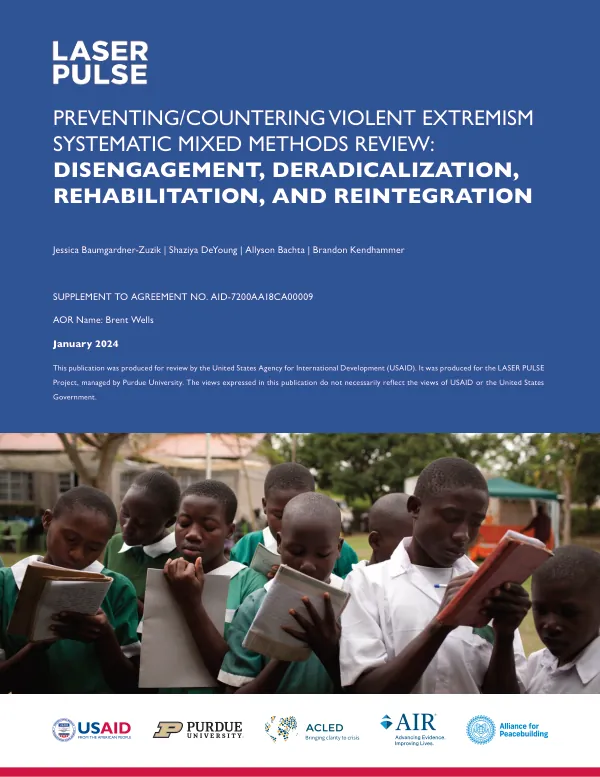
Preventing/Countering Violent Extremism Systematic Mixed Methods Review: Disengagement, Deradicalization, Rehabilitation, and Reintegration
Sign inUNIVERSIT6 DE PURDUE
Preventing/Countering Violent Extremism Systematic Mixed Methods Review: Disengagement, Deradicalization, Rehabilitation, and Reintegration
The systematic mixed methods review on disengagement, deradicalization, rehabilitation, and reintegration (DDRR) was conducted by the Alliance for Peacebuilding (AfP) in support of the Conflict and Violence Prevention Learning Agenda Implementation Team (CVP LAIT).
2024 · 54 pages
Sign in to readA free account is required to download.
Abstract
The review aimed to map the evidence base for preventing/countering violent extremism (P/CVE) programming, including what approaches work in which contexts, and identify gaps that require greater investigation. The review focused on P/CVE programs that apply some version of DDRR Theories of Change (ToCs). These studies exhibit a limited number of high-quality, strong evidence, with limited and developing evidence bases. However, while all DDRR ToCs offer valuable theoretical insights, there remains a significant need to enhance their empirical robustness and evidence base. The review identified several key findings and recommendations. One of the most promising approaches is the curriculum-based disengagement and case management approach. This approach involves providing individuals with prior violent extremism (VE) involvement with tailored interventions that improve their socio-economic prospects, receive psychological support to process trauma and develop skills for managing mental and physical health, and provide opportunities to build healthier relationships. The review found that this approach is associated with a high level of maturity in the evidence base, with six included studies that provide quantitative and qualitative evidence. The studies suggest that individuals who receive this type of intervention are more likely to disengage from VE involvement and/or resist future VE appeals. The review also identified several other DDRR ToCs that offer valuable theoretical insights, but require further research to enhance their empirical robustness and evidence base. These include education, counseling, and training for value complexity, capacity building of vulnerable/at-risk populations, mental health and psychosocial services, family and community-based DDR, and capacity building, mentorship, and financial incentives. Overall, the review suggests that while there is a promising foundation of strong theory, the consistent message is the need for more rigorous, targeted research to ensure efficacy, long-term impacts, and the avoidance of unintended consequences in P/CVE programming. The review also highlights the importance of methodological refinement to elevate research quality and rigor. This includes the need for more robust study designs, larger sample sizes, and longer follow-up periods to ensure that the findings are generalizable and sustainable. In terms of implementation, the review suggests that P/CVE programs should prioritize the development of evidence-informed DDRR ToCs and approaches. This includes the use of curriculum-based disengagement and case management approaches, as well as other evidence-informed approaches that have been identified through the review. The review also emphasizes the importance of community-based reintegration approaches, which involve working with local communities to support the reintegration of individuals who have been involved in VE. This approach is associated with a high level of maturity in the evidence base and has been shown to be effective in promoting long-term impacts and avoiding unintended consequences. Overall, the review provides a comprehensive overview of the evidence base for DDRR and highlights the need for more rigorous, targeted research to ensure efficacy, long-term impacts, and the avoidance of unintended consequences in P/CVE programming.
Related documents
Documents in this collection
 2023
2023USAID DEC
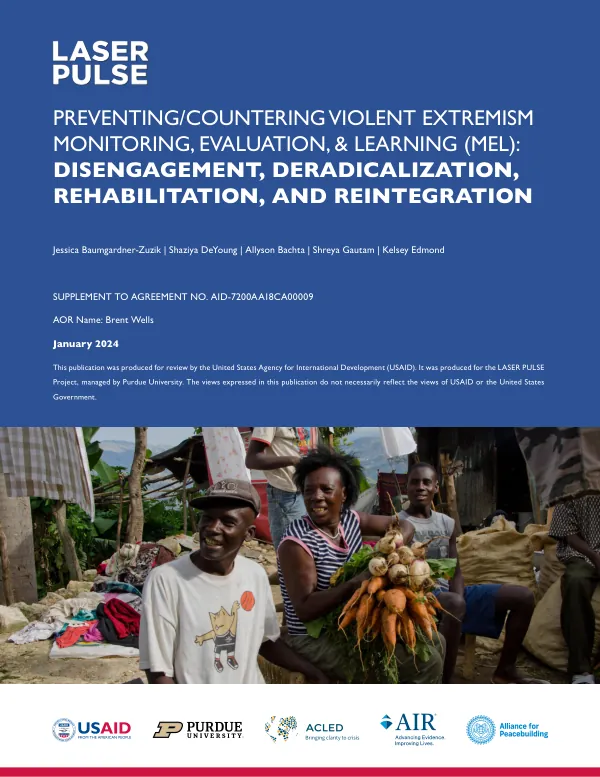
Preventing/Countering Violent Extremism Monitoring, Evaluation, & Learning (MEL): Disengagement, Deradicalization, Rehabilitation, and Reintegration
Open record 2023
2023USAID DEC