UNIVERSIT6 DE PURDUE
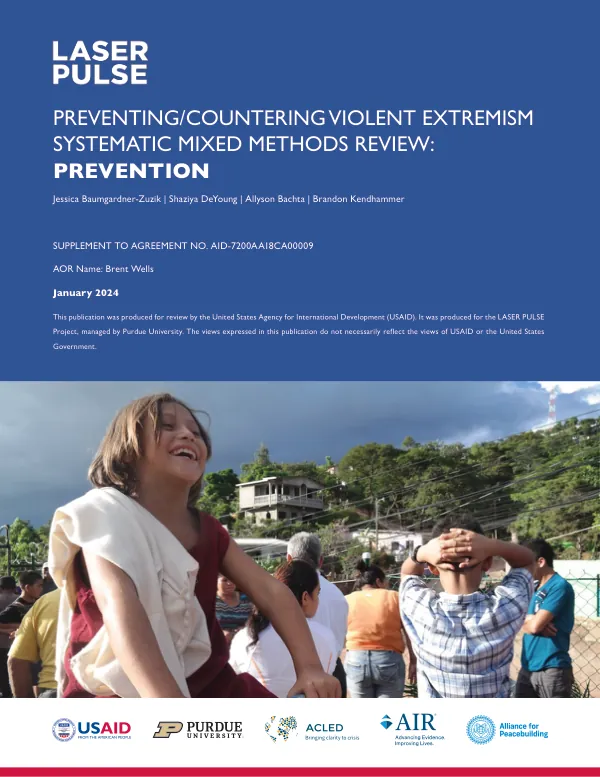
Preventing/Countering Violent Extremism Systematic Mixed Methods Review: Prevention
Preventing/Countering Violent Extremism (P/CVE) Systematic Mixed Methods Review: Prevention is a comprehensive study conducted by the Alliance for Peacebuilding (AfP) under the LASER PULSE program, funded by the United States Agency for International Development (USAID).
2023 · 72 pages
Sign in to readA free account is required to download.
Abstract
The review aims to map the evidence base for P/CVE programming, including effective approaches and gaps in the existing literature. The study identifies preventing/counter violent extremism as a critical effort that can benefit program design, outcomes, policy, and knowledge generation. Through an intensive consultation process with USAID staff, the review focuses on prevention programs that apply some version of Theories of Change (ToCs). These programs exhibit the greatest number of high-quality, strong, and mature evidence bases compared to other types of P/CVE programs. Prevention programs develop and define more explicit ToCs, leading to more useful impact evaluations and assessments. However, there remains a significant need to enhance the empirical robustness and evidence base of these ToCs. Methodological refinement is also necessary to elevate research quality and rigor. The review highlights the need for more rigorous, targeted research to ensure efficacy, long-term impacts, and the avoidance of unintended consequences in P/CVE programming. The study identifies six key Theories of Change (ToCs) for prevention programs: Counter-/Alternative Narratives, Capacity Building for Frontline Workers, Capacity Building of Vulnerable/At-Risk Populations, Conjoined Capacity Building of Frontline Workers and Vulnerable/At-Risk Populations, Socio-Economic Skills Building, and Mental Health and Psychosocial Support. These ToCs offer valuable theoretical insights, but there is a need for more rigorous research to ensure their efficacy and long-term impacts. The review concludes that current research bolsters confidence in evidence-informed prevention ToCs and approaches. However, there are gaps in the existing literature that require greater investigation. The study provides a comprehensive summary of findings, including information on each ToC and more detailed information in the report section. The LASER PULSE program is a 10-year, $70M program funded by USAID's Innovation, Technology, and Research Hub. The program delivers research-driven solutions to field-sourced development challenges in USAID partner countries. The program is implemented by a consortium led by Purdue University, with core partners Catholic Relief Services, Indiana University, Makerere University, and the University of Notre Dame. The Alliance for Peacebuilding (AfP) is a non-profit organization that works to prevent and resolve violent conflicts. AfP is a core partner in the LASER PULSE program and has conducted extensive research on P/CVE programming. The AfP team, led by Jessica Baumgardner-Zuzik, Shaziya DeYoung, Allyson Bachta, and Brandon Kendhammer, has conducted a comprehensive review of the evidence base for P/CVE programming. The review provides a critical analysis of the existing literature on P/CVE programming, highlighting effective approaches and gaps in the existing literature. The study aims to inform USAID staff and other stakeholders on the most effective approaches to P/CVE programming and identify areas for further research.
Related documents
Documents in this collection
 2023
2023USAID DEC
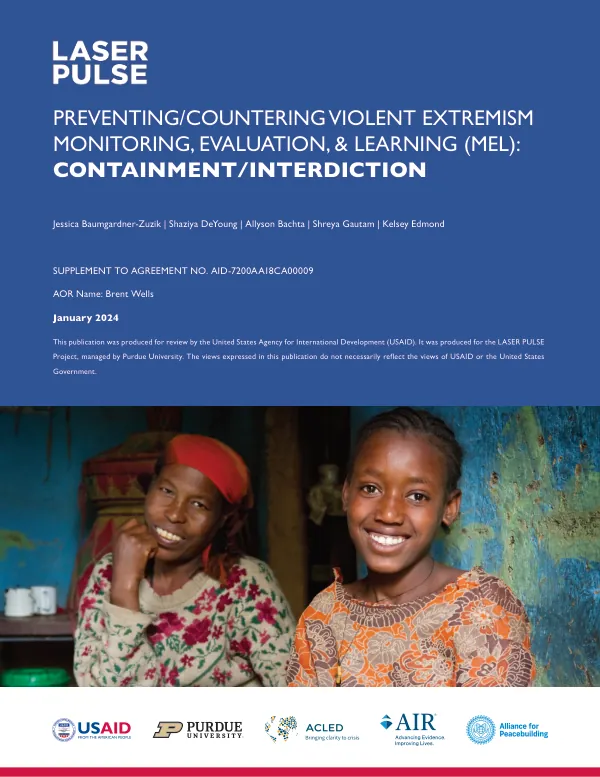
Preventing/Countering Violent Extremism Monitoring, Evaluation, & Learning (MEL): Containment/Interdiction
Open record 2023
2023USAID DEC