USAID DEC
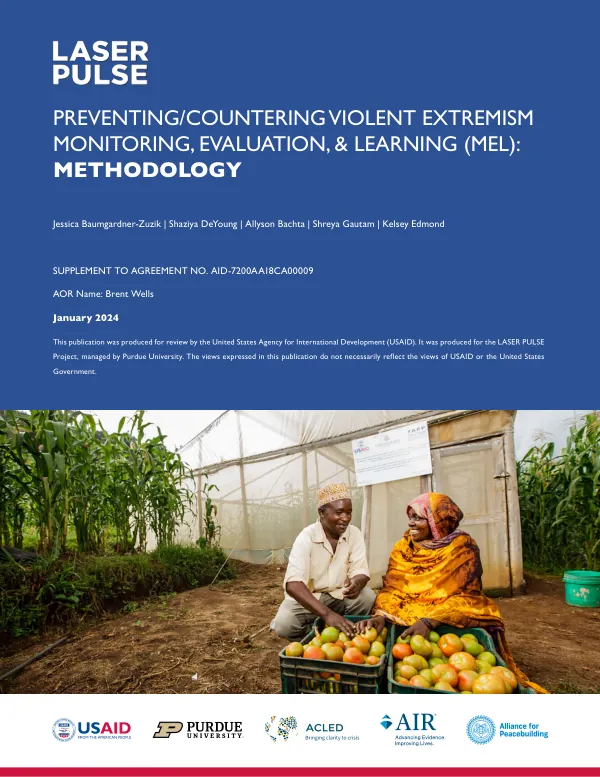
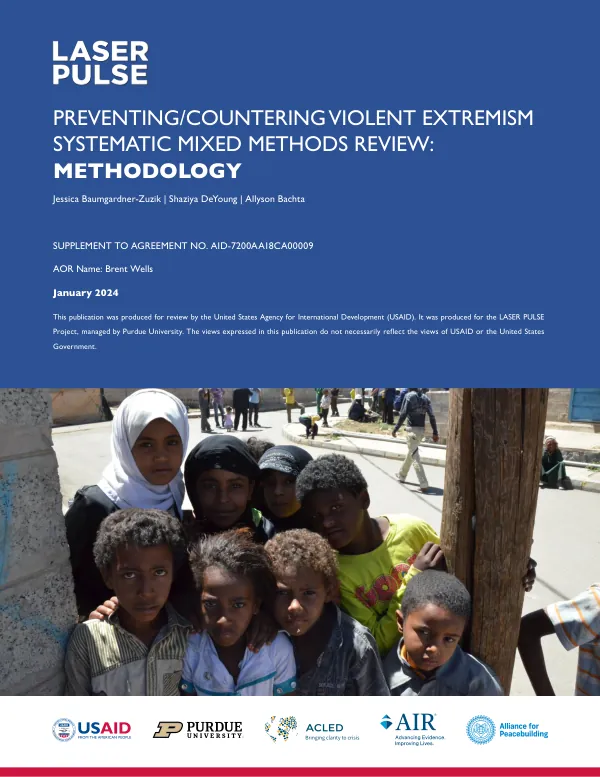
Preventing/Countering Violent Extremism Systematic Mixed Methods Review: Methodology
Sign inUNIVERSIT6 DE PURDUE
Preventing/Countering Violent Extremism Systematic Mixed Methods Review: Methodology
The Systematic Mixed Methods Review was conducted by the Alliance for Peacebuilding (AfP) as part of the Conflict and Violence Prevention Learning Agenda Implementation Team (CVP LAIT).
2023 · 26 pages
Sign in to readA free account is required to download.
Abstract
The review aimed to map the evidence base for preventing/countering violent extremism (P/CVE) programming, including what approaches work in which contexts and identify gaps that require greater investigation. The review involved a systematic mixed method review of the relevant literature, adapted to include a greater breadth of mixed methods studies, particularly qualitative and non-randomized studies. The review focused on three primary programming responses: prevention (PV), containment/interdiction (CI), and disengagement, deradicalization, rehabilitation, and reintegration (DDRR). The objective was to collect and synthesize evidence related to P/CVE theories of change (ToCs) and their supporting rigorous, promising, and anecdotal evidence. Articulating clear ToCs hypothesizing how change will occur is critical for testing and evaluating the impact of P/CVE interventions. The review applied an innovative ToC process, culminating in a comprehensive framework that outlines the key components of effective P/CVE interventions. The framework includes a set of indicators and measures to gauge intervention outcomes and participant changes, addressing the methodological and logistical challenges associated with evaluating P/CVE interventions. The review also identified gaps in the existing literature and highlighted areas that require further investigation. The review's methodology involved several key steps, including resource identification and collection, eligibility criteria, PICO-defined search criteria, and resource search strategy. The review also employed a Theory of Change Analysis, Quality of Studies assessment, Strength of Evidence Continuum Analysis, Evidence Base Mapping and Maturity Analysis, and Thematic Analysis and Evidence Synthesis. The review's findings highlighted the complexity of P/CVE interventions and the need for more rigorous methods of measurement. The review also emphasized the importance of articulating clear ToCs and developing a comprehensive framework for evaluating P/CVE interventions. The review's recommendations include the need for more research on P/CVE interventions, particularly in relation to VE goals, and the development of uniform indicators and measures to gauge intervention outcomes and participant changes. The review's results have significant implications for P/CVE programming and policy responses to VE. The review's findings and recommendations can inform the development of more effective P/CVE interventions and contribute to the articulation of cohesive programmatic and policy responses to VE. The review's methodology and framework can also be applied to other areas of research and programming, addressing the methodological and logistical challenges associated with evaluating complex interventions. The review's authors, Jessica Baumgardner-Zuzik, Shaziya DeYoung, and Allyson Bachta, are affiliated with the Alliance for Peacebuilding (AfP). The review was conducted under the LASER PULSE program, a 10-year, $70M program funded by USAID's Innovation, Technology, and Research Hub. The review's findings and recommendations are intended to contribute to the development of more effective P/CVE interventions and inform the articulation of cohesive programmatic and policy responses to VE.