USAID DEC
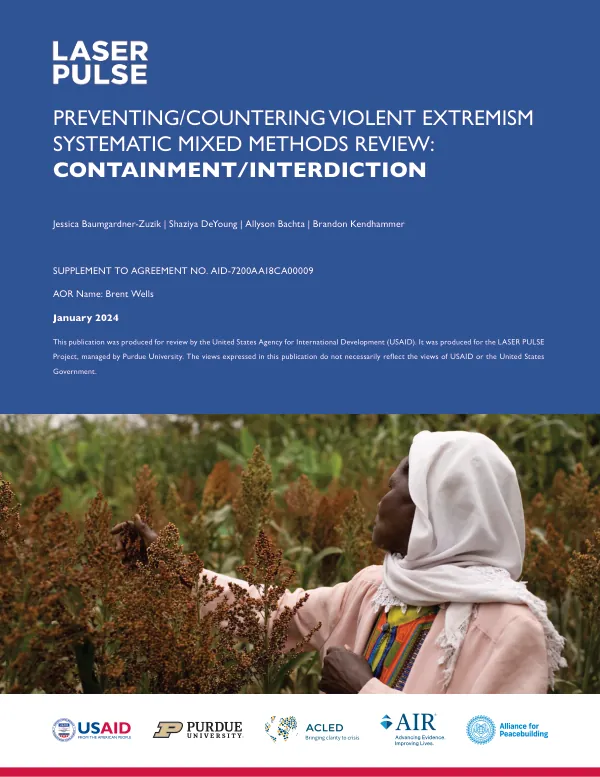
Preventing/Countering Violent Extremism Systematic Mixed Methods Review: Containment/Interdiction
Sign inUNIVERSIT6 DE PURDUE
Preventing/Countering Violent Extremism Systematic Mixed Methods Review: Containment/Interdiction
The Conflict and Violence Prevention Learning Agenda Implementation Team (CVP LAIT) was tasked with co-creating and implementing a bureau-wide learning agenda that establishes the evidence base for effective approaches to armed conflict and violence prevention.
2024 · 44 pages
Sign in to readA free account is required to download.
Abstract
This agenda aims to identify opportunities for investments that would produce new knowledge to fill gaps in the existing literature, provide USAID staff with events, tools, resources, and/or guidance to incorporate learning agenda findings into their work, and conduct original research into armed conflict and violence prevention. Preventing/Countering Violent Extremism (P/CVE) was identified as an effort that, if backed by sound evidence and guidance, could benefit program design, outcomes, policy, and knowledge generation. As part of the CVP LAIT and in support of these goals, the Alliance for Peacebuilding (AfP) carried out a systematic mixed methods review to map the evidence base for P/CVE programming, including what approaches work in which contexts, and identify gaps that require greater investigation. The review focused on P/CVE programs that apply some version of containment/interdiction (CI) Theories of Change (ToC/s). CI studies analyzed for this work exhibit a growing number of high-quality, strong evidence, with maturing evidence bases. However, while all CI ToC/s offer valuable theoretical insights, there remains a significant need to enhance their empirical robustness and evidence base. Additionally, there is an evident need for methodological refinement to elevate research quality and rigor. Capacity Building for Government Actors is one of the CI ToC/s, which suggests that if governmental capacity to identify and analyze the drivers of violent extremism (VE), engage local stakeholders, and/or conduct P/CVE programming is increased, then there will be a reduction in violent extremist sympathy and participation. The evidence base for this ToC is developing, with 31 included studies, mostly qualitative and mixed-methods approaches. The review highlights promising approaches, such as government and local stakeholder collaboration, government institutions and actors' skills-building, and addressing other forms of violence that may decrease the allure of VE due to shared drivers. However, there remains general uncertainty in how capacity improvements connect to P/CVE outcomes across whole-of-government approaches. Ensuring effective application and sustainable integration of capacity building gains into government processes remains challenging. The review emphasizes the need for more rigorous, targeted research to ensure efficacy, long-term impacts, and the avoidance of unintended consequences in P/CVE programming.
Related documents