ABT ASSOCIATES
Private Sector Health Project (PSHP) FY19 Q1 Report
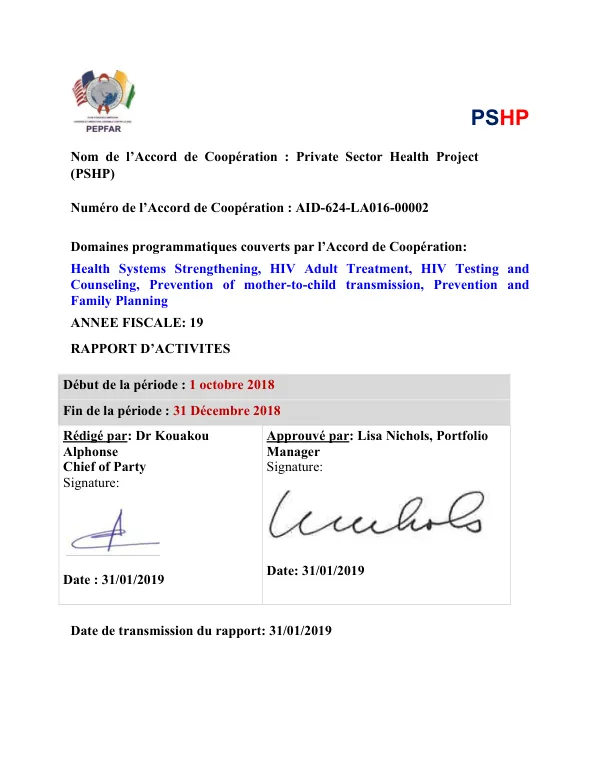
The Private Sector Health Project (PSHP) in Cote d'Ivoire aims to expand availability of and demand for high-quality HIV services in the private sector.
2019 · 15 pages
Sign in to readA free account is required to download.
Abstract
The project supports subownership and oversight, strengthens the enabling environment at the national, regional, and district levels, and ensures linkages to support services. PSHP has scaled up the number of clinics in the private provider HIV network from 44 to 150 in Abidjan, Bouake, San Pedro, Soubre, Yamoussoukro, Daloa, Gagnoa, Sakassou, Guiglo, and Duekoue. In Fiscal Year 19, PSHP focused on providing support to 70 clinics identified by PEPFAR in five health districts with the greatest gap in disease burden. Despite a reduced budget envelope, PSHP used innovative strategies to achieve strong results for key PEPFAR indicators. These strategies include targeted testing, consistent treatment of positives, active search of lost to follow-up, and systematic sampling of clients eligible for viral load. PSHP also collaborated with PEPFAR community-based partners for referrals and treatment of PLHIV in private clinics. PSHP conducted a field visit with USAID from December 17 to 19, 2018, to review the public-private platform and viral load activities. The project achieved 24% of the HTS indicators for testing and 23% for positives. The number of adults and children receiving ART increased by 22.5% from 4,467 to 5,470. PSHP collected 387 samples for viral load, with 246 suppressed and a suppressed rate of 67%. The PMTCT Cascade indicator showed a completion rate of 23%. The number of pregnant women with known HIV status at first antenatal care visit (ANC1) was 2,578, with 44 identified as positive and 43 enrolled in ART with a linkage rate of 100%. The completion rate of this indicator is 23%. PSHP also achieved 24% of the HTS indicators for testing and 23% for positives. The project's progress on key PEPFAR indicators is shown in Figure 2. PSHP's quarterly results for all PEPFAR indicators are included in Annex 1. The figures show PSHP's quarterly progress on key PEPFAR indicators. The PMTCT Cascade indicator showed a completion rate of 23%. The number of pregnant women with known HIV status at first antenatal care visit (ANC1) was 2,578, with 44 identified as positive and 43 enrolled in ART with a linkage rate of 100%. PSHP's quarterly results for all PEPFAR indicators are included in Annex 1. The figures show PSHP's quarterly progress on key PEPFAR indicators. The project's progress on key PEPFAR indicators is shown in Figure 2. PSHP's quarterly results for all PEPFAR indicators are included in Annex 1.