USAID DEC
Probabilistic Long Term Load Forecast for Nigerian Bulk Power Transmission System Expansion Planning
Sign inNATIONAL OPINION RESEARCH CENTER
Probabilistic Long Term Load Forecast for Nigerian Bulk Power Transmission System Expansion Planning
The Nigerian power system in the long term has been considered as unreliable by experience and various researches.
2016 · 5 pages
Sign in to readA free account is required to download.
Abstract
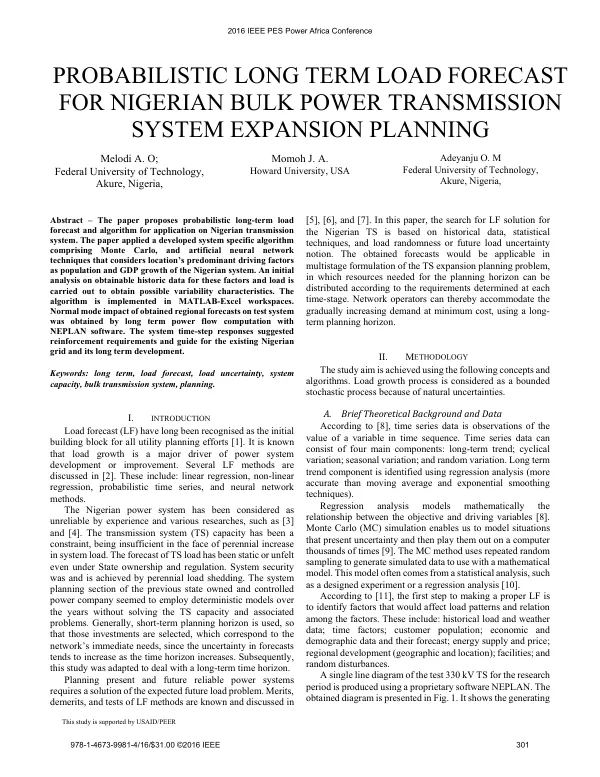
The transmission system (TS) has been a constraint, being insufficient in the face of perennial increase in system load. The forecast of TS capacity has been static or unfounded even under State ownership and regulation. System security has been achieved by perennial load shedding. The system planning section of the previous State-owned and controlled power company employed deterministic models without solving TS capacity and associated problems. The study aims to achieve its objective using concepts and algorithms that consider the load growth process as a bounded stochastic process due to natural uncertainties. The time series data of the Nigerian TS from 2000 to 2014 was obtained and sorted to obtain yearly maximum values. The data of load, population, and GDP for Lagos region from 2000 to 2014 is presented in Fig. 2. The population growth regression model (RM) for Nigeria and its regions between 2000 and 2014 is based on [12]. The model is: ܪݬ,ݎ= ܪ2000,ݎ∝݁∝݁; ∝= 0.03 ܿ. The annual peak load pattern (APLP) for a 15-year period is considered, and major factors of APLP are population (H) and Gross Domestic Product (GDP). Monthly load records from 2000 to 2014 were obtained and sorted to obtain yearly maximum values. The regional equivalent load for producing regioins is annotated as ܲܬ.,௧ and is calculated as: ܲܬ.,௧= ∑ܲܬ.,௧. The regional equivalent load for producing trends is calculated for each region. The regions are presented in Table 1. The time series load on some buses for certain periods can decline while others within the region increase simultaneously, giving invalid load decline or increase models for affected buses. The effects of such error on growth trends in the buses can be obscured by considering only equivalent load for producing trends. The regional equivalent load for producing trends is calculated for each region. The regions are presented in Table 1. The time series load on some buses for certain periods can decline while others within the region increase simultaneously, giving invalid load decline or increase models for affected buses. The study proposes a probabilistic long-term load forecast and algorithm for application on the Nigerian transmission system. The algorithm is implemented in MATLAB-Excel workspaces. The system time-step suggested reinforcement and guide for the existing grid and its long-term development. The study aims to achieve its objective using concepts and algorithms that consider the load growth process as a bounded stochastic process due to natural uncertainties.
Related documents