STATE MINISTRY OF LOCAL GOVERNMENT
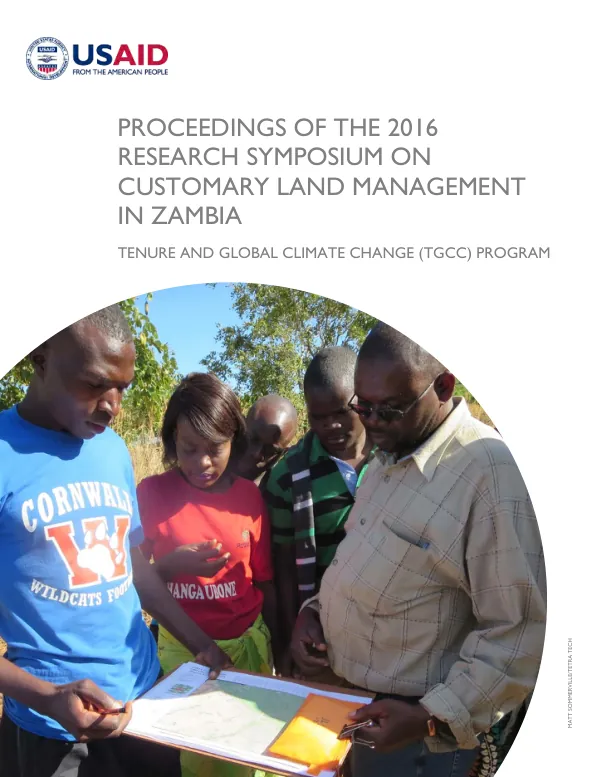
Proceedings of the 2017 Research Symposium on Customary Land Management in Zambia
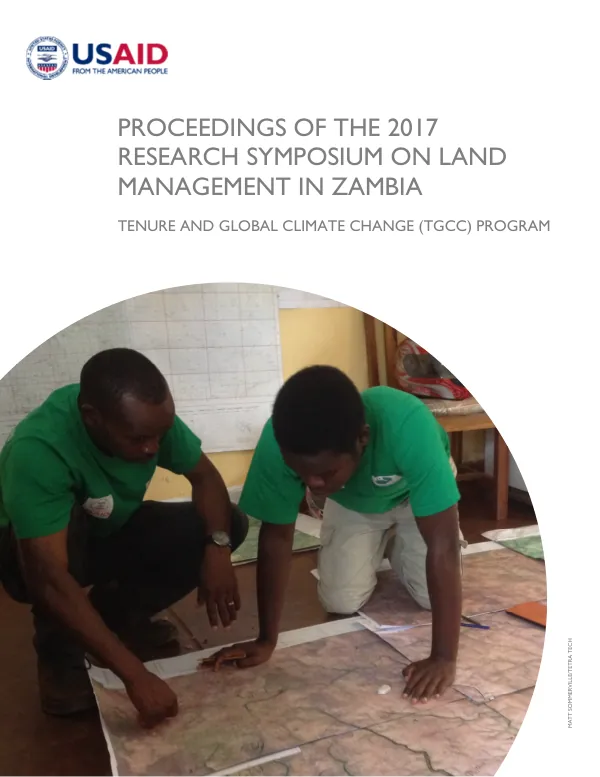
The 2017 Research Symposium on Land Management in Zambia, sponsored by the Tenure and Global Climate Change (TGCC) program, was held at the Mulungushi Conference Center on May 31 and June 1, 2017.
2017 · 30 pages
Sign in to readA free account is required to download.
Abstract
The symposium aimed to share research activities and outputs that were being undertaken in Zambia in support of improving customary land tenure, administration, and management. Participants included representatives from various academic institutions, local authorities, traditional leaders, civil society organizations, and development actors in Zambia. The symposium served as a check-in for the TGCC program's work in Zambia, supporting government, civil society, traditional authorities, and communities to communicate on land administration and governance. Since July 2014, the TGCC program has supported systematic documentation of customary land in Eastern Province through the use of mobile technologies in coordination with traditional authorities and local CSOs. The program has also supported national land policy development through support to national consultations, as well as CSO consultations aimed at improving land tenure governance and administration. The symposium was informed by presentations on technical research and implementation, including the valuable contributions of two traditional leaders who have been engaged in the TGCC process in recent years. Their views allowed for a robust discussion that considered the role of national and local government with traditional leaders in the management of Zambia's rural and peri-urban landscape. The Ministry of Local Government presented on the implementation of the 2015 Urban and Regional Planning Act (URP), describing the key spatial planning legislation that has guided development in Zambia. The Town and Country Planning Act (TCPA) of 1962 and its 1997 amendment, and the Housing (Statutory and Improvement Areas) (HSIA) Act of 1974, provided a framework for planning and development in cities and towns, including the establishment of statutory and improvement areas. The symposium also focused on the current status of the Land Policy, with presentations from various stakeholders. The Land Policy aimed to provide a framework for land governance, including the recognition and protection of customary land rights. The policy also emphasized the importance of community participation in land use planning and management. The symposium identified several key issues facing customary land management in Zambia, including national initiatives on land governance, peri-urban and rural land governance challenges, communal resource management, and emerging experience with community land titling. Cross-cutting themes of gender, youth, and marginalized populations, as well as wildlife management, also informed the discussions. The objectives of the symposium included serving as a platform for consolidation of research information, identifying gaps in land tenure research in Zambia, identifying priority research topics/areas that require further investigation, and examining land issues in a holistic and integrated manner to create a community of practice that will enhance collaboration and value addition. All presentations and associated research were consolidated on a Dropbox website for future reference by participants. The symposium provided a valuable platform for researchers, implementers, and government representatives to share knowledge and experiences on customary land management in Zambia. The event highlighted the importance of collaboration and coordination among stakeholders to address the complex issues facing customary land management in the country.