USAID DEC
Procurement Governance for Home Grown School Feeding: How the school feeding market improved agriculture production and income for farmers in Tulinga, Ghana
Sign inSNV
Procurement Governance for Home Grown School Feeding: How the school feeding market improved agriculture production and income for farmers in Tulinga, Ghana
The agricultural development initiative in Goubkatimali, Ghana, aimed to improve the production and income of smallholder farmers through the creation of a market for school feeding caterers.
2016 · 6 pages
Sign in to readA free account is required to download.
Abstract
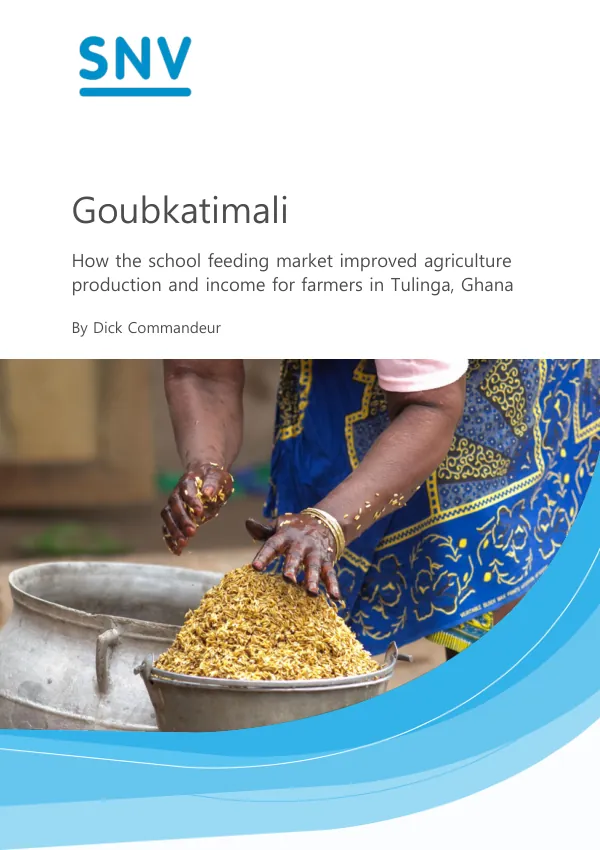
The Goubkatimali Farmer-Based Organization (FBO) was established in 2007 and had 28 male and 19 female farmer members. The organization produced mainly rice, maize, soy, and groundnut for cash and sustenance. Rice production in Karaga was supported by the Rice Sector Support Project, a 5-year project funded by the French Agency for Development. The project introduced new improved rice varieties, Agra rice (UPIA2) and Jasmin rice (UPIA3), developed by the Alliance for Green Revolution in Africa (AGRA). However, the families of Goubkatimali faced challenges in satisfying the demand from caterers due to low productivity and quality of rice production, lack of cooperation between men and women in the rice production chain, and insufficient quality of processed rice. The Procurement Governance for Home Grown School Feeding (PG-HGSF) project, implemented by SNV, worked with the Ghana School Feeding Programme (GSFP) and the District Assembly of Karaga to create a market for smallholder farmers of the Goubkatimali FBO with school feeding caterers. The project developed a producer organization (PO) strengthening methodology based on five intervention areas: managing supply risks, strengthening membership, managing the PO as a company, developing market and buyer relations, and optimizing the financial capacity of the PO. The project's objective was to link the farmers of Goubkatimali with the school feeding and other formal markets to improve the production, income, and organization of the PO and its members. SNV challenged the members to assess the market opportunities, starting with school feeding, and identify how their organization could embark on a change process to meet their demands. The preparation for the support consisted of a review of documentation from the organization and the school feeding market. The assessment led to a business plan focused on adopting improved rice varieties, better rice quality, vertically integrating production, processing, and marketing by delayed payment mechanisms between rice producers and processors/sellers, and the establishment of formal contractual sale arrangements with school feeding caterers. The plan also outlined steps for the organization to strengthen leadership and management. To strengthen the linkage between primary rice production and processing, an internal agreement was accepted with the producers supplying rice on credit to the processors, and the women realizing payments once the processed rice was sold. The project provided equipment to improve the quality of the processed rice, including improved cooked stoves and vessels for parboiling, threshing boxes, a cemented drying floor, and tarpaulins. SNV organized meetings between the representatives of Goubkatimali PO, caterers, and the District Assembly responsible for implementing the School Feeding Program. The District Assembly agreed to be a liaison between the rice processors and the caterers, receiving processed rice from the PO and distributing it to school feeding caterers on credit. The District Assembly guaranteed payment to the PO by deducting the costs of the rice from the GSFP's disbursements to the caterers and paying the PO directly. The combination of these activities led to sales of 8.5 metric tons of parboiled rice to six caterers in the first three months of 2016, for a total value of US $3,500. The new successful business activities with caterers deployed by Goubkatimali generated interest from other buyers, and the organization's sales continued to grow.
Related documents